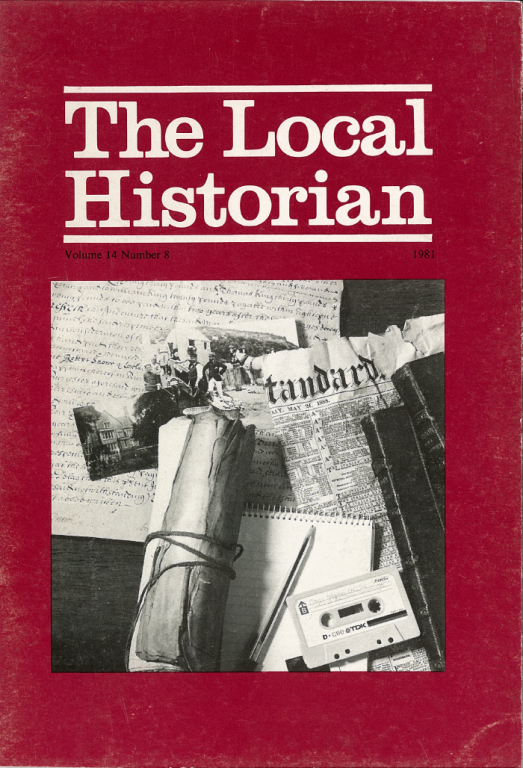
The Local Historian Volume 14 Number 8 November 1981
Contents
The local study of nineteenth-century crime Show more
By D.C. Woods
Woods argues at the beginning of his article that historians have neglected studies of crime in local communities, despite its ubiquity and its obvious importance. He then considers the wide and often voluminous range of source material which is potentially available to the researcher, referring to a range of examples from the Black Country boroughs of Wolverhampton and Walsall and the adjacent county areas. The organisation of law and order is described, as the boroughs established police forces and watch committees and as the county areas became subject to the 1839 County Constabularies Act. The legislative background which determined the collection of statistical material is also noted, and there is consideration of particular themes such as juvenile offences, drunkenness and the role of crime in social contexts - employment and industrial relations, assaults on the police, resistance to compulsory education and matters such as prostitution, vagrancy and public nuisances. Woods gives some coverage to the problems of relating statistics to interpretations of behaviour and of social trends, and suggests that sources such as newspapers, calendars of prisoners and parliamentary papers are needed to supplement the straightforward records of the courts themselves.
The role of the Local Studies Library Show more
By Michael J. Petty
Informal article which considers the use which is made of local studies libraries by the public, the types of questions which are often asked, and the material which may be encountered. There is a discussion of the importance and potential use of: i) newspaper collections and the methods used to conserve and make available such resources; ii) photographic and other illustrative material and the possibility of copying these; iii) maps and plans; and iv) ephemera such as programmes, advertising handouts, political literature and car park tickets.
Ethiopian place-names in Britain Show more
By Richard Pankhurst
Short note about the impact which the British military campaigns in Ethiopia in the late 1860s had upon the national consciousness, as exemplified by the wide variety of street-names (such as Magdala Road and Abyssinia Road) and public houses (often named after one of the heroes of the campaign, General Sir Robert Napier). Other military involvement in Abyssinia in the late 19th and early 20th centuries produced comparable namings and some examples are given.
Social history from school logbooks Show more
By Sydney Wood
Using as a case-study the logbooks of schools in Aberdeenshire, this article considers the social history (as contrasted with education history) which may be derived from school logbooks of the 19th and early 20th centuries. The topics noted include: i) agricultural patterns and child labour on farms; ii) the teaching of domestic skills to girls; iii) accents and the use of dialect; iv) gathering and gleaning in fields and woods; v) temporary mobility as families moved for seasonal employment; vi) the experience of poverty; vii) corporal punishment; viii) sports and leisure activities; and ix) patriotic events.
Sources for the history of the Christian Brethren Show more
By John Wilson
A short description of the origins of the Christian (or Plymouth) Brethren from their foundation in Dublin in 1828, the organisation of the movement and its geographical spread. The absence of any substantial literature on the subject is noted, and it is suggested that such as does exist is either of a theological nature ('some of it hostile') or is concerned with specific and notable individuals. Local newspapers perhaps provide the most useful source, together with directories, and there are also the publications of the movement itself such as magazines and monthlies. The dispersed structure of the movement, with its numerous entirely autonomous assemblies, means that record-keeping was never systematic or obligatory, and as many meetings closed in the 1950s and 1960s their archives were lost or passed into private hands. Examples of such losses are quoted. In consequence, potential researchers may have to contact surviving meetings or individuals known to have been associated with meetings and assemblies, in the hope of tracing any possible archive material, but the outlook is not altogether encouraging.
The parish organ: detection and restoration Show more
By Michael Sayer
The history of church organs is outlined, with references to the development of organs on the Continent as well as in England, and there is also a useful summary of the technical aspects of organs, including the basic principles on which they work. The article then discusses the way in which after the Restoration organs became a standard, and increasingly important, element in English church fittings, as their music became similarly significant in the services. The English Organ Archive at Keele University is then described, with its aims, content and potential noted. The final section of the article reviews ways in which organs may be researched and gives examples of some recent restoration projects such as that at St Julian's church, Shrewsbury.
[Hide]



Hugo Javier Freitas


Laura Yeoman