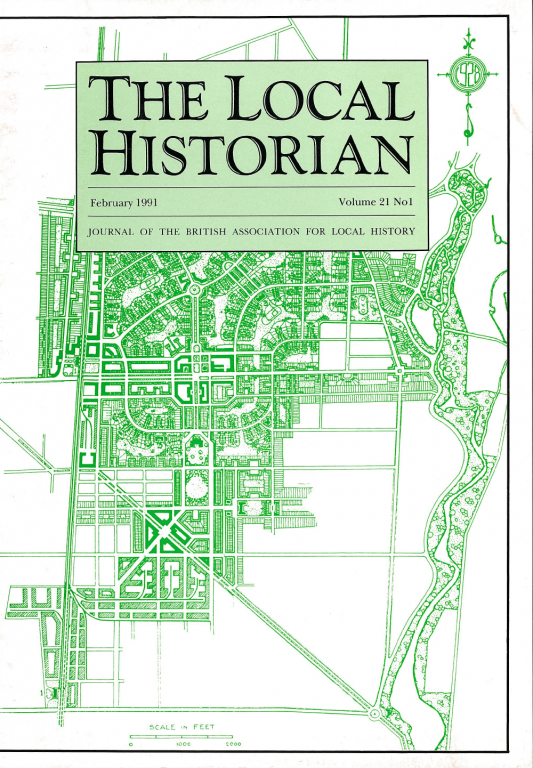
The Local Historian Volume 21, Number 1 February 1991
Contents
The chapel in the English landscape Show more
By Paul Hair
The wide diversity of chapels in English church history have made their mark upon the landscape. As well as the familiar nonconformist buildings the author describes and explains the existence of other sorts of chapel before and after the Reformation. These include: i) private chapels which were built by local squires and landowners for their own use, and which flourished until the Reformation; ii) dependent chapels, which were under the authority of the parish church and often acted as 'satellites' of the parish church in remote areas; and iii) hamlet chapels which resulted from the process of 'self-improvement' of chapels in remote areas. At the Reformation most chapels were abandoned or destroyed, and the author highlights the difficulties in tracing chapel history because records are scanty - most of the data comes from post-Reformation destruction. Socially, there was little resistance to hamlet chapel destruction, but some were saved by local gentry. Some dependent chapels continued under the new system and were eventually upgraded to full parochial status.
Having and eating cakes: a Bedfordshire solution to the problems of custody and local access to archival sources Show more
By Martin Lawrence and Chris Pickford
Study of the issues raised by the custody of local archives, using the experience of Harlington, Bedfordshire, as an example. The authors highlight the problems that local historians may experience in accessing archive materials, and the consequent pressure to develop more localised collections, but also discuss the difficulties - notably that local collections are not always maintained appropriately. The Harlington Heritage Trust was established to inform the local community and to preserve local heritage by ensuring that original records were placed into safe custody at the County Record Office. Copies of many of the documents were made and kept in an office in the village and later were housed in the local heritage centre. A fruitful collaboration has thus been created between local residents and the centralised support bodies.
Witnesses and appraisers in estimates of literacy in Yoxall 1590-1700 Show more
By Denis Stuart
Analysis of research into literacy in Yoxall, Staffordshire, in the 17th century, using signatures and marks made by witnesses and appraisers in probate records. The evidence suggests that the ability to sign one's name increased dramatically throughout the 17th century, that literacy appears to have been more widespread amongst the gentry, and that levels of literacy show clear evidence of family patterns.
Guernsey: local history in an insular context Show more
By Richard Hogart
Description of current state of local history resources and research in Guernsey, including issues of interest to contemporary investigators. After a brief discussion of the island's special history, the article considers: i) archive and printed sources: ii) official records of the Royal Court dating from the 16th century; iii) the civil registration of births, marriages and deaths; iv) public libraries; v) the Guernsey Archives Service; and vi) La Société Guernesiaise, the local history society. The author suggests a range of bibliographic sources and notes the following important themes in local history research on Guernsey: i) local law, language and custom; ii) the similarity (or otherwise) between the experience of Guernsey and that of other 'Celtic' cultures, including the anglicisation of the community; and iii) Guernsey's relative isolation and the determination of the community to preserve its heritage and folk-history.
[Hide]