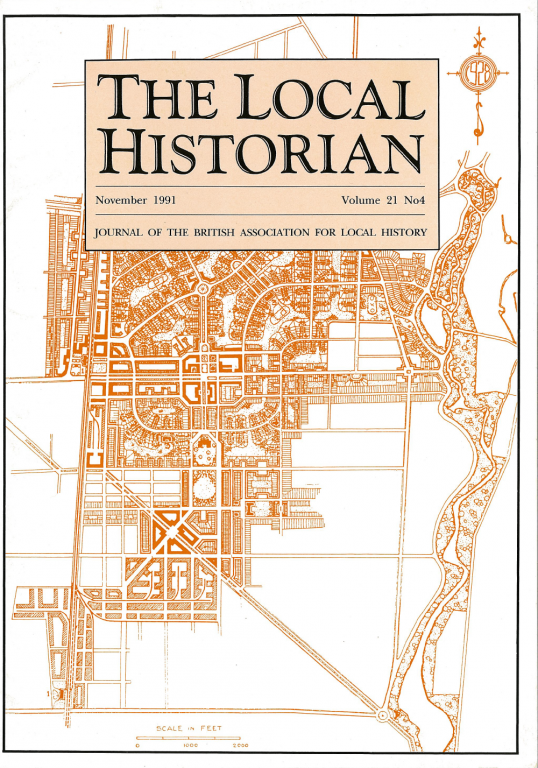
The Local Historian Volume 21, Number 4 November 1991
Contents
The great voting charities of the metropolis Show more
By Norman G. Alvey
Detailed discussion of the hospital charities, some dating from as early as the 16th century, which were funded by wealthy patrons. The article focuses on the development of the notion of charity by subscription and the increasing involvement of subscribers in the day-to-day running of the institutions, including the election of officials. As the system expanded in the 19th century the large subscribers usually became governors, and required that candidates needed letters of recommendation before being admitted - that system could easily be abused and often led to the genuinely needy being disadvantaged. Subscribers were awarded votes depending upon the size of the subscription, and potential patients could lobby for votes: those attracting most votes were admitted. The article examines the doubtful practices of these 'voting' charities and the many attempts to reform the system. There were examples of well-run institutions, but the author highlights the absence of universally available hospital care before the creation of the Welfare State.
Foul and poisonous air: sanitation and public health in a rural community Show more
By Rita M. Sharp
The state of 19th century rural sanitation is an often-neglected topic because the key issues of public health and sanitary reform were, and are, usually considered as urban problems. In this corrective the author focuses on the village of Walkern, Hertfordshire, which like most villages had minimal 'formal' sanitation. The absence of such amenities became a crucial problem as the population expanded. Health problems increased as rudimentary systems for dealing with human waste failed. A local committee attempted to deal with the situation by compelling people to take responsibility for the disposal of their own sewage, but deaths increased.
The archives of the Leeds Education Authority, 1903-60 Show more
By W.R. Meyer
Description of those sections of the archives of the Leeds Education Authority which are held at the Brotherton Library, University of Leeds, including: i) reports of schools inspections, correspondence, school records, details of school activities and practices; ii) reorganisation of schools following the 1944 Education Act; iii) files relating to special schools; iv) records of school welfare including health, school meals, and fund-raising; v) reports on out-of-school activities; vi) records of school-leavers and employment programmes; vii) provision of further education; viii) teacher training; and ix) the effects of the Second World War including evacuation strategies.
Much ado about nothing? Cholera, local politics and health in 19th century Reading Show more
By Klaus-John Dodds
Detailed study of the effects of cholera on 19th century Reading, which traces the rise of the town as a major urban centre and discusses the commensurate growth of public health problems. The response of local government is considered, especially in the context of the first cholera outbreaks in 1832. The variable impact of the disease on different parts of the town is noted and the analysis highlights the impact of the outbreak on moves towards local government reform, suggesting that there was conflict between those council members who were reluctant to spend ratepayers' money on sanitary reform to benefit the non-ratepaying poor, and those groups attempting to improve public health in the town as a whole. The former were reluctant even to admit the existence of an epidemic. The council remained divided for some time and only central government legislation allowed the 'improvers' to force through the appropriate local reforms.
[Hide]