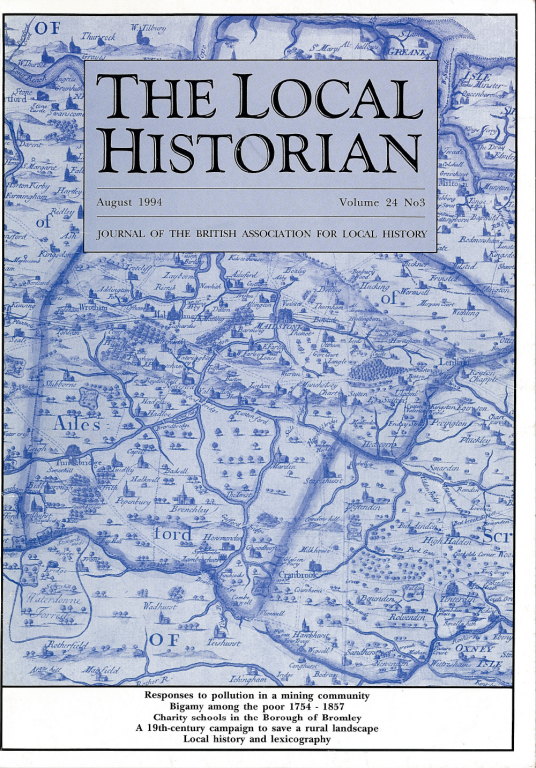
The Local Historian Volume 24, Number 3 August 1994
Contents
Pollution at Leadhills: responses to domestic and industrial pollution in a mining community Show more
By W.S. Harvey
Leadhills is a former lead-mining village on the bleak moorlands of the Lowther Hills in Lanarkshire: its mines worked from the 17th century until 1938, but the village has managed to survive the end of its only industry. The village grew in an irregular and unplanned fashion, and services were minimal. Industrial pollution was a major problem in the 19th century, as it was in most lead-mining areas. Toxic wastes polluted water supplies, while smoke and fumes containing sulphur, lead, arsenic and zinc were produced by the smelters. The article discusses the problems of domestic sanitation, public health and water supplies in the village, and the inadequacy of official responses to these problems. Pollution of water supplies had been noticed as early as the 1790s, but more serious were the effects of smelter fumes, which spread across the surrounding area and affected sheep-grazing grounds on the moors. River pollution from discharges of water from the works was also frequent. It is argued that the Leadhills smelters were particularly inefficient, whereas those at neighbouring Wanlockhead produced no major pollution problems. The article describes the court cases which arose because of the pollution and concludes that the real problem lay with lack of investment in better services and efficient technology.
Bigamy among the Labouring poor in Essex, 1754-1857 Show more
By Pamela Sharpe
Contemporary correspondence is used to examine cases of bigamy in 18th and 19th century Essex. The practice is shown to be relatively common, and its incidence can be attributed mainly to the fact that the 'crime' was treated very leniently and that estranged people rarely knew if their partners were alive or not. Rumour and hearsay played a large part in popular communication. Most marital breakdowns were caused by men leaving home - often because of military service or economic pressures - and eventually finding work elsewhere. There is evidence to suggest that marriage at a young age was more likely to lead to marital breakdown. Abandoned wives were often under pressure to remarry, especially if they were claiming poor relief, or chose to remarry rather than be removed from their parish. However, remarriage in the full knowledge of the existence of the estranged partner also occurred as a form of divorce. Ultimately, it is suggested, women with families sought the apparent security of remarriage.
'Our only object is to preserve the beauty of the road'. A nineteenth-century campaign to save a rural landscape Show more
By Rita Sharp
Very detailed case-study of a controversy in Stevenage, Hertfordshire, in the 1880s, beginning with the proposal by the Post Office to erect roadside telegraph poles in the district. Local disquiet centred on the damaging visual impact of the poles and wires, especially in the town's picturesque High Street, and was exacerbated by the seemingly high-handed attitude adopted by the authorities who, having received permission, erected the poles and prompted a major outcry. The debates among members of the Stevenage Local Board and the often acrimonious correspondence with the Post Office are quoted and the article concludes with the inevitable - the poles and wires, having been erected, stayed there and the campaign was ultimately a failure.
Local history and lexicography Show more
By Edmund Weiner
Study of vocabulary found in 16th and 17th century documents. Weiner suggests that close examination of language used in such sources can be a very valuable tool in interpreting the evidence which they afford the researcher. The problems which may be encountered are twofold: i) difficulties with word identification, including palaeography and erratic spelling, and ii) difficulties with word meanings, exacerbated by the inadequacy of glossaries and the presence of unknown dialect or technical terms. The author uses several examples to highlight these difficulties, as well as detailing the attempts being made to solve them.
[Hide]