The Local Historian Volume 28, Number 1 February 1998
Contents
Late medieval Bristol: from town to city Show more
By J.H. Bettey
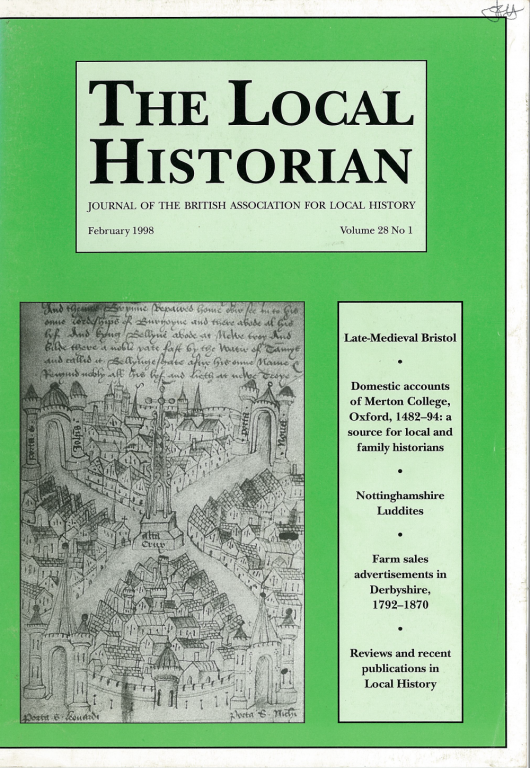
During the later Middle Ages Bristol was second only to London in the volume of trade through its port. It was also by far the most populous town and the most important economic centre in the west of England. The major trade was the export of woollen cloth to Flanders, Spain, France and Portugal, and the import of wines from Gascony and Spain, but a remarkable range of other commodities also passed through the port. It was the extent of its trade, the navigational skills of its seamen, and the wealth of its merchants which brought John Cabot to Bristol in 1495 and led to his momentous voyage to Newfoundland in 1497, a voyage which was repeated by a replica of his ship, the Matthew, in 1997. The article describes the situation and topography of late-medieval Bristol, and the government of the town which had been created a separate county by a charter of Edward III in 1373. Also discussed are the significance of Bristol within its hinterland, its commercial activities, and the search for new markets in the Mediterranean and westward across the Atlantic after the loss of the English possessions in France in 1453. The remarkable collection of ecclesiastical records from the city are used to show the number and opulence of its parish churches and religious houses, and the active social life centred upon them. In 1542 the diocese of Bristol was created, and Bristol formally became a city, thereby finally achieving a status commensurate with its economic and regional importance.
The domestic accounts of Merton College, Oxford, 1482-1494: an unexpected source of information for local historians Show more
By John M. Fletcher and Christopher A. Upton
We are used to looking for source material about local history in the archives and libraries of the place concerned. Perhaps the accounts of an Oxford college would not initially appear to be a likely source of information, except for the city of Oxford itself. However, the internal accounts of Merton College, which have recently been edited for the period 1482-1494, reveal a great deal of relevance and interest to local historians in many communities across the length and breadth of England. As a result of gifts and other acquisitions of property the College held extensive properties and advowsons, from Ponteland in Northumberland to Elham in Kent. The College had continuous and close contact with all its estates, both through the farming-out of rents and the purchase or collection of materials. In addition, many of the fellows of the College were drawn from areas where its estates were located. The accounts now published reflect the significant local impact that a distant landowner might have, and reveal the often-overlooked social role of an academic institution. The editing and indexing of the accounts has generated a long list of local references and personal names. In this article the authors discuss these issues and point to the potential value of this as a source. The article includes an appendix listing the individuals appearing by name in the domestic accounts, arranged by pre-1974 county and then place.
The Nottinghamshire Luddites: 'Men meagre with famine, sullen with despair' Show more
By Christopher Weir
This article explores Nottinghamshire Luddism in the early 19th century. The roots of Luddism lay in textile manufacturing. In the county thousands of framework knitters, working either in their own homes or in small workshops, produced hose on stocking frames that were operated by a combination of hand and foot movements. Most of the frames were rented from wealthy hosiers who controlled the trade. The poor working and living conditions of the knitters combined with more general contemporary economic and political factors to produce widespread unrest in the trade, and eventually led to the rise of Luddism. These factors are considered in the context of an examination of the propaganda campaigns waged by the opposing factions. Today the term is used to describe trade union activities and for any action which seeks to check the progress of technology, but the original Luddites were far from being mindless machine-wreckers. They did engage in sporadic acts of violence but most of their actions were carefully planned and selective, attempting to publicise their grievances. The article compares these actions with other popular risings elsewhere in England and seeks to put Luddism in perspective, looking at its causes and aims and identifying primary sources for its study.
Farm sale advertisements as a data source in historical agricultural study: possibilities and limitations Show more
By Roger Dalton
The value of analysing farm sales advertisements in historical agricultural studies (especially those concerned with the livestock sector) is explored with reference to a sample of advertisements for the south Derbyshire area drawn from the Derby Mercury in the period 1790 to 1870. Two types of advertisement are identified: those relating to surplus stock sales from significant farms, and those concerned with smaller farms where tenancies were being vacated. Tenant farm sales advertisements variously list the numbers, types, breed and quality of livestock offered, the farm equipment, and personal and household effects. The article focuses on the analysis of information relating to livestock, as this source has importance for studies concerned with the period before the first annual agricultural census (1866). Consideration is given to problems of using the advertisements, including the question of completeness where disposal of some items took place before a sale. A scheme of livestock units is proposed to allow meaningful comparisons of different ages and types of stock. Three approaches to the analysis of sales data are discussed: first, the averaging of data converted to livestock units, on an annual or decadal basis, enables temporal changes in farming to be identified; second, the mapping of farm sales on the basis of classifications such as e.g. only dairy or dairying with sheep or by numbers of units, allows spatial variations in farming to be determined; and third, changes in livestock breed preferences can be described but with caution since only 30% of advertisements include breed information.
[Hide]



Hugo Javier Freitas


Laura Yeoman