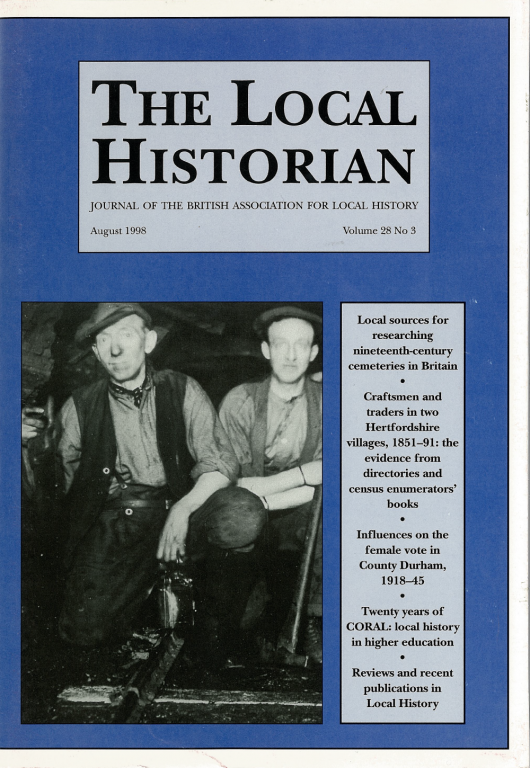
The Local Historian Volume 28, Number 3 August 1998
Contents
Researching early nineteenth century cemeteries: sources and methods Show more
By Julie Rugg
This paper explores the sources which are available for research into the establishment of cemeteries in the first half of the 19th century. The cemetery was a new feature of burial practices, the first being planned and developed in the 1820s. Many of the cemeteries were formed by joint-stock companies and have histories which reflect important aspects of early and pre-Victorian urban culture. The article explores cemeteries in the context of religious politics; fears respecting the integrity of the corpse after burial; speculation and investment; civic pride; and growing awareness of, and concern for, public health issues. It concentrates on sources outside London, including material which might be readily-available in many local history libraries and county record offices. In addition, Rugg discusses the use of prosopographical or biographical methods as a means of discovering more about the motivation of cemetery company directors. The article includes detailed examples drawn from different towns and cities in Great Britain.
An exploration of the craft and trade structure of two Hertfordshire villages 1851-1891: an application of nominal record linkage to directories and census enumerators' books Show more
By Catherine A. Crompton
The methodology discussed in this article involved the application of nominal record linkage to 19th century trade directories and census enumerators' books in order to compile information about individual craftsmen and tradesmen, and their households, in two rural parishes in Hertfordshire. An assessment was made of the relative reliability of each type of data source as a record of individuals and the information obtained is used: i) to identify the economic status of individual craftsmen and tradesmen; ii) to calculate the sizes of enterprises in terms of the numbers of people employed; iii) to analyse the incidence of duality of occupation and the extent to which this changed over time; and iv) to shed light on the continuity of craft and trade occupations in families in the two parishes (Much Hadham and St Paul's Walden). Two assertions are tested: first, that individual rural enterprises employed smaller numbers of people at the end of the 19th century than at mid-century; and second, that substantial proportions of the children of craftsmen and tradesmen did not continue in their family employment. The limitations of nominal record linkage and the shortcomings of the data contained in the sources are also discussed.
The impact of women: the shaping of political allegiance in County Durham1918-1945 Show more
By Pauline Lynn
In this article the shaping of political allegiances between the two World Wars in four districts of County Durham is analysed. It is argued that voting behaviour and patterns of voting reflect, and are determined by, a range of social, cultural and economic factors and that the effectiveness of political parties in manipulating or harnessing these factors is crucial to the voting process. Lynn suggests that in County Durham the Conservative Party was more adept at exploiting the 'value systems' of the local population and emphasises that members of the social elite within the case-study localities were in a position to influence the voting behaviour of working-class women without overtly campaigning to that end. She suggests that a very subtle and pervasive policy of persuasion operated, whereby middle-class women mixed with their working-class counterparts in ostensibly non-political organisations and thereby covertly won support for the Conservative Party.
Local history in context: twenty years of the Conference of Regional and Local Historians (CORAL) Show more
By Edward Royle
The Conference of Regional and Local Historians was founded in 1978 to strengthen and encourage teachers and students of local and regional history in tertiary education. As well as offering seminars and conferences, and supporting the Journal of Regional and Local Studies and other publications, the organisation offers a theoretical critique of the practice of local history. This aims to counter the image of local history as an antiquarian hobby and to present it in broader terms to the academic world as a serious, scholarly pursuit. Though this approach has sometimes led to misunderstandings between, on the one hand, amateurs who have been limited by the practicalities of study to the narrowly parochial approach and, on the other, professional scholars, this article argues against such a division. It urges amateurs and professionals alike to co-operate to establish the credibility of local history as a rigorous and intellectually respectable discipline. As such, it will be able to challenge more effectively the often unhistorical approach to local history of the heritage industry, and it will enable local historians to offer a serious contribution concerning the nature of place and local identity to the current debate about regional devolution.
[Hide]



Hugo Javier Freitas


Laura Yeoman