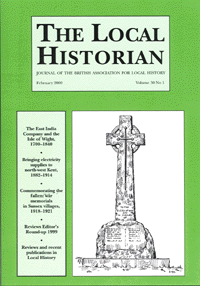
The Local Historian Volume 30, Number 1 February 2000
Contents
The Development Of The Electrical Supply Industry In North-west Kent, 1882 - 1914 Show more
By B.J. O'Neill
By the late 1870s electrical equipment was becoming available for lighting open spaces together with the first electric motors suitable for industrial use. In both the U S A and on the continent public electricity supply systems were being introduced. However in the United Kingdom legislation was required and The Electric Lighting Act 1882 was passed allowing the setting up of supply systems by persons, companies or local authorities. The act was a failure, its financial provisions resulted in few supply systems being started. Following public pressure concerned that Britain was falling behind in the development of a new industry, the government passed in 1888 An Act to Amend the Electric Lighting Act 1882. The new act resulted in many areas having supply systems introduced including those in North-West Kent.
In 1900 North-West Kent was an area of growth. The area included ten local authorities ranging from the highly industrialised northern sector of Deptford, Greenwich and Woolwich to the emerging suburbs of Beckenham, Bexley and Bromley; between 1881 and 1911 its population increaed by some 94 per cent to 620,100. The article examines the technical, operational and economic problems associated with the introduction and development of the various electrical supply systems set up in the area during the period 1882 to 1914. Against the background of an initially unsatisfactory regulatory framework, the new rapidly-developing, highly technical industry struggled to establish itself, its management had to meet competition from coal and gas whilst developing economically viable policies for an industry in which competing technical systems fought to establish the technology to be used.
Investigating Local War Memorial Committees: Demobilised Soldiers, The Bereaved And Expressions Of Local Pride In Sussex Villages, 1918 - 1921 Show more
By Keith Grieves
In the last ten years the commemoration of the Great War through memorials and acts of remembrance has been the subject of writings at the intersection of cultural and military studies and local historians have been heavily involved in generating entries for the National Inventory of War Memorials. Much attention has naturally focused on the physical appearance of war memorials as objects for mourning, whether they be monumental or social amenity structures. Further investigation remains to be undertaken on local processes of commemorating the fallen in rural communities, especially in relation to the interplay of traditional social elites, ex-servicemen's organisations and the relatives of the Absent Dead.
The survival of proceedings of some war memorial committees in parochial records provide remarkable and diverse 'snapshots' of consensus and disunity in six Sussex villages after the First World War, particularly on the question of whether parish churches remained the physical focus and historic embodiment of village life. Evidence of the disruption of hierarchical social relations by the experience of mass soldiering emerges through the study of committees which organised the design, finance, site, inscription and unveiling of war memorials, but this was not always the case. In Slinfold, Warnham, Ashurst, East Chiltington and Angmering highly localised decision-making processes took varied form in relation to the matrices of continuity and change, coercion and consent, and privilege and obligation. These case studies highlight the value of studying commemorative processes for the local historian who wishes to reconstruct the impact of total war on rural communities in the early twentieth century.




Hugo Javier Freitas


Laura Yeoman