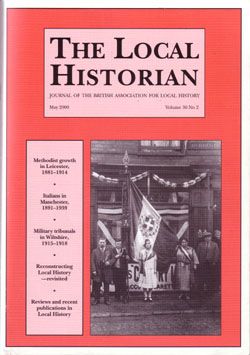
The Local Historian Volume 30, Number 2 May 2000
Contents
Methodism And Society In Leicester, 1881 - 1914 Show more
By GERALD T RIMMINGTON
This is a study, using statistical information culled from Connexional Minutes, of the growth of Weslyan and Primitive Methodism in a rapidly developing town. Leicester, whose hosiery industry had been revitalised and whose new footwear industry was expanding fast, grew from 122,376 people in 1881 to 227,222 in 1911. In a town where the power structure was in the hands of Old Dissent, Methodism at first appealed mainly to the lower working-class people. Methodism grew with the population, not steadily and consistently, but with fluctuations. It continued to grow, however, even when other Nonconformist denominations, mirroring a slowdown in population increase, began to consolidate. To some extent Methodist growth can be attributed to neglect of the working-classes by Old Dissent. Also important was the role of an enthusiastic minister, the building of churches that were non-ecclesiastical in appearance, and the continued use of outdoor evangelism. A slowdown in growth between 1901 and 1914 can be explained by the extention of secularism, the transferance of some working-class people with skills learnt in Methodism to political action in the Labour movement, the alienation of others as buildings became more impressive and services more sophisticated, and competition from fundamentalist and chiliastic fringe sects as well as a resurgent ritualistic Anglicanism. The latter, unlike Weslyanism, did not hesitate to be supportive of working-class political action, and so to identify with the poorest working-class people. Some of the slowdown can be attributed to competition not only with other denominations but within Methodism itself.
Italians In Manchester 1891 - 1939: Settlement And Occupations Show more
By PAUL DI FELICE
This article examines the arrival, settlement and occupational structure of Italian immigrants into Manchester 1891 - 1939. It focuses upon the rather distinctive survival strategies employed by the migrant workers; their niche economic activity; the nature of their ethnic entrepreneurship; the internal workings of the migrant Italian family business; and the extent to which the Italians can be viewed as being apart from the receiving society. A characteristic of the settlement in Manchester was the maintenance of migrationary links with village and town life in Italy. Once in Manchester, the continuation of strong kinship ties was evident, and the settlement reflected the closeness of village life. The distinctive dialect of village and region was also transported to a new setting as was a discernible work ethic. To a degree, aspects of the migrants' popular culture were transplanted into the urban setting and this provided a structure for the new community. The relationship that evolved between the migrants and the receiving society contributed to the maintenance of the Italian presence, known colloquially as Little Italy. The responses of the receiving society were not solely forged by economic and social conditions, but were in part conditioned by popular culture - ice cream, food and perceptions of Italian identity, all of which acted to mediate the host/immigrant relationship as well as being an expression of the immigrants' desire to retain their distinctiveness.
Recruitment Into The Armes Forces During The First World War. The Work Of The Military Tribunals In Wiltshire, 1915 - 1918. Show more
By IVOR SLOCOMBE
Conscription into the Armed Forces was introduced in 1916 for all men aged 18 to 41. With this was established a system of tribunals in each local district for appeals against call-up. This article looks at the establishment of those tribunals and their work in Wiltshire from the 2,000 or so reported cases in local newspapers and the surviving records from the Calne Rural District area.
The huge number of appeals to the tribunals is remakable especially when contrasted with the rush to volunteer at the beginning of the war. In fact in the Clane area, nearly 30% of the eligible men applied for exemption. One might have expected that many of these cases would have concerned conscientious objectors. But, in Wiltshire, these formed under 3% of the cases. The vast majority of appeals came from employers for exemption for what they considered to be their essential employees. As Wiltshire was such an agricultural county it is not surprising that many cases came from farmers and this led to some accusations about farmers' sons being given privileged treatment. Many other cases involved the food trades, especially bakers and butchers, and small businesses.
The local tribunals had the very difficult job of balancing the increasing demands of the army with the need to keep industry and the local economy afloat. The evidence from Wiltshire suggests that they acheived this task reasonably successfully.




Hugo Javier Freitas


Laura Yeoman