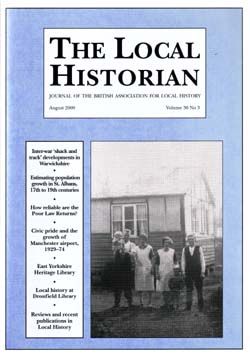
The Local Historian Volume 30, Number 3 August 2000
Contents
Balh Local History Award Joint Winner 2000: Binley Woods: A Warwickshire Example Of Inter-war 'shack And Track' Development Show more
By David Fry
\'Shack and track\' is one of a number of terms used to describe a form of housing that manifested itself in England for a few decades in the first half of the twentieth century. Although already developed in a number of areas before the First World War, it flourished in the unique social and economic conditions that existed in the inter-war years. Shack and track was most commonly developed on farmland of marginal economic productivity which could be subdivided into large building plots of at least an acre of land that would be sold off for individuals to build their own property. Many of the dwellings erected would be considered sub-standard by present day regulations but were passed by the lax regime of the time. The presence of such developments in open countryside, together with a greater access to the countryside by urban residents, caused a degree of moral panic amongst the landed gentry and sections of the professional classes. As a result legislation was introduced which had the effect of choking off the relative freedom to build by individuals.
This article considers the way that one track and shack development in Warwickshire evolved, from its development in the mid 1920s to its maturity in the years after the Second World War. The difficulties encountered in resonstructing the original features of the early years of this settlement and the sources available that make it possible should allow the many hidden examples elewhere in England to be revealed.
Growth In The Population Of St Albans From The Seventeenth To The Nineteenth Centuries Show more
By Norman Alvey
This article describes how annual estimates of the population of three parishes in St Albans from the seventeenth to the ninteenth centuries were derived from counts in the Anglican registers of baptisms. A smooth curve was fitted to these estimates which passed close to population estimates derived from Hearth Tax returns and to counts of population taken from the 1801, 1811, 1821 and 1831 censuses. The curve indicates that the population in all three parishes remained fairly stable during the seventeenth and early eighteenth centuries but then rose steeply. Between 1821 and 1831 the curve indicated lower populations than the census counts of 1831, 1841 and 1851 probably because of a reduction in the use of the Anglican registers, particularly after the introduction of civil registration in 1837. Over all three parishes the population increased from about 3000 in the middle of the seventeenth century to about 7600 by the time of the 1831 census. The increase in population was more marked in St Michael\'s and St Peter\'s parishes which had room for expansion than in the Abbey parish which was crowded even in the seventeenth century.
How Reliable Are The Government Poor Law Returns? Show more
By Shirley Wittering
Galloping inflation, rising unemployment, rising taxes, abandonment of rural industries, authorities accused of \'featherbedding\' the poor, while taking a hard line on immigrants. Sounds familiar doesn\'t it? But this is not the second half of the twentieth century but the second half of the eighteenth century.
Such conditions coupled with a change in the perception of poverty from being an accident of nature to being self-induced, and the poor being seen as lazy, profligate and greedy, resulted in the government introducing a series of inquiries into social conditions. The resulting \'returns\' from 1775-1821 have been analyzed for the Hundred of Thriplow in South Cambridgeshire, a mainly rural arable area of absentee landowners (often Cambridge colleges) with many small copyhold tenants. Where such sources exist the official figures have been compared with the overseers\' accounts for individual parishes. The comparisons resulted in some surprising anomalies.
This article discusses the problem of relying on official Government figures, especially those extracted from returns filled in by rural parish overseers who would, rather be attending to their farms or trades that filling in forms. It highlights the importance of checking secondary sources against primary sources from which such figures came, and warns against the \'it\'s printed so it must be true\' syndrome.
The Promotion And Development Of Manchester Airport 1929-1974 Show more
By Viv Caruana and Colin Simmons
The city of Manchester has been in the vanguard of airport development from the earliest days of British civil air transport. This article seeks to chart the role played by the municipal authority in the establishment and subsequent evolution of Manchester\'s Ringway Airport. The period of consideration extends from 1929, when the first civil airport was laid as a result of the pioneering and progressive efforts of the Corporation, to 1974, when ownership of the facility passed from the city to the Greater Manchester County following major local govenment reorganisation. During these decades, the airport grew from a small, scheduled service to a truly international site. We argue that despite the many potential constraints upon investment decisions arising out of the municipal ownership and control, the airport has been promoted with both vision and viour. Indeed we show that sound commercial principles were put into place from the outset, and continued to operate throughout.
As the scale of activity increased consequent upon the pressures emanating from the increasingly competitive environment, we demonstrate that appropriate financial structures were institutionalised and helped to deflect the intrusion of overtly political considerations. For example, the fierce opposition of those councillors worried about heavy development expenditure was nullified and then, from the mid-1950s, as financial surpluses began to accrue, those eyeing the revenue stream as a means of reducing the rate burden, were defeated. More generally, the municipality has displayed a consistent policy of pursuing a prominent position for the city in this emerging industry. An ambitious programme of terminal, runway and road construction, together with a greatly enlarged route network, suggests that commercial rather than short-term political considerations, prevailed.




Hugo Javier Freitas


Laura Yeoman