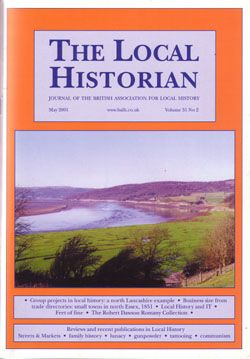
The Local Historian Volume 31, Number 2 May 2001
Contents
A Co-operative Local History Project And Some Lessons Learned From It Show more
By J D Marshall
The Mourholme Society (a local history society at the utmost extremity of present-day Lancashire) in fact represents seven centres of population which can be examined comparatively. The society took the decision to survey the changes wrought locally in the course of the seventeenth century, having already made a large and systematic collection of probate inventories, wills and manorial documents. The team was able to establish that the local economy depended heavily on oatmeal, but that there was little change otherwise in the 17th century; this also applied to farming generally. Open or town fields were still operative, but there were some signs of increasing individualism in agriculture.
There was little change in population levels during the century, and a section of the poorer inhabitants were on the edge of starvation in certain years like 1623. The team discovered that average temperatures were falling during the earlier part of the century, and that a form of 'Ice Age' prevailed. There was a very slow accumulation of wealth on the part of richer inhabitants, and there was a gradual multiplication of by-occupations.
In the matters of political and religious history, the 17th century was one of great change, with the so-called tenant-right struggles raging through the north-west, and with 'extreme' forms of religion (Quakerism and Catholicism) becoming established in the Warton countryside, side by side with imposed forms of outlook and worship in the official Church. With the help of the local historian John Lucas the team was enabled to assess certain Puritan and non-religious attitudes then prevailing.
Many references to regional history have been made throughout.
Trade Directories And Business Size: Evidence From The Small Towns Of North Essex , 1851 Show more
By Neil Raven
This article challenges the view that trade directories reveal nothing about the size of the businesses they record by suggesting that insights into scale are offered in the business descriptions found in classified lists of traders. The opportunity to assess the relationship between the size of a business and its directory description is presented by the arrival of the 1851 census enumerators' returns, which recorded the numbers employed by masters, and the use of nominal record linkage to establish common entries across the two sources.
To assess whether a correlation existed between various descriptive features and numbers employed, the Mann-Whitney non-parametric test is used. This reveals that the term 'manufacturer' was applied to larger employers. The research value of this finding is demonstrated by considering the urban economies of three north Essex towns. With the demise of their woollen textile manufactories, these three towns, along with others in southern England, are considered to have become isolated from the process of early nineteenth-century industrial expansion. However, by distinguishing manufacturers a number of large-scale enterprises are identified operating in the three towns during the 1820s, 1830s and 1840s.
This finding suggests the need to re-visit the economic history of these towns; it also underpins recent claims that industrialisation affected parts of southern England and well as the north and Midlands. Finally, the results demonstrate the potential of trade directories in profiling economic change amongst smaller urban communities during the Industrial Revolution.
History And Information Technology: Some Implications For The Local Historian Show more
By Spencer Jordan
What are the implications of information technology for the local historian? How will the increasing availability of digital resources, particularly through the Internet, affect the discipline? Should the digital revolution be welcomed, or should it be seen as a threat?
This article attempts to answer some of these questions. Through a series of case studies, the article illustrates how computers have come to be a central resource to any historical researcher, tracking developments from the earliest use of mechanisation, such as the use of Hollerith machines in the 1890 American Census, to the present day ubiquitous personal computer.
The article illustrates how the computer has been used as an effective research tool, particularly through the work of the cliometricians, Roderick Floud and associates in their analysis of height data, and E A Wrigley and R S Schofield's detailed reconstruction of demographic trends between 1541 amd 1871.
However, the article also highlights the problems that the digital resource has for the historical researcher. The 'lost' Bristol Social Survey of 1937 is used as an illustration of the dangers of ongoing technological change; and the article offers a simple explanation of how present-day archivists are tackling the long-term preservation of the digital object.
The article ends with the hope that local historians continue to stay informed of ongoing archival developments, noting that the fundamental shift in the way information is being stored, distributed and ultimately paid for, poses as many dangers for the free-lance researcher as it offers benefits.
The Dangers Of Shortcuts: The Feet Of Fine And Landsdowne Manuscripts 306, 307 And 308 Show more
By Mike Davies and Jonathan Kissock
The proposal that Lansdowne manuscripts 306, 307 and 308 are catalogues of the feet of fine produced between 1327 and 1422 is critically examined. They are found incomplete and inaccurate, but not without some value. They are thought to be a collection of notes or copies of notes of fine.
The Jonathan Dawson Romany Collection Show more
By Janet Keet-Black
The valuable collection of photographs, papers, manuscripts, books, journals, paintings, music, videos and audio tapes etc, relating to the history and culture of Gypsies, has recently been donated to the Romany and Traveller Family History Society by the collector, Robert Dawson. The Collection is, however, far from being of sole interest to the family historian. During the spring and summer, Gypsies travelled to where the work was, such as the hop and fruit gardens of Kent, Sussex, Hampshire and Herefordshire, but in the winter many moved into towns to seek employment. Every large town therefore had its quota of Gypsies, and many of the published works within the Collection give an insight into the lives and occupations of those living within specific areas.
Much of the material held in the Collection is still to be sorted and catalogued. However, armed with some knowledge of Gypsy traditions and lifestyle, it is possible for local historians to build upon what is currently accessible to them. The huge collection of books forms the core of the Robert Dawson Romany Collection and almost all of them are now available for consultation at the Rural History Centre, University of Reading.
The Romany people have been in Britain for over 500 years and a study of their presence in or around each large town would doubtless be an interesting and worthwhile project to undertake.




Hugo Javier Freitas


Laura Yeoman