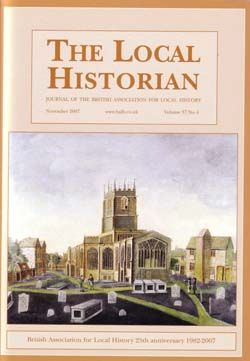
The Local Historian Volume 37, Number 4 November 2007
Contents
Editorial Show more
By Alan Crosby
This issue breaks a record in the long history of The Local Historian and its predecessor The Amateur Historian, it has reviews of 34 books, more than any previous issue. We have been following a policy of reviewing as many books as possible, either in separate items or as part of collective review articles and round-ups, so that we can better reflect the remarkable breadth and depth of work being published in the general field of local history, as well as the specific studies of so many towns and villages, counties and communities across the land. This richness of research and writing is demonstrated by the titles which are covered in the present issue. Some are modest local studies, intended to inform and illuminate primarily for the benefit of a local audience: in this category we might place Janet Murphy's short history of Queen's Park in Chesterfield, a work which draws upon local people themselves for their memories and recollections. Other detailed and highly focussed local studies include the book and DVD by the people of Fontmell Magna in Dorset, and the oral history work at Eardisland in Herefordshire. The publication of a DVD highlights, again, that there are now many more options for presenting the fruits of research, the 'traditional' book, paper or pamphlet has been supplemented by electronic media, and that development offers exciting opportunities to any group or individual with access to the technical skills (which are themselves ever easier to acquire). As a lifelong bibliophile I remain completely confident that books will never be superseded, but clearly the potential for exploiting the wonders of sound and moving image is growing ever greater.
Some of the books reviewed here are the product of collective work by local history societies and heritage groups, a process which I always find particularly gratifying to watch (and indeed, to be involved with). Perhaps local historians can all too easily become introverted or isolated, ploughing purely private furrows and not connecting with others working in the same fields (pun perhaps intended). Group projects, though, have a long and honourable history (Alan Roger's highly influential book Group Projects in Local History was published as long ago as 1977, and though in terms of method it is outdated, as it appeared just before the electronic revolution, it retains much of its validity). Local history societies, pooling resources and using their imaginations, have undertaken remarkable and skilful work in recent years, from full-colour publication of maps to substantial parish and town histories, via exhibitions and history displays, monographs and occasional papers. They remain at the heart of current and innovative work in local history, and it is good to see so many outstanding examples reviewed here. One collective, or collaborative, project which I particularly applaud is Parson and People in a Suffolk Village: Richard Cobbold's Wortham 1824-77 edited by David Dymond and the product of twenty years' work by members of the Wortham Research Group. It is one of the most remarkable and engrossing local history books that I have read in recent years, and is surely destined to become a classic.
On the other hand, there are books reviewed here which are by professional historians who work on a local or regional canvas, using (as so often noted) the particular to illustrate or inform the general. Local history, I believe, is not national history broken up into small pieces and thus rendered less consequential. Rather, national history is in many senses an aggregate of local events and processes, so the local experience and the local example have a special value. Far from being less significant, they are in reality fundamental to our understanding. How can we really appreciate the meaning and relevance of enclosure, the growth
Fifty Years Of 'banburyshire' Publication Show more
By Jeremy Gibson
The Banbury Historical Society celebrated its fiftieth anniversary in November 2007. In this short article Jeremy Gibson, one of its two founder-members and a leading figure in family and local history in England, describes the Society\'s publishing activities. The Banbury society is perhaps the smallest in the country to have its own record series, and over the past half century it has published fine scholarly editions of many local records for the town and its hinterland, giving Banbury a perhaps unrivalled published historical resource. The society has also published a regular journal, Cake and Cockhorse, since 1959, making this one of the longest-running local history journals in the country. The article discusses these activities and also describes recent ventures, including the special volume for the fiftieth anniversary year, Banbury Past through Artists Eyes, which is a particularly attractive full-colour volume portraying the changing townscape of this historic town.
Slavery In Scotland? Scottish Colliers 1606 - 1799 Show more
By Evelyn Lord
The condition and circumstances of Scottish colliers in the seventeenth and eighteenth centuries are investigated in this detail and thought-provoking article, which takes as its starting point legislation concerning the system of bondage for miners and saltworkers which was passed by the Scottish Parliament in 1606. The legislation tied these workers to the master in several important ways, preventing them from moving freely, making them legally the belongings of the master, and instituting elements of forced labour. Thereafter, and especially in the second half of the eighteenth century, there was growing debate as to whether this represented a form of slavery. The article first looks at the perspectives adopted by different historians towards this issue, and then assesses the life and work of Scottish colliers over the two centuries under consideration. It gives information about their domestic and employment circumstances and wage rates and seeks to place their experience in a wider perspective. The potential advantages and benefits enjoyed by colliers and saltworkers are given attention, since it can be argued that the impact of the legislation may have been far from entirely negative. The article concludes with an analysis of the process whereby the legislation was finally repealed at the end of the eighteenth century, noting that the pressure for that change came from the coalowners, primarily for economic reasons.
The Jews Of Warwick C 1180 - C 1280 Show more
By Richard Dace
This article takes a challenging topic, looking at a little documented and small Jewish community in a provincial town in the early medieval period, and demonstrates how fragments of archival evidence can be pieced together to present a picture which, though admittedly and unavoidably incomplete, provides a convincing impression of the fortunes and misfortunes of a small and potentially persecuted minority. It discusses the background to English Jewry in the period and then identifies important local evidence from national records, the Pipe Rolls and the 1194 Donum (or taxation returns) which gives information about the wealth of Warwick Jews. Other sources, such as inquests, summonses and court records relating to financial disputes provide further detail, and the author shows how, using taxation records, the rapid decline in the wealth and status of the Warwick community can be traced during the thirteenth century, in line with wider trends observable nationally. The article includes tentative reconstructions of the genealogies of some leading Warwick Jewish families. As well as being of specific interest in the context of Warwick and Warwickshire, the article will provide valuable ideas and methodologies for those researchers who might want to investigate the history of medieval Jewry in other provincial centres.
Local History At The Crossroads Show more
By Kate Tiller and David Dymond
In this article we reproduce the text of the two keynote addresses which were given at the BALH Local History Day, held in London in June 2007. The theme of the morning's proceedings was the future of local history, which is considered by many to be 'at the crossroads'. The two speakers (and authors of this paper) are both very well-known and highly-experienced local historians who have been actively involved in education for many years, and they drew upon their accumulated knowledge and experience to present their personal views of the state of the subject and its prospects. Kate Tiller, in the first part of the paper, looks at the distinctive characteristics of local history as it has been practised in Britain, including its wide-ranging and broad-based appeal, its network of close practical and intellectual links with other disciplines, and its very diverse activities which link the scholarly work or research and analysis to the community work of societies, exhibitions, schools, museums, recording schemes and higher and further education. She highlights the disturbing trends and recent threats evident in the last named of these, and then offers a list of ten suggestions for the future, firmly based upon the current activities and their strengths and opportunities. David Dymond follows this with a review of how local history has fared in the world of higher and (especially) continuing education, demonstrating the evolution of the subject in tandem with the changing world of education itself, and addressing contentious issues such as accreditation and qualifications; funding and access to resources; the role of groups and community projects; and the danger of structural disintegration as educational provision fragments. This article has major contemporary importance in the context of local history as a whole.
'Education, Education, Education': Researching The 1902 Education Act Show more
By Roger Ottewill
Themes in local history series:
The Education Act of 1902 was among the most bitterly contested pieces of legislation of the Edwardian period, producing vitriolic debate in the pages of the press and in parliament, and throwing into sharp relief the sectarian divisions within society. Its controversial character was primarily the consequence of its relationship with religious teaching, a subject of major concerns to educationalists, church members and local communities at the dawn of the twentieth century. The major practical provisions of the Act (summarised in a table) related to the abolition of school boards and the formal establishment of local education authorities; the first statutory provisions for secondary education; and the future methods of management of elementary schools, including their funding. The government intended to end the division between voluntary schools (mainly operated by the different religious denominations) and the state-provided board schools which were secular. The article discusses the nature of the controversy, including the differing attitudes to education among religious denominations, and then analyses the local impact of these heated debates. The legislation was one of the most significant determinants of education policy, locally and nationally, in the first half of the twentieth century and as such merits much closer attention from historians. Roger Ottewill describes the different sources which can be used to research the question at local level, and highlights the importance of newspapers (with due warning as to their often partisan nature). The notes and references are particularly detailed and represent a valuable reading list on educational history in the pre-First World War period.
Review Article: The England's Landscape Series Show more
In the summer of 2006 English Heritage, in conjunction with Collins, published an eight-volume series on the history and development of England\'s landscapes. These books, which are beautifully and generously illustrated with maps, plans and photographs (many specially drawn or taken for the series) are authoritative texts and give an unrivalled coverage of the landscape of England from prehistory to the early twenty-first century. They are written by acknowledged experts and are collectively an outstanding publishing achievement. In this review article each volume is considered separately, and some common themes emerge. The quality of the production, the weight and value of the text, and the beauty of the books themselves, are all revealed in every review, but almost all the reviewers express puzzlement about the choice of boundaries and geographical areas, several arguing that these seem to make little geographical, historical or administrative sense. Overall, the series and its component volumes are warmly welcomed.


Hugo Javier Freitas


Laura Yeoman