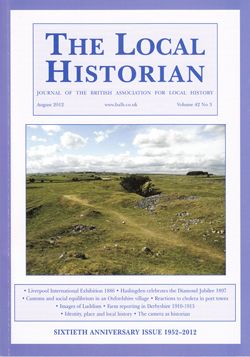
The Local Historian Volume 42, Number 3 August 2012
Contents
Editorial Show more
By Alan Crosby
Amid the minor royal sideshows, ephemeral anniversaries and the trivial sporting competitions with which 2012 is heavily burdened, one worthy anniversary shines with dazzling effulgence. In August 1952 the first issue of a new journal, The Amateur Historian, was produced as a speculative venture by Terrick FitzHugh of Shepperton, published on his behalf by C.E. Fisher & Co. of London EC4 and printed in Eastbourne. It is a slim drab volume of 36 pages of cheap austerity paper, some 5½ inches by 8½ inches in size, and copies are now as rare as roc’s eggs or hen’s teeth. It would be fair, I think, to suggest that in appearance at least vol.1 no.1 was not only Amateur but also a touch amateurish, though that is not to pass censorious judgment—times were hard, money was desperately short, and one man financed this venture from his own pocket. It was a brave endeavour, and it did not let him down. The proof is in your hands—you are now reading its distant and renamed descendant on the occasion of their collective Diamond Jubilee—60 years on, a lusty 88 pages, larger, stronger, with fine quality paper, packed with material and nestling enticingly within its luxuriously opulent full colour cover.
Terrick FitzHugh was a remarkable man. Like some other prominent local historians of his generation he had been a fervent ‘intellectual Communist’ in the 1930s and retained his leftward leanings thereafter, but his day job after leaving the RAF at the end of the war was as a director of documentary films. The real passion, though, was family history and, through that, local history. He met his wife Mary when, at the age of 18, she went on a guided tour of the Highlands of Scotland, and he was the guide—she fell for him immediately and at Fort William Station, as a subtle hint, ‘deftly dropped her handkerchief out of the train window onto the platform as the train steamed away on its journey south’.1 They married five years later, in 1937. After his retirement he devoted himself to genealogy, being awarded the gold medal of the Society of Genealogical and Heraldic Studies in 1989. He died a year later.
The contents of the first issue of the new journal merit closer examination. The editor himself contributed a brief article on how to set up and run a local history exhibition, in itself a remarkable demonstration that this was not intended as yet another antiquarian publication but instead was aimed at active members of the local community, the grassroots who were discovering the riches of sources newly available in the fast growing list of county record offices, and who could use their greater leisure time and disposable income to follow this new pursuit.
But the honour of having the first article of all went to Ralph Pugh, formidable and energetic editor of the Victoria County History of the Counties of England since 1949. He described the genesis and subsequent history of the VCH andhighlights of the VCH noted among its highlights the translations of Domesday entries, the descriptions of religious houses, and the immense amount of fine topographical detail in the parish histories. Pugh’s own How to write a parish history appeared in 1954 and represented an early move in the process whereby the world of the VCH was opened up to a wider audience. Article no.2 was also by a famous name. R.E. Latham, compiler of the still essential Medieval Latin Word List which bears his name, wrote the first in a series of six articles entitled ‘Hints on interpreting the public records’, which finished in July 1953 with an article by L.C. Hector on the newly-accessible splendour of the 1841 and 1851 census returns. Latham contributed pieces on the feet of fines, letters patent, inquisitions post mortem, ministers’ accounts, and plea rolls. None of this may seem remarkable, but sixty years ago it was pioneering.
As if Pugh and Latham were insufficient, and reflecting his own political consciousness and associations, FitzHugh also secured the services of one of the greatest twentieth century historians to write for the first issue of his little journal. Christopher Hill introduced readers whose ideas of the Civil War were possibly derived from Captain Marryat to the complexities and challenges of interpreting that period in our history, emphasising the local dimension. Heconsiders how the divisions in society during the Civil War came about, their extent and depth, and their impact upon on local activities, events and people, and warns against trusting, at local level, the traditionally accepted existence of a geographical split between the Royalist north and west and the parliamentarian south and east. Hill argues that locally the divisions were far more complex, since they could be occupational or ‘class’ led, and suggests a number of lines of investigation into potential sources of stress and tension which could affect local allegiances, including enclosure, emigration, friction between towns and rural gentry, local monopolies, friction between individual towns, local struggles over the rights of freemen, the presence of Levellers or Diggers, the effect of religious adherence, local clergy allegiances, and the transfer of land ownership—all that in only five small pages. It was an ambitious task, but powerfully demonstrated the seriousness with which Terrick FitzHugh approached his self appointed missionary role as the bringer of modern perspectives on local history to the reading public. To all those who then believed that ‘local’ meant ‘antiquarian’ Christopher Hill should have given pause for thought. Unfortunately the equating of the two terms is by no means unknown even today, and with even less justification.
The journal was a success. A second issue appeared two months later, again sprinkled with the names of top people. Latham contributed his next piece, W.E. Tate jointly wrote an article on the parish constable and his role in the community, illustrated as we might expect with quotations from documents in parish chests, and Margaret Gelling introduced readers (in many cases perhaps for the first time) to the fascination of ‘place-names as clues to history’, providing a very handy glossary of the hundred commonest English place-name elements from beac/bece (OE ‘stream’) toworth/weorth/wyrth (OE ‘homestead’) as well as a typically lucid exposition on the themes which she was to follow in her lifetime of research and writing. Among the letters in that second issue I read one from George Bolton, a youngish man who was then setting out in the pursuit of family and local history here in Lancashire. Forty years later he was for me a kind and generous friend and had become the doyen of local historians in the town of Leyland. He was just the target market (not a phrase he would have liked) for Terrick FitzHugh’s journal. The project worked well and it’s still going strong.
1 http://www.ottershawsociety.org/our-village/notable-ottershavians/mary-fitzhugh/
Civic Pride On An International Stage: The Liverpool Shipperies 1886 Show more
By Murray Steele and Mike Benbough-Jackson
This article considers the experience of the Liverpool International Exhibition of 1886, one of a number of major international exhibitions which followed the triumphant success of the Great Exhibition of 1851. The authors begin by pointing out some of the underlying motives for holding the 1886 event, including showcasing Liverpool’s commercial and maritime significance, and providing a major boost to the economy of the city and its hinterland at a time of lean years. The exercise was hampered by financial constraints, not least because in Britain the funding for such events could not be provided by the local authority (since this contravened legislation on legitimate use of rate income) and would not be provided by the government. Costs had therefore to be met or underwritten by the men of substance within the city. The article then outlines the logistics of organising the event, drawing attention to the importance of individuals and their dynamism, the arguments about venue and types of buildings to be erected, and the unfortunate consequences of misguided economies. The content of the exhibition is described, with analysis of the decision-making which lay behind the main themes—the international port, the trade with Empire, the variety of entertainments, and the showcasing of trade and industry. The diversity of themes and the lack of a single specific focus is considered to be unusual and a possible cause of problems. The next sections discusses the responses to the exhibition in the local and national press, much of which drew unfavourable comparisons with other exhibitions, and the authors show how the Manchester exhibition held a year later was much more favourably received. The attendance figures were a serious disappointment, and there were numerous complaints about judging and possible financial malpractice. The finances told their own tale—a loss of almost £20,000 compared with profits at Edinburgh and a huge surplus at Manchester. The final section sums up the unfortunate story and shows how Liverpool’s somewhat humiliating experience was a sharp lesson to the organisers of the Manchester exhibition which followed.
With Right Good Will: Haslingden Catholics Celebrate Queen Victorias Diamond Jubilee Show more
By John Dunleavy
This short article considers the way in which the Roman Catholics of Haslingden, Lancashire—a town known for its large Irish population and strong associations with Irish nationalism in the later nineteenth century—celebrated the diamond jubilee of Queen Victoria. Despite the seeming incongruity of an Irish Catholic population demonstrating patriotic loyalty to the queen, there was general enthusiasm for the events held to mark the jubilee. Dunleavy shows how in the processions the symbols of Irishness (such as images of Daniel O’Connell and green sashes) were carried but much outnumbered by the regalia and badges of Catholicism—statues of the Virgin Mary, and sashes of the Catholic orders and societies—and he argues that the local Catholic population, though many of them were of recent Irish origin, took pride in their newly incorporated town and wanted to show that they were loyal subjects of the queen.
Nineteenth Century Customs And Maintenance Of Social Equilibrium In An Oxfordshire Village Show more
By Mavis Curtis
Mavis Curtis continues her exploration of society and community in the village of Elsfield near Oxford by considering the survival of traditional customs through to the early twentieth century, pointing to the role played by Herbert and Louisa Parsons, who moved to the manor in the 1850s, and the author John Buchan and his wife, owners of the manor from 1919. She begins by looking at the views of E.P. Thompson, who has argued that links between customs and agricultural life inevitably loosened as the later eighteenth and nineteenth centuries saw the rise of industrial and mechanised employment (which was not seasonal) and urbanisation which broke the link with the countryside. He also argues that the propertied classes sought to annex working class rural customs, which were often considered vulgar and were frequently unruly, and to tame them and control them.
The Parsons made many changes, including rebuilding cottages, providing basic amenities such as piped water, and replacing casual labour with waged regular labourers. They strongly resisted the influence of the National Agricultural Labourers’ Union, and promoted the village Coal and Clothing Club as a channel of social well-being. In terms of customs, the annual cycle included the giving of Christmas presents to villagers—usually meat or other food—and the provision of clothing for the village children (cloth for suits, and a cap, for the boys, and dresses, hats and scarves for the girls). Village festivals included Christmas, Easter and May Day, the first two being focused on the church and the manor but the third more community-orientated and demonstrating ancient survivals in the May day Song.
The article concludes with an overview of the different agencies which shaped village life—the school with its crucial role in promoting order, respect and industriousness; the manor and its occupants, with their powerful place as the arbiters of village life; and the church, the only place of assembly and, historically, the venue for many of the celebrations and activities in the annual calendar.
Anxiety, Dread And Disease In The Ports Of Liverpool And Tynemouth Show more
By Sarah Hutton
This article contrasts the reactions of local authorities in the two ports of the title when confronted by the reality of cholera in the mid-1850s. Sarah Hutton begins by providing on overview of the question of public health, epidemic disease and the role of quarantine, pointing out that the latter has received remarkably little attention despite its crucial role in efforts to prevent the import of infection from overseas. She argues that port towns, which were in the front line of these efforts, need to be seen in terms of their settled and transient populations, the latter being perceived as the real threat. Her article reasserts that cholera, first ‘imported’ in 1831, was a special psychological importance because of the speed with which it spread, the extent of its impact, and the extreme uncertainty about its cause or the mechanism by which it travelled—the disease was therefore anthropomorphised.
Hutton then focuses on the two towns. In the case of Tynemouth, an area which had been badly affected in 1849, the separation of the infected from the uninfected was an important principle and an isolation hospital had been established, but the authorities had little apparent interest in the problem—the documentary record is almost silent on the matter. But in 1854, when a single infected sailor arrived in the port (sent over-river from South Shields by the medical authorities there!) a flurry of activity was generated—Hutton suggests that this was because of a fear of ‘foreign’ disease, whereas domestic cases of cholera were dealt with in a matter of fact way. In Liverpool, by contrast, the assiduous and far-sighted medical officer, William Henry Duncan, was notably concerned about cases of infection on ships entering the port, but the town council disregarded his recommendations and told him to focus on sanitary improvements, arguing that he should concern himself with the ‘inside’ community rather than with ‘outsiders’. The author suggests that this different attitude was because Tynemouth was not accustomed to the import of people, only of goods, and therefore paid particular attention to the individuals entering the town, whereas Liverpool was so familiar with major flows of passengers that it downplayed their role.
Yorkshire Luddism: Image And Reality 1812 - 2012 Show more
By John A Hargreaves
The Yorkshire historian John Hargreaves has played a prominent role in the commemoration of the bicentenary of the Luddite unrest of 1812. In this article he focuses on a single image, very widely used to illustrate the events of that year, which purports to show Luddites engaged in smashing machines. He begins by reviewing the many publications and other sources, and television programmes, in which it has appeared and which use it as the archetypal illustration of the unrest. The article then challenges the provenance of the image, showing how it cannot possibly be contemporary because the machine shown is a Jacquard loom, and these were not used in Britain until the 1820s at the earliest. Hargreaves then demonstrates that the image is a fabrication, because the background first appeared in the Penny Magazine in January 1844. The figures were clearly superimposed upon this image later in the nineteenth century. The final section of the article places this in the context of wider misunderstandings and falsehoods about Luddism and its circumstances, and argues that these have created much confusion and seriously impeded general historical enquiry as well as providing misleading evidence for Luddism itself.
Farm Reportage In The Derbyshire Advertiser 1910 - 1915: Assessment And Interpretation Show more
By Roger Dalton
The agricultural historian Roger Dalton draws attention to the potential importance of newspaper reportage as a source for farming history in the early twentieth century, looking at a lengthy series of articles published in the Derbyshire Advertiser each of which profiled an individual farm and gave extensive information about its activities, economic rationale, marketing and links with, for example, urban markets and commercial cheese and milk factories. He begins by assessing the value, coverage and limitations of the source and then analyses the evidence given under a series of themes: farming types and classifications; land use including percentage in pasture; livestock (including dairy cattle and the dairying business; cattle rearing and fattening; sheep; horses; poultry; and pigs). He shows that the picture of farming in Derbyshire and immediately adjacent areas closely matches the more generalised and far less factual descriptions which were published in a number of farming surveys between the wars, but that the farm surveys, by virtue of their greater detail and statistical information, allow more thorough and comprehensive analysis.
The results are placed in the context of factors such as the rail network and its relationship to the dairying industry; the geology and soils; the evidence for specialisation and diversification; and the rapid economic and social changes which took place in the first half of the twentieth century and which dramatically altered the basis on which agricultural decision-making operated.
Opinion: Identity, Place And Local History Show more
By William Evans
The author begins by arguing that ‘identity’ is a theme which crosses academic boundaries, and in which philosophers, psychologists, sociologists and historians have much to learn from each other. He suggests that historians approach such a concept in a very different way—a non-scientific approach which focuses on questions such as the identity of places and localities. He then proposes that local historians should consider identity from the perspective of five criteria: spatial identities, physical manifestations of form, appearance, building materials and architectural styles; social identities defined by such factors as birthplace, social groups and communities, ethnicity, class and mobility, with ‘badges’ such as football clubs as one of the identifiers; and political identities which relate to levels and areas of government—counties, boroughs, regions, and parishes, with special reference to the first of these. The longevity and importance of the county as a unit is discussed, as is the destabilising and confusing impact of local government reform upon these loyalties and identities. He concludes by suggesting that ‘every place has its local identity, but that identity is articulated fully only by local history, and only local history can do it’.
The Camera As Historian ; Review Article Show more
By Alan Crosby
In this review article the editor of The Local Historian draws upon the themes addressed in an important new book, The camera as historian: amateur photographers and historical imagination 1885-1918, by Elizabeth Edwards. The book is centred upon the work of the county photographic surveys, some seventy of which functioned during the period covered in the title. These surveys, the first of which was in Warwickshire, sought to make a permanent record of the historic buildings, landscapes and archetypical features of the areas in question. Few chose to consider mundane or contemporary aspects of life, such as poverty, industry or transport, and most instead looked nostalgically back to a somewhat illusory ‘golden age’, which carried on until the late eighteenth century, before Britain as sullied by noise, dirt and ugliness. In his review Crosby argues that this book is a major contribution to local history and our understanding of the people and institutions that shaped the subject in the late nineteenth and early twentieth centuries. Although that was not its primary purpose, the volume has added greatly to the historiography of our subject. The article concludes with a series of reviews (by other contributors) of recently published local history books which employ old photographs.
Reviews
Family Matters A History Of Genealogy Show more
By David Hey
Surnames, DNA & Family History Show more
By Alan Foster
Hampshire And Surrey County Council Elections: 1889-1974 Show more
By Christopher French
Whitchurch Divided Conforming And Nonconforming In A Shropshire Parish 1526-1720 Show more
By Roger Ottewill
Religion, Gender And Industry Exploring Church And Methodism In A Local Setting Show more
By Paul Anderton
The Story Of Newbury Show more
By Joan Dils
Growing Better Lincolnshire And The Potato Show more
By John Martin
The Victoria County History of Wiltshire vol.18 CRICKLADE AND ENVIRONS Show more
By Steve Hobbs
Forests And Chases Of Medieval England And Wales C.1000-c.1500: Towards A Survey And Analysis Show more
By Alan Crosby




Hugo Javier Freitas


Laura Yeoman