Local History News Number 150 Winter 2024

Contents
A bright light shining through history Show more
By Alan Crosby
From time to time one comes across a book which makes a particularly deep impression – one which captures and excites the imagination and perhaps prompts new and tantalising trains of thought. For me, over 30 years ago, one such was Oliver Rackham’s The History of the Countryside, a wonderful and idiosyncratic exploration in landscape history which is deeply personal and quirky, and which made me look at all sorts of familiar things in a new light. It also has the most audacious ending of any book I know. The final sentence (concerning the esoteric topic of fish-weirs) states simply: ‘There was a similar device on the River Calder near Wakefield.’ No contrived attempt to round off the text, no high-flown sentiment, no superficial summing up of anything at all. It’s as though the last pages of the typescript somehow became detached and were lost.
Now I am re-reading another book which has had a powerful impact on my thinking. I first read it in November, and am now (in mid-January) revisiting it and finding all sorts of new points and ideas which I missed first time round. The book is Eleanor Parker’s Winters in the World: a journey through the Anglo-Saxon year, first published in 2022 (by Reaktion Books). It’s not local or regional history – its author is lecturer in Medieval English Literature at Oxford – but it sheds bright light on the beliefs and perceptions of the Anglo-Saxons, their world view and their attitude to place and environment, in that absolutely crucial period in our history. It was a world of opposites and balances: dark and light, cold and hot, young and old, sick and well, anger and calm, fierce and gentle. As the circle of the seasons revolved each year, so it reflected the cycle of human lives, from conception and birth, through growth and maturity, to decline and death… and then rebirth, as the circle and cycle began again.
All of this, initially, could be interpreted via the panoply of gods and supernatural or legendary figures whose realm this was. Latterly, it could readily be slotted into a framework of Christian belief, in which the one and only god shaped and guided, moulded and chided his and our world and us, its inhabitants.
The book is not at first glance an easy read, because of the depth of its analysis and the inclusion of numerous sections of poetry in the original rhythmic and alliterative Anglo-Saxon, but that doesn’t matter at all. The poetry is translated, and the narrative is beautifully written in clear and accessible modern English, with warmth and sympathetic understanding not only of the subject itself, but of the people whose beliefs and perceptions are described and
discussed – our ancestors, a millennium and a half ago.
Recently, some of my work has involved place names and their meanings, especially in the context of landscape history. From the 1960s onwards a group of imaginative and pioneering experts, including the late Margaret Gelling, reappraised and reassessed the interpretation of place names, freeing themselves from the tightly dogmatic restrictions of those who took a purist linguistic or philological approach and instead trying to see how the Anglo-Saxons and the Scandinavians might have seen and sensed their world – the subtle distinctions in the shapes of hills and valleys, sophisticated awareness of soils and geologies, expert knowledge of different types of woodland, acute consciousness of micro-
climates.
Their painstaking work not only transformed the study of place names, but also highlighted their value as a historical source, a precious resource which has been passed down to us across the centuries. Now, reading Eleanor Parker’s fine book, I have discovered new and interwoven strands to the Anglo-Saxons and their experience. They were fine-tuned to their world, its sights and sounds, its appearance and its changes, its moods and its temper. I think I understand them better, those people who were instrumental in creating this country.
Awards Show more
BALH Outstanding Individual Contribution award winner Graham Thompson has had a significant impact on the study of local history in the Teign Valley in Devon.
Shortly after moving to Christow after retiring from general practice, Graham set about the mammoth task of learning all he could about every aspect of the rich history of this Dartmoor village and its locality, sharing that knowledge with others by founding the Teign Valley History Group in 2010. Regular talks and outings are now enjoyed by many. Later he founded the Teign Valley Museum and Archive Trust, which runs Teign Valley History Centre, www.tvhistorycentre.org, an online resource that is widely used and has an ever-growing collection of newspaper articles, letters, posters, photographs, essays and oral recollections.
Despite battling the onset of age-related mobility problems, Graham, a native of the area, has also written three books: Teign Valley Tales, interviews with long-term residents of his village; A Devon Village, an account of Victorian life in Christow; and The Pellews of Canonteign, the story of the lords of the manors of Canonteign and Christow. He is now working with volunteers to interview more of the long-term residents for Teign Valley Tales 2.
Without Graham’s drive and initiative none of this would have been possible. He has engendered a love and keen interest in history among both young and old alike in the Teign Valley and his legacy will last for generations.
Graham told Local History News: ‘I wanted to study local and social history in the Teign Valley, which has a population of about 3,000 spread over seven villages. The first meeting of Teign Valley History Group attracted just six people, but our reputation soon spread until we had 140 members and 60 regular attendees to our meetings such that we had to hire a larger hall. Our remit was to allow local people to add to their knowledge of life in the valley, although we now look more generally at the whole of Devon but with an emphasis on how Devon, and even national life, impacted on valley life.’
Graham said that this led to collecting artefacts, and the History Centre website has now recorded more than 4,000 items, with as many still to be catalogued. ‘Our third aim,’ he said, ‘is to instil a love of the district in our children and we have given a number of talks to local primary schools.
None of this could have been achieved without the enthusiastic support of the community, which is the answer to any project like this.’
To nominate someone for next year’s BALH Outstanding Individual Contributions awards, visit www.balh.org.uk/resources-balh-annual-awards (deadline 31 December).
Using theatre to explore Southampton’s local history Show more
By Cheryl Butler
A theatre company may not be an obvious member of BALH but the The Sarah Siddons Fan Club Theatre Company has been a member for many years. SSFC is a site-specific company, in that it produces new work based on historic content and performs in the place where the action actually happened. This usually means performing outside – but it does save on scenery as historic remains act as the backdrop for the shows. Our main ‘theatre’ of operations is the remains of the medieval town of Southampton and our first show took place in 1986 – this was a ghost walk, ‘The Leper’s Day Out’, raising funds for the mayor’s charity, and was supposed to be a one-off event. We invited people to turn up and make a donation at the end. When we found 400 people waiting for us at the Bargate we thought we might be on to something. We decided to become a little more formal and to try out a summer show, ticketed of course; this show was based on Jane Austen’s time in Southampton and was called Taking the Flounce. At that point our little troupe had no name so we decided to call ourselves after Jane Austen’s favourite actress, Sarah Siddons, another former resident of Southampton, and the Fan Club was born.
We were somewhat unsure if the group had a future, but as we still perform to sell out audiences, we must be doing something right. Our group is made up of historians and local history enthusiasts who also love drama and to perform. We have three core productions a year, our summer show, Halloween, and Christmas ghost walks, the latter telling the more gory and unsavoury stories from Southampton’s past. These shows are usually perambulations moving the audience around the old town as the story unfolds. There is a central character who leads the audience and sets the context for the show and the scenes that will unfold. We do at times venture beyond Southampton, mainly to other venues in Hampshire from Beaulieu to Milestones, Eastleigh and Hamble. Our plays are sometimes commissions and we have performed at Tudor House Museum, Hilliers Garden and God’s House Tower among many other historic venues, telling the history of those places in dramatic form.
Anniversaries are another big inspiration and the story of Titanic, votes for women, D-Day and the centenary of powered flight have all provided inspiration. We quite often perform in historic churches, most recently for the 400th anniversary of Pear Tree Church and the delayed 950th anniversary of St Michael’s Church, the oldest building in Southampton.
Covid of course meant that we could not perform in the traditional way. We had already had some experience of filming – for the BBC documentary on Titanic and as part of the national commemoration of the 600th anniversary of the Battle of Agincourt. We had been due to perform at Pear Tree for its 400th anniversary, telling the story of the local cabin boy Richard Parker, whose fate changed English law. We managed instead, within the restrictions, to produce a film The Sad Tale of Richard Parker. Pandemic restrictions also ruined lots of plans to commemorate the 400th anniversary of the sailing of Mayflower and we managed to turn our show into another film, A Funny Thing Happened on the Way to America. The restrictions during filming were even more challenging: we had to be outside, with no more than three people, and one of those was the cameraman of course.
As things started to improve, we made a partnership with the United Voices of Africa, who wanted to work with us on telling the early history of black people in Southampton. That led to the film Six Characters in Search of a History and our return to the streets with Bought; we also worked on a film telling the story of King Lobengula and Cecil Rhodes, The Chameleon and the Fly. The films can all be seen on our YouTube channel (www.youtube.com/@sarahsiddonsfanclub8312) and have been very well received thanks to the magic of the film-maker James Henderson. We were also invited down to Titchfield Abbey for the ‘Earl of Southampton’s Fayre’, where we took on the roles of travelling players commissioned to produce a piece of drama about ‘Sir Bevis of Hamtun’ which included audience participation and had to appear to be unintentionally bad – it takes some skill to make something look appalling and clever at the same time!
Once we have decided on our projects for the year, the first step is the historic research using primary and secondary sources, searching for stories and characters that can form the basis of a piece of theatre. Once the research is completed, a directorial line has to be decided upon; we want the play to portray the history as closely as possible but there will have to be compromises. In more modern pieces we can use reported speech but the further back in history more creativity is required without undermining what the research has shown us. The lead character has to be chosen; in a recent ghost walk based upon stories from Victorian penny dreadfuls, a reporter was the obvious choice. For the spa town, Mrs Austen trying to find suitable husbands for her daughters gave a drive to the action. In Bought we decided to focus on the late Georgian period, beginning with Ellen and William Craft, escaped American slaves who had come to Southampton as part of a lecture tour to raise awareness of the effects of the slave system. Once their story had been told, the characters then told the audience they were going to learn about stories from their own town. Having the backdrop of original buildings from the period helps to set the scene but costumes still have to be made. Colours used and design also contribute to the storytelling but they have to be suitable for quick changes – which will be taking place on the street, of course!
We do give a talk now and then. For example, ‘Behind the Scenes with Sarah Siddons’ told our own story of run-ins with the police, dealing with drunks, being dragged in to make an appearance at a senior citizens’ Christmas party in the middle of a show and why ghosts are always fat (in the cold, layering costumes up keeps you from freezing!).
Our recent shows have been Bloody Royals for Halloween 2023 and Piss Pot Alley for Christmas and we are looking forward to collaborating with the history department of the University of Southampton to tell the story of the maritime community of the port in early modern England in 2024, then returning to the history of Jane Austen for her 250th anniversary in 2025. We are always pleased to hear from our audiences, who often tell us they had no idea about a particular aspect of the history of their town or building and that they are going to do follow-up reading and research after seeing one of our plays. And of course that they have enjoyed and been entertained by the performance.
Cheryl Butler is a founder member of SSFC and a BALH Outreach Team member. She read History & Drama at Winchester before going on to complete a PhD in history and is an associate of the New Era Academy.
Making the most of manorial court rolls Show more
By Sharon O’Connor
Manorial court rolls provide a wealth of material for family and local historians, and those for Dulwich, a manor of about 1,200 acres in south London, covering the years 1333 to 1903, are no exception. Such a long chronological range makes them a hugely valuable historical source, and it was an enormous but worthwhile project to get them online. We hope this potted outline of how we did it is useful to anyone contemplating digitising their own manorial records.
To begin with, Dulwich College Archives arranged to photograph the court rolls, which are held at the College, to a high resolution. We paid for half the costs using a bequest from Mary Boast, a much-respected member of our local history group. Patrick Darby, a current member of the group, typed out transcriptions and translations of the Latin (and occasional legal French). On our website (www.dulwichsociety.com/courtrolls) the rolls are arranged by date, with the English translation and the Latin transcript as PDFs, then the photographic images of the rolls. You simply click on a file to open it.
For most historical projects, the key lies in knowing what to search for and where to find it. For court rolls, however, the original material is readily available, though not usually in an accessible form. Once we had high-resolution images of the rolls, Patrick painstakingly worked through them. And never forget that useful palaeographical tool of inverting an image to make it negative, or back to front (and upside down) where text from one roll has stuck to another, to render otherwise incomprehensible text readable.
For the Dulwich rolls it was therefore a question of deciphering the handwriting (which became progressively easier for Patrick as he approached modern times), having a Latin dictionary handy, and making sense of the meaning (which included working out the meanings of various abbreviations – usually, but not always, obvious). The National Archives website has useful tips on its ‘Reading Old Documents’ pages (see www.balh.org.uk/GCR171).
Whoever first catalogued the Dulwich rolls, probably in the 19th century, divided them into different series using all the letters of the alphabet, double letters like TT, XA and even the Greek letters alpha and beta. This was a bit of a muddle to say the least, so Patrick decided to rename them (with the approval of Dulwich College Archives, which hold the originals), generally starting a new series after a gap of four or more years without extant rolls or evidence of lost rolls. This enabled him to give the files names that were computer friendly, i.e. all lower case and with dashes between the words, e.g. a1-front.jpg, a1-back.jpg. This was a great help when uploading them to our website and also makes it easier to discuss the files with others. The transcripts and translations for each roll refer to it by its new name as well as its former name for the benefit of those using an old catalogue.
Most online transcripts of court rolls make little attempt to follow the layout of the original roll. Patrick made a conscious decision to adhere to the original layout, which means that when you see his transcript next to its photograph it matches, making it easier to follow. He used different colours for original text, indecipherable words, extrapolated abbreviations and later additions to a roll, and added a front page to each PDF file explaining all this. Sometimes users will come to a court roll because they googled for a name that is within a roll, so it’s helpful that this context is in each PDF. Having a front page also allowed us to add a link back to the overall court roll project, so that if people did come to an individual file from a search engine, they can orient themselves within the overall project.
The translations were tricky to match up to the original court roll layout, line for line, because the English translation might be longer or shorter than the Latin original. However, as a general rule, the lines are spaced so that any paragraph in the translation matches up with the same paragraph in the transcription. For later rolls the typeface Lucida Bright (with occasional forays into Lucida Blackletter) was chosen, because it most closely resembled the original script. Many of these decisions had to be made along the way, so we would urge anyone thinking of taking on such a project to think these through beforehand to make their life easier!
If you start such a project, don’t think you need to wait until it’s finished to put it online. It will probably make for more work, but if you upload files as they are ready, Google will start indexing them, meaning people will find them more quickly, making your hard work all the more useful to the wider world. Our Dulwich rolls were put online in two batches – the first up to 1673 and the second the remainder up to 1903.
Lastly, let any relevant archives know what you are doing. For London that included our Southwark borough archive and the London Metropolitan Archives. The National Archives were very interested in our project and wrote a piece for their newsletter as well as linking to our website on their own site.
Sharon has lived in Dulwich and been a member of the Dulwich Society local history group since 2004. Now retired, she was assistant archivist at Dulwich College.
Government wills consultation Show more
The Ministry of Justice has been holding a consultation on the storage and retention of original wills from 1858 onwards (those under the aegis of the Principal Probate Registry), proposing a controversial move to digital-only storage – see www.balh.org.uk/BPD179 for the consultation papers. The closing date was set at 23 February. The government says that storage of the paper copies and related documents costs around £4.5m a year.
Peter Calver of LostCousins.com has some interesting analysis on will usage at www.balh.org.uk/UFH182 – he submitted a Freedom of Information request to TNA to gauge interest in accessing the original pre-1858 wills, and has extrapolated this to suggest that there is perhaps not much justification for holding on to the post-1858 ones – however, destroying historic source documents is a one-way journey that we might regret, especially in the light of situations such as the cyberattack recently bringing the British Library’s online resources to their knees. A petition against the MoJ proposals has hit around 11,000 signatures. Its initiator, genealogist Richard Holt, notes ‘While I… welcome digitisation as a means of access to original wills, it is not a method of preservation’.
BALH is one of a list of organisations receiving consultation documentation, and is preparing a formal response – keep an eye on our website and social media.
A local history workshop at Swansea University Show more
By Lauren Golding
I am a second-year undergraduate in Medieval Studies at Swansea University and social secretary of our History Society. I am also a member of BALH and excited to share my passion for local history – a combination that places me in a fortunate and perhaps unusual position of being able to introduce a BALH workshop into the student social programme. But how would a more academic-focused event be received by students familiar with the society’s usual offering of quizzes, pub socials and trips?
It was time to enlist help and get some enthusiastic experts involved. Joe Saunders, BALH Outreach Team Chair, warmly supported the idea and suggested Helen Palmer, county archivist at Ceredigion Archives and a BALH Outreach Team member, as a key contributor. Having secured BALH support, we decided to also involve several lecturers from the university, providing an opportunity to share their own local-based research and to show students how local history fits with the work of people already familiar. The Richard Burton Archives (RBA) is the repository of Swansea University and holds material of local, regional and national significance. I had previously enjoyed a tour of RBA and felt that they would be an excellent addition to the workshop line-up.
We were able to hold the event on campus in the Taliesin Studio. Numbers for the RBA tour needed to be limited to 15 due to capacity restrictions and we decided to open the event to 30 people with those booking first attending the tour. The workshop was promoted via social media, poster distribution and direct contact with students. On the day, 20 students had booked to attend, and six university lecturers also made up the audience. However, a few ‘no-shows’ allowed for the entire group of students to attend the archive tour.
The workshop began with a welcome and introduction from Jane Golding, BALH Vice-Chair. Helen Palmer then gave a lively and engaging introduction to BALH and local history which immediately captured everyone’s interest and was well illustrated by local archive material and artefacts. She emphasised how local studies can inform the national picture, how BALH is the ‘go-to place’ for local history, and demonstrated ways in which students can get involved. Helen was then joined by Kim Collis, West Glamorgan county archivist, who discussed how to use archives, particularly the West Glamorgan Archive held in Swansea.
Professor Martin Johnes gave the first of the four lecturer presentations, discussing his use of school log books as a source of local history. Describing the log books as ‘windows into local communities’, he talked about the challenges faced in using these records, and the insights that they can provide into not only education, but also key aspects of local life such as events, values and poverty.
Next up was Professor Louise Miskell, author of Swansea Copper: A Global History. Her presentation focused on her use of local archives, particularly RBA and West Glamorgan Archive, to research Swansea’s copper industry for her book. She discussed the types of records and archival collections she utilised and how they aided her research.
After questions and discussion, Katrina Legg and Emily Hewitt from the Richard Burton Archives further developed the theme of how to use archives and provided an overview of career opportunities within the archive and record-keeping sector. The group then made the short walk across to RBA for a tour of their on-site storerooms followed by an exciting look at a wide range of archive material that had been specially selected for the group and laid out in the search rooms.
Returning to the Taliesin Studio, refreshments (pizza and chocolate!) awaited, and Helen explained the instructions for the next session. Handing out photocopied extracts of archive material, she invited everyone to write a relevant entertaining social media caption with the promise of prizes for the winning entries. The point of this exercise was to take a detailed look at the images and documents and to think about what they signified.
While the judging took place, the final two talks were given. Dr Gethin Matthews shared his experience in discovering the stories behind the 81 names of a local WW1 roll of honour as part of a project supported by the Heritage Lottery Fund. This enlightening presentation discussed the use of the rolls of honour in conjunction with other records and provided a glimpse into the types of stories that can be uncovered about WW1
servicemen, including Gethin’s own ancestor.
The final presentation was given by Professor David Turner who introduced CHART (the Centre for Heritage Research and Training) and its goals as a hub for interdisciplinary collaboration and partnership in public history and heritage. He discussed the local public history work that CHART has been doing over the last few years and the opportunities available for students interested in a career in heritage.
The workshop then concluded with the announcement of the caption contest winners, with historic maps of Swansea (kindly supplied by the Historic Towns Trust) awarded to the runners-up, and a BALH student membership awarded to first place. There was also a BALH bookstall for students to purchase publications and several editions of Local History News for them to browse.
Overall, I am delighted with how the workshop went. It provided a great taster session as BALH was previously unknown to most participants. Feedback comments included: ‘the workshop was a fascinating and enlightening experience’; it ‘opened more doors of curiosity for me’; ‘provided a better understanding of how local history can be used’; and ‘gave a good look at how you can build on the skills you learn during your degree’.
The organisers are very grateful to BALH for supporting the event, the speakers for their excellent talks, RBA staff for organising the archive tour, Swansea University History Society for funding the main costs, the Historic Towns Trust for donating prizes, and all those who generally contributed to making the workshop a very enjoyable and
interesting event.
While out walking… Show more
‘I went to Noke / But nobody spoke…’ – the old rhyme was true enough on my visit to this tiny village (pop. 136) while walking another section of the Oxfordshire Way. The rhyme is said to refer to the locals refusing to inform on the Otmoor rioters of 1829-30 protesting against enclosure. St Giles’s church dates from the 1270s. Painter William Logsdail (1859–1944) spent his last two decades here and is commemorated with a blue plaque. I liked the noticeboard with a hand-drawn map of local house names – not with histories, but the names alone give clues to the past. Onward to Beckley for lunch in the Abingdon Arms, where Evelyn Waugh had his first honeymoon, and back in 1830, the people ‘spoke directly’… Andrew Chapman
Mr Lowry and Mr Cornish: post-war industrial realism in north-east England Show more
By Mike Thornton & John Banham
This year sees a major art exhibition at the Bowes Museum in County Durham celebrating the work of two acclaimed artists who focused on showing life in the industrial communities of the North. L.S. Lowry (1887–1976) spent much of the last 15 years of his life visiting north-east England and shared a friendship with Norman Cornish (1919–2014) based on the Stone Gallery in Newcastle upon Tyne where they both exhibited their work for sale. Lowry was over 30 years older and had retired from rent collecting in Manchester in 1952 whereas Cornish was a working coal miner until 1966, thereafter becoming a full-time artist. The friendship was based on formality… they called each other Mr Lowry and Mr Cornish.
They had first exhibited together in 1951 at an exhibition in Tullie House, Carlisle entitled ‘Realism in Contemporary Painting’, which the modernist Victor Pasmore described as ‘the expression of working-class sentiment’. In 1952 Cornish and Lowry exhibited in the Artists International Association’s Exhibition, ‘The Mirror and the Square’, at the New Barrington Galleries in London. Other exhibitors included Pasmore, Stanley Spencer, Graham Sutherland and Barbara Hepworth. However, the two artists first exhibited in the north-east in 1959 at the Stone Gallery in Newcastle upon Tyne – the exhibition also included work by John Piper. The 1960s saw the reputations of both artists grow significantly partly because of the frequent exhibitions of their work at the Stone Gallery. In 1962 the Newcastle gallery relocated from Brunswick Place to St Mary’s Place. Lowry’s wonderful drawing of the gallery with its steps up to the front door is of the latter building. Mick and Tilly Marshall, the gallery proprietors who acted as their agents, were a great influence on both artists. Lowry purchased two of Cornish’s paintings and according to Tilly Marshall ‘he was the only artist he was jealous of’.
Cornish was a native of the region, living and working in the mining town of Spennymoor, which had a strong arts tradition through activities at the Spennymoor Settlement created in the 1930s. Lowry first visited the north-east in 1933, staying in Berwick-upon-Tweed. After his mother’s death in 1939 he became a more frequent visitor to Berwick and in 1947 he almost bought a house there. However, in 1960, at the beginning of his association with the Stone Gallery, Lowry visited Sunderland, stating that ‘one day I was travelling south from Tyneside, and I realised that this was what I had always been looking for’. As a result, the Seaburn Hotel on the Roker seafront became his base for frequent visits during the next 15 years. Lowry explained that he liked ‘Sunderland because of the shipping and shipbuilding and the countryside at the back. I like the sea. I sometimes escape to Sunderland to get away from art and artists.’ Cornish’s experience of Sunderland was somewhat different; when he became of full-time artist in 1966, he was invited to work as a part-time lecturer at Sunderland College of Art.
We have no direct record of what Lowry thought of Cornish’s work, other than his purchase of the latter’s paintings. However, in his autobiography, A Slice of Life, Cornish wrote in 1989: ‘One chat we had concerned the artist’s work after death. Lowry wondered what might happen to his own work – at that time he was eighty years old. He wondered if it would live on or be forgotten. I was personally in no doubt that his work would be much treasured after his death, and I expressed such an opinion.’
Both Cornish and Tilly Marshall, who wrote an account called Life with Lowry (1981), attest to Lowry being a difficult character to understand. Cornish’s view was that Lowry ‘had, I think, an impish sense of humour, matched at times with displays of bad temper. He liked to be the centre of attention (and who can blame him after his long struggle for national recognition). He would sometimes pretend to be asleep, but nevertheless he missed nothing, and he had a broad knowledge of painting history, and of art matters.’
In their 2009 analysis of Cornish’s work, the authorised biography The Quintessential Cornish, Robert McManners and Gillian Wales compared the two artists, stating that: ‘Both were loyal to their communities, and both depicted their versions of the effects of industrialisation. However, the resemblance in their work is purely superficial… It is true that both artists use distortion, at times to the point of caricature, but their respective motivation was very different.’
The Daily Telegraph obituary of Cornish contrasted him with Lowry: ‘his pictures carry no sense of alienation; rather they radiate a mellowness and warmth… and a nostalgia for an era in which, despite its terrible deprivations, there was a rich feeling for community. They are not only works of art, but also socio-historical documents.’
They go on to say that Cornish ‘benignly parodied’ his characters to ‘emphasise their personalities and idiosyncrasies’. They were ‘real people living real, if slightly exaggerated, lives’. However, Lowry’s characters were ‘distorted to the point of depersonalisation’. Later this year, a decade after Cornish’s death and almost half a century since Lowry’s, there is the opportunity to compare these different views of the impact of industrialisation. The exhibition at the Bowes Museum in Barnard Castle is entitled ‘Kith and Kinship: Cornish and Lowry’ and it runs from 20 July 2024 to 19 January 2025. The exhibition follows a successful Cornish Centenary exhibition at the Bowes in 2019/20. Lowry also had a connection with Bowes Museum, being well known to Tony Ellis, its then deputy director, and his wife, Joan. Ellis had previously been keeper of Salford Art Gallery and Lowry wrote to them in 1961: ‘It was very nice to see you there in Barnard Castle, and every time I see the collection in your museum, I like it better and better – I always find something fresh to my mind, in some way or other.’
The Cornish centenary was also marked in the artist’s home town of Spennymoor, where a Cornish Trail was created, mirroring the already established Lowry Trail in Berwick-upon--Tweed. Furthermore, Norman Cornish’s studio is now on display in Spennymoor Town Hall Gallery, and, at Beamish Museum, a replica of the artist’s Bishop’s Close Street home has been built as part of a 1950s town.
Mike Thornton is Norman Cornish’s son-in-law and writes a blog for the official Norman Cornish website: https://normancornish.com/homepage/latest-
news. John Banham is the secretary of Durham County Local History Society and has written about Spennymoor’s artists and historians in the society’s Journal: https://www.durhamweb.org.uk/dclhs/dclhspublications.html
The exhibition at Bowes Museum will run from 20 July until 20 January 2025. Details: https://thebowesmuseum.org.uk/exhibitions/kith-and-kinship-cornish-and-lowry/
Medieval Ruislip and the Abbey of Bec Show more
By Celia Cartwright
The Ruislip, Northwood and Eastcote Local History Research Group began a project in 2017 to examine the mediaeval records from the abbey of Bec in Normandy which are now in the archives at King’s College Cambridge. In summer 2020 an article about the project was published in Local History News (LHN 136).
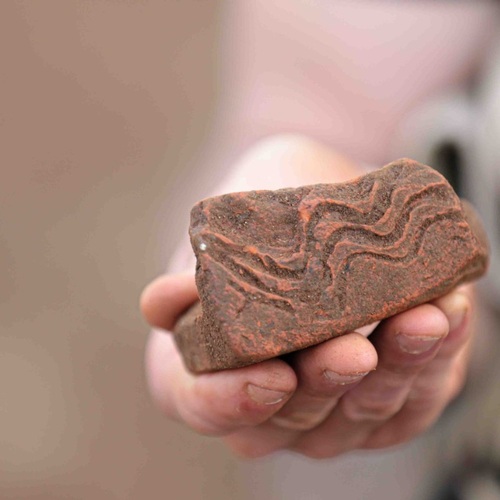
The manor of Ruislip was left in the will of the Norman lord Ernulf de Hesdin to the abbey in 1087 and remained in its possession until 1404 when the abbey’s estates in England were finally broken up. Copies of documents have been transcribed and translated and work on analysing them has continued. Progress has predictably been slow because of Covid and there are fewer of us now working on the project. Nevertheless the website has been updated and articles written for the society’s journal. The charter of Robert de Rading dated 1232 and a rental looking at the property holdings in the manor were written up in 2020, as was a fascinating doodle from the original manuscript (pictured).
The Journal of 2021 contained several articles on medieval themes, including ‘Edible Ruislip – feeding mediaeval Ruislip’, produced by the group for Heritage Open Day in 2020 with the theme ‘Edible England’. Another article dealt with Nicholas Shorediche, who owned property in Ruislip and whose family lived for centuries in Ickenham; comparisons were made between a rental from the end of the century and a court roll of 1383; and Roger atte Rudynge (probably a descendant of Robert de Rading) featured in an article on the ‘Lease of Northwood’ from 1384.
Articles for the 2022 Journal included a study of women in 14th-century Ruislip, while an analysis of occupational surnames from the custumal of c.1246 and a court roll of 1247–8 yielded some fascinating details, such as the names of Humfrey Stikewricte, who might have made sticks, rods or staffs used for fencing or supports from wood produced from coppicing, and Robert Croys, who might have been the bearer of a processional cross or the maker or seller of such crosses. ‘Croyser’ appears in several later records and Crosier Way in Ruislip preserves the name. ‘Sixteenth century builders at Manor Farm’ sheds light on the workmen and materials involved in the rebuilding of Manor Farm.
Field names and surnames have continued to be a source of local interest. Names were analysed from their roots in the diverse languages from which they are probably derived. These included Latin, Norman and Old French and Anglo-Saxon. Surnames were becoming more fixed in the later middle ages and can tell us more about the area and its people. The resulting data has been recorded in spreadsheets.
For the wider picture, we have noted that there are other sources to examine besides those in King’s College Archives, such as documents at The National Archives and the London Metropolitan Archives and wills. We have even discovered a new vicar named John in 1290 to add to the list in St Martin’s Church, and also that Philip Howlet, vicar from 1386 to 1400, left a will. No other wills from clergy in the 14th century have been discovered so far.
It is tempting to look for a connection between sources. A Piers or Peterwych appears in a petition of around 1378 at TNA (SC 8/134/6670) as ‘servant and valet of the duke of Lancaster’ in connection with a complaint about intrusion into property in Ruislip, Stanwell and elsewhere by Alice Perrers. Alice was Edward III’s hated mistress and given the date this was almost certainly part of the huge backlash against her after Edward’s death. Peterwych also appears in the court rolls and there is land with his name. In 1383 Peter Petirwich was amerced for not mending his ruinous house, which he had been ordered to mend before the next [court], under pain of 40d. The same year in Eastcote he brewed and broke the assize of ale six times and was fined 2s. Then four years later he was fined 4d for not sending for the ale tasters. In 1390 Richard Palmer was fined 2d for not cleansing his ditch at Petirwicheszate. This may be linked to Peteridge, a tenement in Eastcote (see E. Bowlt, The Goodliest Place in Middlesex, 1989). We would need more evidence to be sure that these references were all about members of the same family, but it seems likely.
The detailed rental RUI/190 dated 1375–1400 in the King’s College catalogue has presented challenges and raised more questions than answers. The manuscripts were copied and assembled in the wrong order and proved quite difficult to sort out. In the correct order, the scribe of the manuscript is named John Hotoft in the first line. Was he a descendant of Roger Hottot/Hototh who had granted the tithes of his land called ‘Linda’ near Worcester to Bec in a charter of 1172 before he took holy orders there? (See M. Morgan, The English Lands of the Abbey of Bec, 1946.) This may indicate a continuation of the connection with the abbey – or did he take his name from Huttoft in Lincolnshire? Bec manors did extend as far as that.
For 2023 a comprehensive account of the 13th century, written by Laurence Morris in the 1950s, is being published in the Journal. An overview of four court rolls from the end of the 14th century will also appear. However as we have now discovered that there are at least 18 more court rolls from the 14th century, this work may have to be revised. There is still plenty to be learned about life in mediaeval Ruislip!
I would like to thank Dr Jonathan Mackman for his support with this project. I wish to dedicate this article to Eileen Bowlt (1937–2023), Ruislip local historian who first inspired me to take up the study of local history.
Letters to the editor Show more
Send your letters to: editor.lhn@balh.org.uk
All that glisters… is actually Goldie
On re-reading my paper on 1840s York published in Local History News in 2019 (‘The importance of the 1840s in York (and elsewhere)’, LHN 130). I realise I have made a most egregious mistake.
This was the claim that York’s 1840s Catholic cathedral, built in front of the West Front of the Minster, was ‘designed by local architect Joseph Hansom, inventor of the Hansom carriage’.
Well, Joseph Hansom (1803–1882) was a York-born architect and he did design one of York’s big Catholic churches and invent the Hansom carriage; but he was not the architect of York’s Catholic cathedral.
That honour goes to another local architect, George Goldie (1828–1887), the extremely Catholic son of very Catholic parents, the important medic Dr George Goldie (1784–1853) and his wife Mary Anne Bonomi (1796–1872), whose father Joseph Bonomi the Elder (1739–1808) and twin brother Joseph Bonomi the Younger (1796–1878) were both celebrated architects and sculptors.
I should have spotted my Hansom faux pas because at the same time as I was writing the afore-mentioned bloomer-bearing article, I was also starting one about the Goldies, whose history is at least as interesting as that of the Hansoms (‘Why did George Goldie leave York in 1832?’, Yorkshire Philosophical Society Newsletter, available at www.tinyurl.com/Bibby22). Mea completely culpa!
John Bibby, York
Hidden in plain sight
On the interesting subject of chronograms as evidenced by the article on the Salisbury inscription (‘While out walking…’, LHN 148), subsequently picked up by Peter Smith (Letters, LHN 149).
I wonder how common these are in people’s experience and whether a national survey or census might be valuable. I have seen very few (they do not exactly jump out at you and the uninitiated would quickly be forgiven for not noticing them at all) and my vague hunch and memory is that they may be more common in European (French?) cathedrals and larger churches.
David Wright, Whitstable
Editor: A Victorian solicitor and antiquarian called James Hilton (1815–1907) published several editions of chronograms in the 1880s and 1890s, documenting thousands of them from architecture and from books, across Britain and Europe. He seems to have been the most comprehensive recorder of them. See, for example, www.archive.org/details/chronograms5000m00hilt and the British Library’s blog post at www.balh.org.uk/URF172. Can any readers shed further light on the subject?
Mapping the past, looking to the future: the Historic Towns Trust Show more
By Vanessa Harding
Readers of this journal will probably already be aware of the Historic Towns Trust (HTT) – we’ve partnered with BALH in online lecture series in 2021, 2022 and 2023 (and will be doing so in 2024 – see page 35 of this issue), and in 2023 we joined with BALH and others in the All About That Place challenge.
Our two organisations have many similarities, in mission, outlook and volunteer-led activity. HTT creates and publishes historical maps and atlases of Britain’s towns and cities, in partnership with local organisations and individuals, and we are always keen to engage with the wider local history and family history communities.
In the past ten years, we’ve published 14 folding maps and four atlases, covering 16 towns and cities; three more maps and an atlas are in preparation, and we’re hoping to increase our rate and range of production in the next decade.
A big question that we face in planning future activity is, which towns or cities will we map? In a country as long and as densely urbanised as Britain, there are literally thousands of potential subjects for historical mapping, each of which could be interesting, rewarding and instructive. Our approach, which we think suits British towns and cities well, is to create a multi-layered map, using a 19th- or early 20th-century OS base, overlaid with historical features, whether still visible or already lost. This is after all how we experience townscapes today, as a physical present shaped by the past, revealed in street plans, street names, buildings, uses and practices.
The distant past may have greater weight or influence in what we regard as ‘historic’ towns and cities – York, Winchester, Chester and Canterbury, for example – but almost every British town would repay study and mapping with a richer understanding of the influences that have shaped it and a greater sense of engagement with it as it is. And our aim is not just enrichment of local understanding, but a fuller appreciation of our shared urban heritage through comparative study. Our maps are all at the same scale of 1:2500 (about 25 inches to the mile), facilitating comparison and highlighting similarities and differences.
Within the multitude of British towns and cities, we hope to cover a wide range of urban types, from smaller towns with a local market function to regional metropolises, from medieval cathedral cities to industrial conurbations.
Spa towns, port cities, fortified sites, planned and organic growth – the list of important and interesting characteristics is long. And as a national organisation (we cover England, Scotland and Wales but not Northern Ireland) we aim for a wide geographical coverage, and to develop projects in areas where we’ve not yet been active.
There are interesting possibilities in comparing towns and cities within a region or with specific links to each other, such as the Welsh marcher towns or the Cinque Ports. We’ve recently undertaken an internal exercise to review our ‘places prioritisation’ and added further criteria, including financial ones such as the potential for local sales, outreach and educational activities, or access to earmarked regional or national funding.
But a further question is, should we be picking places for study ourselves or waiting to be approached by a potential local partner? HTT can facilitate and guide a mapping project, supply the cartographic expertise and see the publication through, but both the detailed historical and geographical information for the map or atlas and the funding for the work have to be found locally. Britain is rich in enthusiastic and knowledgeable local history groups, some of them with a long history themselves: this is where the impetus needs to come from. They – you! - have the necessary familiarity with historical, archaeological and visual sources for your town or city; you are also best equipped to identify and access local sources of funding. While we have a number of towns, cities or regions in our sights, we welcome approaches from local groups who would like to produce a map of their own town and are prepared to drive the project forward.
Vanessa Harding is chair of the Historic Towns Trust. For more information see www.historictownstrust.uk/faqs
Ask BALH Show more
Send your questions to ‘Ask BALH’ at editor.lhn@balh.org.uk
I am writing on behalf of the Cottingley Village History Society. Our archivist has written a very interesting book on the history of the village. We are a small society with limited funds. The cost of printing this book will be in the region of £500. Do you know of any organisation that awards grants to cover this type of thing?
Martin Holdsworth
BALH Reviews Editor Heather Falvey writes:
I do not know of organisations that give grants for publication but in the past my own local history society has received small grants from one of our local councillors – apparently they have (or, had) access to funds to be made available to local voluntary groups, to be spent on specific items (as opposed to a general grant). It might be worth making enquiries locally about this.
LHN Editor Andrew Chapman writes:
We do sometimes have details of grants in our news pages, often with a regional specificity, and it’s worth searching online for others perhaps.
Alternatively, one option to avoid upfront costs would be to use a print-on-demand service (three operate in the UK: bookvault.app, based in the UK, plus kdp.amazon.com and ingramspark.com
internationally).
The prime purpose of these is to enable individuals and small publishers to make their publications available through websites such as Amazon, and it is also possible for titles to be ordered by local bookshops.
Buyers order the book and the publisher receives a cut of the sale price – it is still possible to place a bulk order of copies in the traditional way (subject to having the funds, of course!).
BALH has run a webinar on this subject in the past and I will be providing further information on this subject in a future issue of Local History News as I work in the book publishing arena.
A successful get-together for Northleach heritage bodies Show more
By Richard Owen
The main heritage institutions in Northleach, Gloucestershire got together for the first time at the beginning of November 2023 to stage an exhibition of the town’s history at the Old Prison on the Fosse Way (A429). A further exhibition is planned for 2024, and the ultimate aim is a Northleach Museum and Archive.
Over 700 people attended over four days, and there were many warm comments combining praise for the display together with hope for future exhibitions. The stallholders were the town council, the town trustees, the Sly Trust, Northleach Historical Society, Northleach School and the Friends of the Cotswolds charity, which bought the Old Prison from the Cotswold District Council ten years ago and has turned it into a thriving visitor attraction.
The displays, the volunteers and the visitors all featured in a broadcast by Cotswolds Radio, also housed in the Old Prison. The opening speech was given by Enid Sly, a former Northleach teacher and founder of the Sly Trust. ‘I am not far from my 101st birthday, and I have seen so many changes in the town of Northleach,’ Enid said.
Her memories included the Nostle farm buildings which housed the Durham Light Infantry in World War Two being taken down to make way for the Nostle Road housing estate; the burning down of Westwoods Grammar School in 1989; the Great House at the bottom of Farmington Rd ‘where I played with Doreen Stratford’ before the Stratford and Teas petrol station moved over to what is now known as Meadow Court; the closure of the brewery in the 1920s and the coming of the Northleach Electricity Company; and the dismantling of the male cell blocks at the Old Prison ‘where I had played as a child’.
‘I well remember the inmates of the old workhouse – the men and boys looking through the gates at the west side and the women and girls looking through the gates at the east side,’ Enid added. She also paid homage to the crew of HMS Starwort (the corvette sponsored by Northleach during WW2), who held an annual reunion at the Sherborne Arms. ‘I met many of the crew,’ Enid recalled, ‘and last Sunday the daughter of the last but one left had his ashes scattered on a river close to their home. What a lot of history Northleach has!’
Lou Chandler-Mullins of the Friends of the Cotswolds was ‘delighted for the Old Prison to host an exhibition which connects Northleach heritage to the local community.’ The display followed the formation of a steering group of the six organisations involved to promote local history.
The town trustees’ table explained the annual court leet, the list of high bailiffs since 1548 and Northleach Town Trust’s responsibility for the town’s almshouses as well as land holdings and local charities, with photographs of the gavel, bell and staves used on ceremonial occasions.
A table of items from Gloucestershire Police archives showed photographs of Northleach constables at a time when the police were stationed at the Old Prison, which still has the courtroom and the women’s prison cells. There were also activities for children, including police helmets and uniforms, colouring sheets and rubbing a replica of a Northleach sheep from one of the church brasses.
Local visitors were fascinated by past photographs of schoolchildren at the Northleach School display – many found their younger selves in the photos! Next year Northleach school celebrates its 150th anniversary, and the exhibits included past headmasters and headmistresses
as well as the teaching staff over the years.
The Historical Society table displayed past brass rubbings of wool merchants and their wives in Northleach church, and members of the spinners and weavers group demonstrated how wool was spun in the Middle Ages. The town council table included a model of HMS Starwort as well as the ship’s bell and documents listing the ship’s crew.
The Sly Trust showed photographs and letters relating to the Sly family and its business as Northleach’s wheelwrights, carpenters and undertakers, as well as the top hat worn by Enid Sly’s father, J.W. Sly, at funerals.
The organisers included members of the Northleach institutions as well as Jessica Clark, archivist of the Sly Trust, who is also a senior archivist at Gloucester Archives (Heritage Hub).
Richard Owen is secretary of Northleach Historical Society. Photos by Julia Owen.
Farewell Box Nats, hello to…? Show more
By John Chandler
Almost 55 years ago two teenagers, inspired and enthused by taking part in the excavation of a Roman site in their Wiltshire village, decided to found the Box Archaeological & Natural History Society. The somewhat grandiose name, imitating that of the august county society, was rapidly abbreviated to the Box Nats, by which it has been known ever since. Both the founders took up archaeology as a career, one working in Wiltshire until her premature death in 2001; the other has become a distinguished academic with an international reputation in European archaeology. The society flourished, and continued with lectures, outings, nature forays and holidays for decades after its instigators had moved away. It even fundraised and sponsored further investigation of the local Roman villa that had led to its creation. It became a respected part of the social and community life of the village.
I was involved with the Nats from the 1980s, and for more than 30 years led them on an annual ‘mystery’ coach trip on a summer Sunday. But with the passing of most of the early members and the ageing of the rest of us, a difficult decision had to be faced. No replacements came forward for the officers who felt they must retire, so a viable committee could not continue, and attendance at events had not recovered from the Covid hiatus. So it was a dignified annual meeting tinged with sadness, held in the Methodist church on a December evening in 2023, that voted with little dissent to bring the Box Nats to an end and begin the process of disposing of its modest assets.
We are all conscious, within BALH, that local history societies are formed with enthusiasm, flourish for decades and then may begin to decline as active research gives way to mere attendance at lectures and younger members do not come forward. Better to call it a day, and to celebrate half a century of stimulation, enlightenment, fun and above all friendship, as the Box Nats have done, than to struggle on. Other societies will spring up, with a slightly different focus and new enthusiasts, and the cycle will begin again. I feel privileged to have played a part in so many adventures with so many characters over so many years. Box Nats lives on in all our happy memories.
Camdens Worldwide: a local history project with global scope Show more
By David Hayes
Camden History Society in London has recently completed an unusual project in cooperation with local historical societies in the USA and Australasia. Some 50 places across the globe are named Camden. Most of them derive their names – ultimately – from the Elizabethan historian and antiquarian William Camden, best known for his Britannia, a county-by-county survey of the British Isles published in Latin in 1586 and later translated into English. The 400th anniversary of the scholar’s death was marked at his final home in Chislehurst, Kent on 9 November 2023.
When, nearly a century later, his house there was demolished, its replacement was named Camden House in his memory. In 1760 it was acquired and renamed Camden Place by the lawyer and politician Charles Pratt (soon to be appointed chief justice and later lord chancellor). On being ennobled in 1765, Pratt took as his title ‘Baron Camden of Camden Place’. So, unusually, one man’s surname passed as a title of nobility to an unrelated family.
One of Lord Camden’s positions was as recorder – or presiding judge – for the city of Bath, hence the Georgian neighbourhood there now called Camden, whose impressive Camden Crescent was completed in 1788. Soon after, in 1791, house building began just north of London on farmland that the (by then) Earl Camden had inherited through marriage. The new suburb quickly became known as Camden Town. In 1965, three metropolitan boroughs were combined to form the London Borough of Camden, its name chosen because of Camden Town’s central location within it.
Two centuries earlier, in parliament, Charles Pratt was a staunch defender of the rights of the American colonists, opposing the 1765 Stamp Act and condemning the taxation of settlers without representation. Although he never visited America, he thus became very popular there by reputation, and many settlements in North America were named Camden in
his honour.
Charles Pratt’s son, John Jeffreys Pratt, who became the 1st Marquess Camden, served variously as lord lieutenant of Ireland, where a coastal fortress was named after him, and later as secretary of state for war and the colonies. Also named in his honour are an island group in Tierra del Fuego, sea bays in Alaska and Australia, and indirectly a town that is now a suburb of Sydney.
Might we, I wondered, produce some sort of publication, both to mark William Camden’s quatercentenary and to chart the worldwide spread of Camden as a place name? I contacted all the local historical societies I could find in, or covering, places called Camden. Each was invited to contribute a short history of its own community, and most of them responded enthusiastically.
My further online research uncovered a host of Camden places, scattered across six continents – including small villages, towns, urban neighbourhoods, cities and whole counties, ghost towns, the sites of three Camden-named battles, sheep stations, bays and islands, one mountain, a prime minister’s official residence and a heliport.
Entitled Camdens Worldwide, the end product takes the form of a set of interactive web pages, with links to the websites of contributing societies and many other online resources. It can be accessed at www.camdenhistorysociety.org/camdens-around-the-world, as can a downloadable 78-page PDF version.
On 3 November 2023, CHS hosted an international Zoom event to launch the compilation, with talks from London, Chislehurst and South Carolina, and attendees in the USA, Canada and Australia.
A pleasing aspect of the project has been establishing contact with sister societies abroad. Perhaps other UK societies with overseas namesakes, or near namesakes, might find a similar exercise rewarding.
David Hayes is publications editor at Camden History Society, www.camdenhistorysociety.org
The Welsh Women’s Peace Petition 1923–4: celebrating the centenary Show more
By Siân Howys & Ffion Fielding
The story of the Welsh Women’s Peace Petition to the women of America is one that had been lost in the mists of time. Now, to mark its centenary, the aim of a new Heritage Lottery-funded project is to ensure that it is never forgotten again.
The work towards this project started several years ago with the discovery of a beautiful ‘memorial’ in the Temple of Peace, the headquarters of the charity the Welsh Centre for International Affairs. Staff were amazed to find a handwritten, gilded, leather-bound ‘Appeal to the Women of America’ on a dusty shelf. Written in May 1923, its closing words were intriguing, and demanded attention:
‘To us has come an opportunity as real as is the responsibility grave. We would therefore appeal to you women of the United States of America… to aid in the effort to hand down to the generations which come after us the proud heritage of a warless world.’
No less intriguing were the words on the cover, stating that this memorial was accompanied by a petition signed by 390,296 Welsh women – approximately 30 per cent of the female population of Wales at the time. What happened to these signatures?
Since this discovery, research has uncovered that the petition was the result of an inspirational campaign led by Annie Hughes Griffiths. Annie was the chair of the Welsh Union of the League of Nations, and she was helped by hundreds of highly committed organisers from across all political parties and social classes. In February 1924, Annie and her fellow delegates, Mary Ellis, Eluned Prys and Gladys Thomas travelled to New York, taking with them an oak chest holding the petition papers and a copy of the peace declaration.
The deputation met Calvin Coolidge, the American president, and over the next four weeks they travelled across the States, with the support of networks of Welsh émigrés and internationalists. The aim was to inspire and influence the American government to play its part in the Permanent Court of International Justice so that international conflicts could be resolved by the rule of law not war.
The petition itself was eventually given to the Smithsonian Institute in Washington DC. In April 2023, with support from the Welsh government, the petition was gifted to the National Library of Wales.
Currently, staff at the library are working their way through the 33 boxes of petitions to scan them, catalogue them, tag their locations, and generally get to grips with a document that (according to a contemporary source) would stretch to seven miles long, end to end.
We are also recruiting hundreds of volunteers to help transcribe all the names into a searchable database. With this work we are providing future researchers with a valuable and unique resource, a record created on the basis of women’s names in their own right at a time when very few of them even had the vote. So many stories are already emerging of ordinary women playing their part in an extraordinarily ambitious and heartfelt campaign.
If you are interested in helping us, we’d love to hear from you. A basic understanding of Welsh spelling and place names (but not necessarily the Welsh language) would be an advantage, and you’d need a laptop or PC rather than a tablet in order to use the interface. If this is you, and you can spare at least 20 minutes, we’d love to hear from you! Who knows what stories we might discover together?
To find out more about the project or to volunteer as a transcriber, please contact post@academiheddwch.cymru, or go to library.wales/peacepetition.
News round-up Show more
With thanks to John Chandler, Paul Dryburgh, Heather Falvey, Kate Kersey, Neil Robson
A building site in Alresford, Hampshire has yielded details of a variety of local treasures, including a Bronze Age barrow cemetery and one of the largest Anglo-Saxon cemeteries found in the county. Finds included the skeleton of a young woman buried with a rare gold disc pendant. An information board is planned for the site, where new homes are being built. Another building site, in Keresley near Coventry, has led to the discovery of a medieval building and a cobbled surface, thanks to work by Worcestershire Archaeology.
Meanwhile a medieval cemetery has been found in the grounds of Fonmon Castle, near Cardiff Airport. The burials date back 1,500 years and are notable for their crouched positions, as well as signs of unusual wear to the teeth, speculated as being related to textile work of some kind.
Archaeologists in Cambridge have compiled a series of ‘bone biographies’ by studying the skeletons of nearly 500 ‘ordinary folk’ in the medieval city found in various burial grounds. Analysis has provided details of poverty, disease and diet, as well as revealing that manual labourers often had asymmetric arm bones due to their extensive use of their right arms, compared to asymmetric bones in the gentler world of medieval academics. Further findings will be published at www.aftertheplague.org
Further study of an Anglo-Saxon temple complex found near Sutton Hoo, Suffolk in 2022 has now revealed that the site is twice as large as originally thought. The site of the royal hall is around the size of 20 football pitches, and is being kept secret while excavations continue.
Two academics at the University of Dundee have hit upon an unusual format to explore a 17th-century courtroom drama in Edinburgh. Dr Allan Kennedy came across details of a complex and sensational adultery trial from 1694 at National Records of Scotland – lovers Daniel Nicholson and Marion Maxwell had conspired to kill Nicholson’s wife, Jean Lands. Now Kennedy has teamed up with Professor Chris Murray to produce a graphic novel about the events, The Persecution of Jean Land, published by History Scotland. ‘Comics are a great way of sharing history,’ Dr Kennedy said.
A local historian in County Durham has unveiled a plaque to the little-known Battle of Stanhope Park (1327) in Weardale, in collaboration with the Battlefields Trust. John Bailey has spent the last decade researching the site, while facing the challenges of a wasting muscle disease. The battle was fought between Edward II’s army, commanded by Roger Mortimer, and a Scottish force under James, Lord of Douglas, and is now believed to be the first battle where St George’s flag was flown and cannons were used.
Meanwhile, in Leeds, a local historian in Beeston, Sam Kirk, has been campaigning for the ‘Battle of Holbeck Moor’ to be commemorated with a blue plaque. The skirmish took place in 1936, where a crowd of anti-fascists saw off Oswald Mosley and a group of around 1,000 Blackshirts, drowning them out by singing ‘The Red Flag’. This was two weeks before the more well-known Battle of Cable Street in East London. Leeds Civic Trust hopes to unveil a plaque later this year.
Part of a Roman road described by archaeologist Murray Cook as ‘the most important road in Scottish history’ has been found in the garden of a cottage and former 17th-century drovers’ inn west of Stirling. Dr Cook led a dig at the site – the road was built by Agricola in the first century AD and connected crossings at the Tay and the Forth. Stirling celebrates its 900th anniversary this year – see www.yourstirling.com/whats-on/stirling-900 for upcoming events.
Excavations at Tintern Abbey, Monmouthshire during restoration work have revealed that after the dissolution of the monasteries in the 16th century, when the site fell into ruin, local people were sometimes buried there. Three graves – of an adult and two children – have been studied so far, showing signs of poor health; a further 15 will be studied in due course.
A total of 159 sites were added to the latest update of Historic England’s Heritage at Risk Register, first compiled in 1998 – although overall the total of 4,871 is down 48 on 2022. New additions include Holbeche House in the West Midlands, associated with the Gunpowder Plot; the Great White Horse Hotel in Suffolk; Priory House, Much Wenlock, Shropshire; and 53 places of worship, including the Hawksmoor church St-George-in-the-East, Stepney. Sites removed from the list included Holmfirth Conservation Area, Bourn Mill in Cambridgeshire and Bromley Old Town Hall. The list can be searched via www.balh.org.uk/QBX174
Historic England has also updated its national list of heritage sites. More than 200 sites have been added, including 16 described as ‘remarkable historic gems’. These include an early 17th-century carriage wash near Royston, Hertfordshire and a railway pub built by the Stockton and Darlington Railway. https://historicengland.org.uk/listing/the-list/
A new publication from Historic England, meanwhile, examines the evidence for the medieval undercrofts of buildings in Westgate Street, Gloucester. The report is available free from https://historicengland.org.uk/research/results/reports/31-2023
Two local history enthusiasts who met at their local museum in Redditch, Worcestershire have teamed up to create an archive of artefacts and information relating to a prominent local employer in the late 20th century, IT company ISTEL. Dave Handley and Derek Coombes had both worked for ISTEL, and wanted to set a more modern business in the context of employment in the town over the last two centuries. https://istel.redditchheritage.online
Societies Show more
Margaret Koppens, who had been secretary of Halliwell Local History Society in Greater Manchester since 1990 and died last year, has been commemorated with a plaque at Smithills Hall in Bolton. Known as the Local History Lady, Margaret was also a leading light of the Friends of Smithills Hall, one of the oldest manor houses in the North-West.
Tipton Town Libraries Local History Group and Tipton Civic Society in Sandwell, West Midlands have teamed up to place a blue plaque at the Pie Factory pub, marking the centenary of what was originally the town’s Five Ways Hotel.
Wandsworth Historical Society has created a fully searchable, digitised version of its 1970s analysis of 1851 census enumerators’ returns for Putney, long out of print. Visit www.wandsworthhistory.org.uk/publications.htm to download the file for free.
Kent Archaeological Society welcomes applications to the Allen Grove Local History Fund. The fund was established from a legacy made to the society by the late Allen Grove (1910–1990), a former president of the society and curator of Maidstone Museum. Its objects are to promote research, preservation and enjoyment of local history in Kent. Applications for a wide range of local history projects are welcomed and encouraged from individuals, groups or societies. The average grants recently awarded have been in the region of £500. Grants will not be made for excavation, fieldwork or works of fiction. Application forms can be obtained from allengroveadmin@kentarchaeology.org.uk. The window for submitting applications is 1 June to 30 September 2024.
Lancashire and Cheshire Antiquarian Society is offering a research grant to anyone undertaking a research project related to the old counties of Lancashire and Cheshire, including Greater Manchester and Merseyside. The research should come under one of the following headings: archaeology, local history, architectural study, folklore, economic or social history or industrial archaeology/history. The grant is open to everyone and is a good chance to get work published in the next edition of the society’s Transactions. All applications will be judged by a group of council members and the results given by the end of April 2024. Make contact via secretary@landcas.org.uk; applications should be in by 1 April.
Harpenden & District Local History Society is holding a Local History Community Event on 20 April this year at Eric Morecambe Centre, Rothamsted Park, to include marking the society’s 50th anniversary and the official opening of its new museum. The society has also produced a commemorative publication exploring its first 50 years. www.harpenden-history.org.uk
Issue 125 of Cleveland History from Cleveland & Teesside LHS reports on acquiring, preserving and developing the Tessworks Collection at Teesside Archives, reflecting on steel production in the area and how to preserve its records and history. Details of the collection are now in the TNA Discovery platform.
Following the resignation of its chair for personal reasons, Hatfield Local History Society is looking for more support and for ways to continue. Under discussion is the possibility of becoming predominantly online with only an annual meeting. At the time of writing its website (www.hatfieldhistory.uk) does not list any forthcoming events.
Historic Buildings & Places is holding a centenary lecture online, entitled ‘From malthouses to mills. Industrial casework – a personal view’, by industrial heritage specialist Amber Patrick. The event will be on 12 March at 6pm – see www.balh.org.uk/TKN178. The society (formerly known as the Ancient Monuments Society) has launched an online archive of its Transactions going back to 1953, at https://hbap.pdfsrv.co.uk.
Avon Local History & Archaeology has published its 40th booklet, Rails in the Avon Gorge. It is planning a conference and local history day on 13 April in Thornbury in conjunction with ALHA member group Bristol & Gloucestershire Archaeological Society. The conference will mark the bicentenary of local colliery owner and politician Handel Cossham.
Dumfriesshire and Galloway Natural History and Antiquarian Society is offering a prize of £500 to the winning author of an original research paper on a human or natural history topic relating to the region. The deadline is 1 October – see https://dgnhas.org.uk/
truckell-prize
Cockermouth Heritage Group recently staged an exhibition on the history of the footwear industry in the town. Research in historical trade directories reveals that tanned leather was one of the principle manufactures in the late 18th century, and by 1861 there were more than 20 businesses in shoemaking or related trades. Cumbria Local History Federation reports on Ulverston Civic Society’s ongoing efforts to protect the town’s conservation area in the face of the loss of many period features such as sash windows, iron railings and lead hoppers on drainpipes. The group has now produced two booklets to educate home owners on their responsibilities and on the importance of heritage features. The federation also welcomes two new groups, Arnside Archive Group and Lunesdale Archaeology Society.
Broseley Local History Society’s Journal has reached the milestone of its half century. A note in issue 45 – which contains articles on the Severn crossings at Buildwas through time and railways in Benthall – looks at its history. Editor Neil Clark was at the helm before 1987, then returned in 1996 and has been doing it ever since! Could this be a record for years at the ‘typeface’ of local history journals?
Southwark and Lambeth Archaeological Society’s Newsletter reports that Brunel Museum has secured £200k to restore the Grade II* listed Engine House, which will become a new gallery showcasing the story of the Thames Tunnel. Look out for the society’s talk on 9 April about ‘Archaeology of
the privy’!
Archives Show more
Wirral Archives will be closed to the public from 19 February until 8 April 2024. This temporary closure is to facilitate the relocation of other council teams from the Cheshire Lines Building and to ensure visitors are kept safe while the move is underway. Enquiries can still be made via phone (0151 606 2929) and email, archives@wirral.gov.uk
Durham County Council has announced that its major new archive centre, The Story at Mount Oswald, is not expected to open until early summer this year. It was originally intended to open the facility by the end of 2023. According to archivists, there are more than six miles of archives now being moved to the new centre, the main building works having been completed.
West Sussex Record Office is monitoring how users access collections and comparing with the pre-pandemic period, in the light of diminishing use of the search room, particularly on Saturdays. A public consultation on opening hours has been launched – see www.balh.org.uk/CXG183 (closing date 3 March).
The Treasure House, home to East Riding Archives and Local Studies in Beverley, Yorkshire, remains closed to visitors until building works have been completed, but staff are still able to process remote enquiries. The Archives – this year celebrating its 70th anniversary – reports that the public search room is already transforming, and it is hoped it can reopen later this year.
Shropshire Archives recently hit a milestone of having digitised more than 500,000 items. The organisation has also introduced a new series of talks, ‘Off the Shelf’, on the last Thursday of every month. Recent talks have covered records from the Ludlow Board of Guardians and the life of a former slave who performed at Shrewsbury Music Hall; the talk in March will look at watercolours of flint arrowheads from the Lily Chitty collection.
The Keep, home to East Sussex Record Office and other local collections in Wollards Way, Brighton, has celebrated its tenth anniversary since the £19m centre opened. www.thekeep.info
Plans at the National Library of Wales to create a new National Broadcast Archive for the country have been indefinitely delayed – planning permission was granted in 2018 for the centre, but lapsed late last year. An extension has now been granted, meaning that work would need to start in the next five years. It was estimated in 2018 that the centre would cost £9m to build.
Museums Show more
A new exhibition at Abbey House Museum, Leeds explores the history of advertising, particularly through local brands such as Bile Beans (owner C.E. Fulford Ltd was taken to court in 1904 over fraudulent medicinal claims), Tetley’s and Vibrona Tonic Wine. The exhibition runs until the end of the year – see www.balh.org.uk/RDN173
Vestry House Museum in Walthamstow, the local history museum for the Borough of Waltham Forest, has closed its doors for a major £4.5 million ‘heritage destination’ redevelopment project. It is expected to reopen in early 2026.
A suburb of Bristol now has its own local history museum and art gallery space in a shipping container, thanks to the efforts of former local resident John O’Connor. The Museum of Totterdown on Firfield Street ‘takes history out of the filing cabinets and puts it back onto the streets’. Mr O’Connor hopes to use the space in future for archives and resources for researching the area.
The Museum Data Service is a new, free collaboration between Art UK, Collections Trust and the University of Leicester to help museums of all sizes to share their data in the form of object records, in the absence of any comprehensive database of these. Further details are available at https://museumdata.uk/about/
‘Glasgow – City of Empire’ is a new permanent display at Kelvingrove Museum and Art Gallery examining the legacies of colonialism and how they have shaped the city, bringing local and global history together – see www.balh.org.uk/JXN175
The Museums Association reports that several museums are under threat of closure due to local government austerity measures. Five sites in Hampshire are in danger, including Westbury Manor Museum, Eastleigh Museum and Andover Museum. Suffolk County Council was planning to axe its entire annual culture budget from April 2025, which could threaten the Long Shop Museum in Leiston and Gainsborough’s House in Sudbury. Nottingham is facing similar cuts and its museum service is under review.
The PA news agency reports that Freedom of Information requests suggest more than 1,700 items are missing from museums in England. This news is in the wake of discoveries that more than 2,000 artefacts at the British Museum are stolen, missing or damaged.
Education Show more
The Department for Continuing Education at the University of Oxford has a new local history course on ‘Five more medieval new towns in Oxfordshire’ starting on 26 April. The course covers Wallingford, Woodstock, Bicester, Dorchester and Faringdon and is led by Trevor Rowley. Details: www.balh.org.uk/HKA181
The Friends of the Centre for Midlands History and Culture at the University of Birmingham have produced a special edition of their newsletter in honour of Malcolm Dick OBE, who has retired from his directorship of the centre.

Gloucestershire Archives, now the Heritage Hub, has a near neighbour along Kingsholm Road. Gloucester Rugby Club was formed in 1873, and so in 2023 has been celebrating its sesquicentenary. In 2007, when an old grandstand was being demolished for a new stadium, the ‘stuff’ cluttering the office was rescued from the skip where it was destined, and deposited down the road at the archives. Lottery money secured in 2008 enabled a volunteer project, Gloucester Rugby Heritage, to get under way, to catalogue and exploit in various directions this treasure trove of sporting history. Out of this was conceived the ambitious idea of publishing a comprehensive history of Gloucester rugby, embracing all aspects of the club, in five large volumes. More than 1,400 pages and seven years later this fifth and final volume was published by Hobnob Press in time for Christmas 2023. Congratulations to Malc King, Dick Williams, Chris Collier and their meticulous team of rugby enthusiasts, and to Heather Forbes and her Gloucester team of archivists who have nurtured the project.
Good ideas to borrow… Show more
Oxfordshire Local History Association’s revamped journal now includes a feature called ‘On the spot’, a series of questions and answers posed to a local historian, a little in the vein of the Guardian’s long-running questionnaire feature. The first one interviews Janet Hurst of Goring Gap Local History Society on her life in local history, and how she switched from a scientific profession to one in knowledge management. Meanwhile OLHA’s e-newsletter reports on an innovative partnership between Age UK Oxfordshire and Historic England, the Banbury Heritage Project, which aims to make the town’s heritage more accessible to older people, particularly those with sight loss.
Despite describing themselves as ‘a bunch of amateurs’, members of Collyweston Historical and Preservation Society in Northamptonshire have found the remains of a lost Tudor palace to the west of the village high street. After five years of research followed by Lidar surveys last summer, the group tracked down the site of the palace which had been used by Henry VIII and Elizabeth I. Six new digs are planned for the site this year.
www.collywestonhistoricalsociety.org.uk
Janet Owen, who has recently left the publications committees of BALH and Hornsey Historical Society (HHS), has won first prize for the best book of 2022 in the London & Middlesex Archaeological Society’s Publications Awards, presented at its conference in November 2023. Her award was for 100 Stories from the Archive; HHS was also highly commended in two other categories. Janet is pictured being presented with her award by Dr John Price of the LAMAS Local History Committee. Meanwhile Edmonton Hundred Historical Society was the winner of the best newsletter category – a fitting tribute to outgoing editor Kate Godfrey.
Website news Show more
The General Register Office has added a further 70 years of digitised death registration records online, with the collection now spanning 1837 to 1957 (www.gro.gov.uk). The records are now available for £2.50 each. The GRO has also posted a £38m five-year contract for tender, for scanning and transcription services – perhaps suggesting marriage records may follow the already digitised birth and death ones in due course.
Historic England is creating a crowdsourced map of ‘ghost signs’ from old ships and advertisements across the country, accompanied by photographs and other details. Explore the map and contribute to the project via www.balh.org.uk/HJX176
The National Library of Scotland has collaborated with nature regeneration specialists Zulu Ecosystems to create a digital mapping layer showing ancient woodland on Ordnance Survey six-inch-to-the-mile maps from the 19th century – see www.balh.org.uk/AUG177
Book reviews Show more
By Heather Falvey
Lyminge: A history, Parts 12 and 13 edited by Rob Baldwin (Lyminge Historical Society 2022 102pp ISBN: 978-1-9162415-1-0; 2023 103pp ISBN: 978-1-9162415-2-7) £7 each + p&p
Lyminge: A history is an annual serial publication by Lyminge Historical Society covering aspects of the history of this Kent village, which is about five miles from Folkestone. The chapters are continuously numbered from Part 1. Part 12 (chapters 90 to 96) is mostly about the parish church and its environs. ‘Excavating Queen Ethelburga’s church’ discusses what was found during archaeological excavations in 2019 of the simple mid-seventh-century church situated by the south wall of the existing church. The findings of the dig contradicted, or played down, the account of the site when dug in the 1850s and 60s by Canon Robert Jenkins, rector of Lyminge from 1854 to 1896. The mortar of the standing church was also analysed, proving that the church was built towards the end of the 11th century, rather than in the 10th. Chapter 92 looks at the ‘changing face’ of the current parish church, based on 130 years of photographs. Chapter 96 discusses the life, work and family of Canon Jenkins, who was a keen antiquarian. The lives of his 12 children who reached adulthood were varied, and between them they travelled to all continents except South America and Antarctica. Other chapters cover the extraordinary story of George Whitehead, in receipt of out-relief but possessing gold coins amounting to £380 when he died in 1908; personal recollections of the Midland Bank sub-office in the later 1960s and of life on Little Rhode Farm in the 1950s; and the story of Edward Bannister Callow, secretary of the Elham Valley Railway Company, who disappeared with most of the company’s funds in 1867.
Part 13 (chapters 97 to 102) begins with a study of Elizabeth Bowen, the mid-20th-century Anglo-Irish author, who, for some of her childhood, lived in the house now known as Wellfeld in Lyminge. The 1921 census has been used to populate various houses in the village. The story behind the postcard with a drawing of the ‘unique cross in Lyminge churchyard’ (now gone) is revealed following some impressive research: the cross was erected by Canon Jenkins as a memorial to those who died in Elham Union Workhouse in Etchinghill. Records from Little Rhode Farm are examined – such as price lists for fruit, vegetables, chickens and cockerels, records of movement of animals, and photographs of activities on the farm – to offer various insights into living and working on a small farm after World War Two. Evidence of early inhabitants comes from two almost identical neolithic axe-heads found in the village at different times. Chapter 102 discusses how the poor were helped and supported in the parish during the period 1735 to 1769, based on parish records, including overseers’ accounts listing payments to parish pensioners, vestry minutes documenting the allocation of wood to the poor, and those of 8 August 1766 which reveal the parish renting several houses to accommodate poor parishioners.
These booklets provide a growing resource for the history of the parish and end with a plea for more local historians of Lyminge to contribute chapters on other topics. [HF]
‘Meet me at Harold Wilson’: Stories from St George’s Square compiled by Christine Verguson & Beverley Norris (Huddersfield Local History Society 2023 156pp ISBN: 978-0-9929841-6-8) £٥
In issue 141 of Local History News (Autumn 2021) Christine Verguson reported on Huddersfield Local History Society’s project, which had received funding from Historic England, to celebrate the history and heritage of St George’s Square, one of more than 60 sites across the country which had been designated by Historic England as High Streets Heritage Action Zones (HSHAZ). As one objective of the HSHAZ scheme was to encourage community groups to add to the understanding of the heritage of the high street, the Society launched a dedicated website, ‘Memories of our Square’, on which people were invited to share their stories of the Square, in words or images: many are in this book.
‘The making of the Square’ describes its genesis: Huddersfield railway station, built 1846–50, was the first grand Victorian building there (architectural critic Ian Nairn’s description of it as a ‘stately home with trains in it’ is quoted more than once), but shortly afterwards the George Hotel, Britannia Buildings and the Estate Buildings were also constructed around the Square. Comments about the state, and indeed safety, of the Square, over the years have been summarised. Traffic, including buses and trams, has literally come and gone, as have other features, including a fountain, flower beds, a flagpole and a statue of Sir Robert Peel. The latter was removed in 1949 and in July 1999 a bronze statue of former prime minister, and local boy, Harold Wilson was unveiled – hence this book’s title.
St George’s Square is a place of arrival, so there are recollections from, for example, people arriving at the station from the Indian subcontinent as a result of partition and in response to request for labour in the town’s mills. Rallies were (and are) held there, such as May Day marches, meetings in support of women’s suffrage, recruitment meetings for World War One, and protests against it. On 19 February 1918, the Huddersfield Daily Examiner reported on ‘some particularly daring manoeuvres [over] St George’s Square’ by an aeroplane. Demonstrations of faith have also taken place there, including processions by ‘Band of Hope’ groups (temperance organisations) in the 19th and early 20th centuries, Catholic processions in the 1930s, and in 1969 a procession by the Huddersfield Sikh community to mark the 500th birthday of Guru Nunak.
The Square has sporting connections: the founding of Rugby League at the George Hotel in August 1895; celebrating Huddersfield Town’s promotion to the Premier League in 2017; and in 2014, marking the Tour de France’s Grand Départ from Yorkshire, a French rural scene, complete with animals, fruit, flowers and vegetable plots tended by actual French gardeners. And then there are very personal stories of the Square (contributed via the website) such as the Alassio Café with its jukebox; marriage proposals; and mortgages provided in the premises of the Huddersfield & Bradford Building Society.
This lavishly illustrated book, produced by the project and modestly priced thanks to funding, brings to life ways in which Huddersfield people, past and present, have experienced the Square. [HF]
St Thomas of Canterbury, Goring on Thames: A history of the organ by Janet Hurst (Goring Parochial Church Council 2023 44pp no ISBN) £5 + p&p contact 01491 875651 or officeofgsandss@yahoo.com
In 1885, the new vicar at Goring-on-Thames, Rev Henry Littlewood, embarked on an ambitious new scheme to reorder the church. He had the backing of Charles Gardiner, lay rector and major landowner. It was decided to install a pipe organ at the same time. To get the right acoustic effects from the high quality and expensive instrument, it was deemed necessary to build an organ chamber on the north side. After much disagreement, eventually a new organ chamber was erected with gothic arches opening into the chancel and north aisle, the organ and chamber being officially opened on 22 May 1888. The organ had three manuals, 20 stops and 1,080 pipes.
Initially it had been pumped by hand, but in 1920 it was decided to fit an electric blower. By 1925 the whole organ required a thorough overhaul and worn-out parts needed to be replaced. That year Harry Lacey Smith, organist for the 37 years since the organ had been installed, died unexpectedly at the age of 54. A memorial fund was set up for him to cover the cost of the restoration work. Insufficient funds were raised, so the work was on hold until 1930, only to be financed by Lacey Smith’s own legacy of £1,000 for ‘some definite improvement to the interior of the church’.
Janet Hurst’s research reveals that the organ has been quite a drain on resources, having been overhauled again in 1999–2000, and then rebuilt in 2022–23 for the huge sum of £360,000. As well as providing the music at weekly services, the church and organ will be used by the wider community for concerts and workshops, and there are plans for an organ fellowship scheme to encourage young musicians to play the rebuilt organ. As well as details of the specifications of the organ after its various reincarnations, there are biographies of the six main organists since 1888, and information about the different organ builders.
This is a rather different, nicely illustrated, local history: the history of the organ in a parish church, and of individuals linked in various ways with that organ, technical aspects of the instrument and work done on it since its installation. [HF]
Cromer Hospital 1866–2023: “Built via the donations of the living and the legacies of the dead” by Brenda Stibbons (Poppyland Publishing 2023 200pp ISBN: 978-1-909796-46-1) £12.95 + £5.00 p&p
These days hospitals are familiar to all of us, but their origins are less well known. Here, in this nicely illustrated book, Brenda Stibbons traces the history of Cromer hospital from one of the earliest cottage hospitals to its part in the Norfolk & Norwich University Hospitals Trust.
Dr James Cooper was the prime mover in setting up a hospital in Cromer, having recognised the difficulties inherent in accessing the hospital in Norwich (before the coming of the railway): to send a person acutely ill or following a serious accident such a distance was ‘almost like signing his death warrant’. He was supported by, among others, Rev Frederic Fitch, local gentry and a gallery of middle- and upper-class ladies. Funds were raised in various ways, including annual subscriptions, church collections and donations, and legacies were gratefully received. Patients were expected to contribute towards the cost of their stay in hospital, but it appears that no one in need was turned away.
The first premises were the pair of cottages known as School Cottages. Initially there were beds for six patients, but in 1874 an additional room was added on the ground floor, with one bed for accident cases. These are the two main strands of the hospital’s story: funds being raised locally and continual expansion, causing the hospital to be relocated several times. (A map showing the various sites would have been helpful.)
There were strict rules (displayed around the building) regarding conduct and also who could be admitted. There was a designated area served by the hospital, from which donations and subscriptions were collected and patients admitted. Details are provided of staff recruitment and the use of local businesses to supply goods. New premises opened in 1904 were described in the Eastern Daily Press. The 1911 census indicates that some of the staff had come from some distance away, including Buckinghamshire and Hertford.
The hospital transferred to yet another new site in 1932 (which it vacated in 2012). Details of the nursing and domestic staff to be employed, together with their salaries, were recorded in the committee’s minute book. The hospital was still dependent on subscriptions, payments by patients and fundraising. It also received gifts in kind, such as 120 lbs of potatoes from the Upper Sheringham WI in 1934. As the account moves forward in time, Brenda Stibbons has been able to provide illustrative recollections of patients and employees, both medical and administrative.
The sources for this study are varied: some are specific to the hospital, such as the records generated by the hospital’s management (now held in Cromer Museum) and the papers of George Collinson (b.1808), a very generous benefactor, others are more generally available, such as the censuses and local newspapers. [HF]
Cleeve Hill: The History of the Common and its People by David H. Aldred (new edition Hobnob Press 2023 300pp
ISBN: 978-1-914407-55-0) £١٩.٩٥
Cleeve Hill in Gloucestershire is known for being the highest point of the Cotswold Hills, commanding a view of many miles around and set in more than 1,000 acres of common land. This dramatic landscape and the people in its surrounding communities such as Bishop’s Cleeve, Cheltenham and Winchcombe have seen many changes over millennia of history.
David Aldred, an expert in the region’s local and landscape heritage, wrote the first edition of this book in 1990. He has now revisited it, prompted in part by Cleeve Common’s increased popularity since Covid hit, and benefiting from many archaeological discoveries since the first edition. The book begins with prehistory, and follow a series of themed, chronological explorations, with chapters covering the eras from Saxon times to World War One successively focusing on shorter timespans. Aldred notes that broader themes of conflict, continuity and change underpin more specific ones of grazing, quarrying, woodland and settlement. The new edition gains from many updated illustrations, often in colour – most spreads have at least one.
The land’s journey through agriculture and industry (the quarrying most particularly) to leisure today is documented in engaging and accessible detail – the turning point coming in 1818 when Cheltenham races were first held on the western approaches to West Down, and more generally the spa-goers expanding their recreational orbit. Aldred also looks at threats to the common land status, and its ongoing role in the community.
Each chapter is accompanied by a useful guide to further reading, and the end matter included a snappy glossary and an index of places. [AC]
Banburyshire: A Walker’s History by Martin Greenwood (Robert Boyd Publications 2023 158pp ISBN: 978-1-908738-45-5) £12.95
‘Banburyshire’ has never been a county, of course – the term has been used since the 19th century to describe the area centred around the market town in north Oxfordshire, and including parts of Northamptonshire and Warwickshire. It serves to make a distinction between this area on the cusp of the Midlands and the rest of the official county focused on Oxford. This book begins with a useful essay on the
‘myth or reality’ of Banburyshire’s
identity.
Here established local history writer Martin Greenwood’s primary focus is on nine communities in particular – Aynho, Chesterton, Greatworth, Hornton, Middleton Stoney, Shenington, Stoke Lyne, Warmington and Wroxton – as a follow-up to his 2006 book Villages of Banburyshire. Both volumes use short walking tours of various settlements as a vehicle for exploring architectural, local and social history.
The format for each of the nine places featured is the same: a sketch map of key streets and landmarks, followed by a short introduction and then a series of brief sections on themes such as the railways, nonconformity and population changes; Greenwood also provides timelines of key dates and has culled from censuses and trade directories to show the main occupations, mainly from the mid-19th to mid-20th century. There’s lots of information given, and the impression is a little like those original trade directories in terms of presenting key facts. These are then followed by the walking tours themselves (distances are not given, but they appear to be very undemanding), which take the reader around the village in question with plenty of detail on the interesting houses and landmarks they would pass, whether on the spot or imagined from the armchair – the latter form of traveller will appreciate a generous smattering of B&W photographs. [AC]
Books for review should be sent to: Dr Heather Falvey, 119 Winton Drive, Croxley Green, Rickmansworth WD3 3QS – or contact her via reviews.editor@balh.org.uk

New ruling over copyright Show more
By Andrew Chapman
A lawsuit last year offers potential good news for anyone needing access to images of historic sources but under the constraints of limited funds.
Copyright law applies to all created works – literary, artistic, photographic, musical and indeed modern innovations such as software and databases – and generally for 70 years after the creator’s death (some variations and exceptions apply, such as 25 years for typographical arrangements of publications – see also the image caption on this page). A grey area, however, has been whether it applies to modern digital copies (e.g. scans or photographs) of original works which are themselves now out of copyright.
A key concept has historically been that of ‘sweat of the brow’, the effort required to create something – original, ‘creative’ works unmistakably attract copyright, but what about situations relying more on ‘diligence’, such as compiling data? The US rejected this notion in the 1990s, but in the UK and Europe it has persisted. But then – does a scan of an old picture require any ‘sweat’ at all? Until recently, this had not been fully tested in UK courts, although in 2015 the UK Intellectual Property Office did advise that digital reproductions of public domain images are not protected by copyright.
However, a consequence of THJ Systems vs Sheridan in November last year (a dispute partly over the display of copyrighted software in presentations) is that Lord Justice Arnold explicitly declared in the Court of Appeal:
‘What is required is that the author was able to express their creative abilities in the production of the work by making free and creative choices so as to stamp the work created with their personal touch… This criterion is not satisfied where the content of the work is dictated by technical considerations, rules or other constraints which leave no room for creative freedom.’
The consequence of this is that museums, image libraries and other organisations controlling access to digital copies of public domain works should not be claiming copyright over those digital copies. The Art Newspaper reported on this subject, noting ‘No major UK museum has taken anyone to court over copyright of such images, and no sensible trustee will let them now.’
This does not stop those organisations charging for access to high resolution images, of course, as they are the gatekeepers of this content – it is simply that they should not be claiming copyright. However, it may be that they will turn to contract law instead, imposing licences based on intended usage regardless of copyright status – for more on the subject, see www.balh.org.uk/FKC180.
The core principle would presumably apply similarly to resources such as digitised newspapers, too – although many such publications still exist, content within them is only in copyright (a) if the author is named and died less than 70 years ago (or is still alive) or (b) where no author is named, if the material was published less than 70 years ago.
In practice this would suggest that most such material dating from the 1940s and earlier is perfectly find to reproduce, unless there is some other legal impediment.
Please note this article does not constitute legal advice, and you should always read the terms of any usage licence very carefully!
Some piercing observations Show more
By Alan Crosby
Among the great ‘might-have-beens’ of history is Alan Crosby’s career as a television local historian. It all began – and indeed it all ended – some 20-odd years ago. I had appeared briefly on North West Tonight on the occasion of the queen’s golden jubilee, in 2002. My role was to talk about how, in north-west England, royal events had been celebrated in the past. For various reasons to do with how programmes are organised, this was not quite how it turned out, but never mind. There I was, on prime-time local TV, as ‘a local historian’. Perhaps on the strength of this, I subsequently appeared (in an undeservedly minor role) in a short series about the region during the industrial revolution. A couple of people – admittedly, friends of mine – said how much they had enjoyed my contribution.
That must have prompted the next surreal development. I received a telephone call from an enthusiastic young lady who worked for a TV production company. She explained that ‘they’ had come up with a new idea for a local history series, and wondered whether I would be interested in being the expert presenter. Naturally I expressed interest, but what exactly were ‘they’ contemplating. She outlined the proposal. I would be on board a catamaran as it sailed down the Manchester Ship Canal from Salford Quays to Liverpool, and I would give a form of running commentary, talking about the places and landscapes that we passed and explaining their local history.
‘Well,’ I thought, ‘it’s certainly unusual, and I’m not sure why a catamaran, but it has plenty of potential.’ So I confirmed that I was definitely interested, and asked what happened in the next stage. ‘Ah,’ said the young lady. ‘First, I need to know more about you. What do you look like? You’re obviously not a woman, which is a pity, but please would you describe yourself.’ What a task – me, the Adonis of the local history world! I began my word portrait, but she very quickly interrupted.
‘I don’t suppose that you are heavily tattooed or multiply pierced, are you?’ I made it clear that the tattooist’s needles and ink had never been near my tender skin, and neither had the piercer’s instruments of torture. She sighed with a heavy sense of regret. ‘Oh dear, this isn’t going to work, I’m afraid. We want someone with a unique visual selling point. It doesn’t sound like you’re sufficiently distinctive.’ Adonis was rejected, his flawless good looks being unsatisfactory. An Adonis with a tattooed cheek and silver-laden eyebrows would have been a winner, and would unquestionably transformed the image of local history, but ’twas not to be.
It was pointed out to me later that the chests of filthy lucre and the global fame and adulation which would inevitably have flowed from that catamaran trip would surely have justified a small tattoo or two, and perhaps a nose stud, but I had missed my chance. Anyway, what design of tattoo might I have favoured? A small but detailed section of a tithe map? An inscription reading Sciant presentes et futuri? The name of my favourite 18th-century diarist? My birth date including the regnal year of Elizabeth II (though I suspect that ‘The Feast of the Assumption of the Blessed Virgin Mary 4 Eliz II’ would probably have been too long in any case)? The possibilities were endless, but the moment had passed.
And thus my glittering career as TV’s local historian was abruptly terminated before it even began. I don’t regret the fact that I have eschewed tattoos and piercings, but I occasionally muse about the catamaran trip that never happened, and wonder where else we might have ventured… the Tyne, the Trent, the Thames, the Tamar? All in my dreams!
BALH Trustee profile Show more
Sophie Anstee de Mas
My current interest with local history is most definitely a product of a childhood often spent escaping the rain to visit the nearest local history museums. From Andover’s Iron Age Museum (which must have been visited on a weekly basis at one stage), to the Cambridge Folk Museum and Gressenhall Workhouse (from which a strong understanding of the clothing of a workhouse child was built – aka I always ran straight to the dressing-up box). These visits gradually enabled me to develop a fascination and appreciation for the history around me and an understanding of how life and times have changed over the years and how our local histories have influenced the present day.
I went on to read History at Bristol University and subsequently worked towards a masters in Museum and Gallery Studies at the University of St Andrews. These experiences honed my general interests towards the field of public engagement and exploring not just the histories of our local area, but the way in which we can encourage and help communities to engage with them. For a while I worked with English Heritage on their youth engagement project, using digital channels to engage younger audiences with the heritage around them. One particular campaign focused on Local Community and History Month where we featured participants telling readers all about their favourite pieces of local history. We covered topics from rotten boroughs to villages lost to purposeful flooding, to German PoWs becoming lifetime friends with Cheshire farmers.
Since university I have tried to find as many ways as possible to further involve myself in local history. During lockdown I explored my family’s history and started tracing them around the local area, visiting houses they used to live in, farms they used to work on and churchyards they are now buried in. I love how this can bring your ancestors’ lives to life in such a visual way.
Last year I was lucky enough to be brought on to English Heritage’s Blue Plaque panel. Being able to read about so many fascinating people throughout history and be part of the process for making their histories accessible to the communities in which they once lived is an experience I am relishing.
I currently work at The National Archives in their grants and funding department and am excited and honoured to have been asked to be a Trustee for BALH. I hope to bring my interest and experience in public and youth engagement to the role to further inspire and engage communities in their local history.
On the BALH blog… Show more
As well as articles here in LHN and in The Local Historian, BALH publishes a wide variety of fascinating articles at its blog, www.balh.org.uk/blog – and don’t forget to watch the latest ten-minute talks at www.balh.org.uk/ten-minute-talks, where recent subjects include border reiver Kinmont Willie Armstrong, and a look at the local history resources put online by Milford-on-Sea Historical Record Society.
Notes News Issues Show more
By Paul Dryburgh, Andrew Chapman & Joe Saunders
BALH and the Historic Towns Trust
The Association is thrilled to announce the programme for our third annual series of lectures in collaboration with the Historic Towns Trust (see page 16). The series examines the historical urban geography and mapping of settlements across Britain and has proved immensely popular. We hope this year’s lectures will really pique your interest. The programme kicks off on Thursday 29 February with Dr Tony Kirby discussing ‘The Cambridge Townscape, 1550-2024’ (details of how to book can be found via www.balh.org.uk/events). On Thursday 28 March members of the Suffolk Archaeological Trust will present on the history of Ipswich. Finally, on Thursday 25 April Dr Stephanie Brown (University of Warwick) will speak on the Medieval Murder Maps project, which gives a unique insight into violence and justice in late medieval London, Oxford and York. As in previous years, individual members of BALH can attend the lectures for no charge upon registration. The charge for members of member societies is £3 and for non-members £5. Each lecture will begin at 7pm. We very much hope to see you there.
Looking back over 150 issues
This issue marks the milestone of 150 issues of Local History News in one form or another. It began in 1982 as the eight-page, biannual NAB Local History News, not long after BALH itself started and had quickly grown to 900 members. (This information is thanks to David Hayns, who kept a file of back issues from the start and edited the journal from its beginnings until 1992.)
From issue 6, the title settled as Local History News (can anyone explain to the current editor what the NAB stood for?). In its first few years, LHN went through a variety of redesigns (see the back cover of this issue), but after the addition of full colour covers in 2000, it tweaked its look in 2006 and has kept it ever since. It turned quarterly in 1993, when Michael Cowan took the helm – that was also the year when Alan Crosby first contributed his much-loved columns; and from 2004 until 2023, LHN thrived under the editorship of Jane Howells. Printing of the journal has sometimes moved with its administrators, from Derbyshire to Hertfordshire, and has been supported brilliantly by Salisbury Printing since 1990.
That first issue in 1982 carried a mission statement: ‘This publication is issued to spread news about BALH and its members; to note events; to enable members to share the pleasures and the problems of running local history organisations, an archive repository, a museum, or of doing a piece of research work.’
I hope we can stand by those words to this day. And none of this would have been possible without the ongoing support of people across the local history world, and particularly BALH members. Thank you to everyone, and please… keep your ideas, articles, letters and suggestions coming (next copy deadline is 1 April, editor.lhn@balh.org.uk).
BALH Outreach Team news
In recent months the BALH Outreach Team have been taking a break from our activities over 2023 and preparing for 2024.
We unfortunately had to postpone our third annual Dymond Lecture by Professor Fiona Edmonds of Lancaster University. This was due to be held online on 14 December 2023. We plan to reschedule this when possible.
BALH attends as many events as we can but we can only do so if we are aware of them. Please get in touch with our Outreach Coordinator Stephen Miller if you are running an event and would like us to attend: outreach@balh.org.uk
The Outreach Team, which promotes the Association and local history generally, is looking for new members to help with our initiatives. Please contact outreach@balh.org.uk if you can help.
The BALH blog continues to draw in excellent research as does our popular series of online ‘Ten-Minute Talks’. We are always looking for new blogs and videos so please get in touch if you would like to share your local history research with a wide audience. In 2024 we are especially looking to share ideas on ‘doing’ local history from researching to running a society. Get in touch with the Digital Team with your idea: digitalteam@balh.org.uk.