Local History News Number 156 August 2025

Contents
‘The premier county’ in focus Show more
By Alan Crosby
Thanks to the generous good offices of our honorary Irish correspondent, James Scannell, I have acquired 17 volumes of the Tipperary Historical Journal (Irisleabhar Staire Thiobraid Árann), from the period 1993 to 2011. Do not fear – the transaction was entirely above board, as Wicklow County Libraries was getting rid of hard-copy stock. The journal was first published in 1988, by the County Tipperary Historical Society, which was founded in 1987, and since then 37 issues have appeared. I am always very interested in the local history of ‘other places’, and reading these journals has been enjoyable and rewarding.
Tipperary is the sixth largest of the 32 traditional Irish counties by area, and 12th by population (about 168,000 people in 2023). The shocking haemorrhage of population caused by the Famine of the 1840s, and the subsequent 140 years of massive emigration, is highlighted by the fact that the 1841 census recorded 436,000 people in Tipperary, so a subsequent loss of 62 per cent. The county population reached a low point in the 1966 census, when there were only 121,000 people. At least the decline has now been decisively reversed.
The county extends from the River Shannon in the north to the River Suir in the south, and in 1838 it was divided into two ‘judicial counties’ when the county assize system was introduced. This division was reinforced in 1899 by the creation of separate county councils for the North Riding and South Riding of Tipperary, the county towns being Nenagh and Clonmel respectively. In 2014 the two county councils were abolished and their areas united to make one county again. Its towns are small – even the largest, Clonmel (19,000 people) is only 27th in the urban rankings of the Irish Republic.
But Tipperary is among the most diverse Irish counties geographically and in terms of landscape, and one of the most significant historically. In that regard its ‘star attraction’ is the magnificent Rock of Cashel, where the castle, cathedral, round tower and chapel ruins crown the huge limestone rock soaring above the rich green of the broad plains – among the most impressive medieval sites in Europe. But there is much else of great historical interest, ranging from medieval and post-medieval silver and lead mining at the aptly named Silvermines, via Ireland’s only Elizabethan gentry house at Carrick on Suir, the lovingly restored 13th-century abbey at Holy Cross, the great castle at Cahir and the attractive Georgian buildings of Clonmel.
But there is also plenty of more recent history. The cover of the 2011 journal is a photograph of an apparently unremarkable country lane, but this is one of the most evocative locations in 20th-century Irish history. It is Soloheadbeg, a few miles north of Tipperary town, where on 21 January 1919 the IRA ambushed a detachment of the Royal Irish Constabulary who were escorting a load of gelignite to a local quarry. Two RIC men were killed. By coincidence, on that very day the illegal Dáil Éireann met and unilaterally declared Irish independence. Soloheadbeg is generally considered the first engagement of the 1919–1921 war of independence, and as such is an event of special historical interest. Some 71 years earlier, in the summer of 1848, members of the Young Ireland movement very briefly raised the flag of revolution at the village of Ballingarry, in south Tipperary, skirmishing with police officers is what was mockingly labelled ‘the Battle of Widow McCormack’s Cabbage Patch’.
The journals which I have been reading are very well produced and display excellent standards of referencing and research. As the examples above suggest, in County Tipperary we can see the local, the countywide, the regional and the national histories intermeshing. The range of papers which have been published is tremendous, from local parliamentary history and many studies highlighting the county’s important role in the struggle for independence to research about architecture and historic buildings, religious history, epidemic disease in town and country, archaeological finds and sites, labour history, sport, place names and linguistics, and biographical studies, among much else. Most issues have at least one paper in Irish … and in all of them there’s nothing about ‘that’ song! You know the one I mean.
Congratulations to BALH Outstanding Individual Contribution award winner Julia Neville Show more
A major part of the Devon local history scene for many years, Julia Neville has written, organised and lectured on many aspects of Devon’s history. She is renowned now as a community historian working closely with a wide range of local and community history groups encouraging them into active research. One of her greatest achievements is bridging academic and local history society research.
She is a trustee of Devon History Society. She has led or been a key member of many projects including those covering everyday lives in World War One, war hospitals, early Victorian schools and Devon suffrage activists. She leads a research group at the Devon and Exeter Institution, is coordinator at the Poltimore Estate Research Society and is a committee member of the West of England and South Wales Women’s History Network. Her major activity at the moment is a prestigious Devon in the 1920s project (see page 14).
She has published widely, including academic articles in Southern History, Medical History, Women’s History Review, The Devon Historian, Studies in Church History and the Institute of Historical Research conference series.
In her nomination, Julia was also described as dramatically efficient, friendly and positive. She produces a staggering number of reports, newsletters and papers. And through all this she is very modest about her contributions and achievements.
Making sense of the history of local history Show more
By Barry Shurlock
It hardly needs saying that new projects should start with finding out what others have already done. This is perhaps especially true of local history – and history in general – as so much has now been published (and posted online) on almost every place in the country. Even in 1798, the Catholic priest and historian Dr John Milner wrote, with some exaggeration, in his History, Civil and Ecclesiastical of Winchester:
We have now ſeparate, hiſtories, not only of moſt of the counties, cities and towns, of any note, in England, but alſo of innumerable pariſhes, villages, and hamlets
A good starting point for research is, of course, a bibliography for the region or place in question, though coverage is by no means universal. One of the earliest works was the three-volume A Bibliographical Account of the Principal Works Relating to English Topography published in 1818 by William Upcott (1779–1845) sub-librarian at the London Institution. Although little had been published for most counties at this date, the entries are extremely detailed, with contents pages and lists of plates. Later, more local works came along, including Bibliotheca Devoniensis (1852) and The Yorkshire Library (1869), a title demonstrating that the contents of collectors’ libraries often form a useful base for the exercise.
Similar Latinised titles were adopted for other counties, including Dorset (1885, with modern reprints), Hampshire (1872, 2nd edn, 1891) and Staffordshire (1894), while the three-volume Bibliographer’s Manual of Gloucestershire Literature published in 1895–7 is one of many others, too numerous to list. The current go-to standard for researchers is the online Bibliography of British and Irish History of the Institute of Historical Research, but it is limited in its coverage of local history and only available by subscription in major libraries.
One problem with most bibliographies is that they give no information on authors, yet clearly the background and experience of a writer is crucial in assessing how useful a source might be. Even the topographer John Leland (c.1503–1552), sometimes dubbed ‘the father of English local history and bibliography’, compiled a dictionary of more than 100 historians to help with his Itinerary.
Beyond bibliographies, the assessment of sources has been greatly simplified in some cases by the surprisingly large number of antiquarian publications now online – even those which might be regarded as ephemeral – but it still remains the case that the lives and work of local historians from the past are generally obscure. This situation, among others, was at the root of a project of the Hampshire Field Club and Archaeology Society (HFC) embarked on in 2021 to prepare profiles of all those who had contributed to the story of the county – subject to a limit of ‘dead by 2000’ – as outlined elsewhere in earlier issues (LHN 146, 7–8; 153, 6–8, 10–11) and a recent paper in The Local Historian (August 2025, 242–54).
Called Celebrating Hampshire Historians (CHH – see also Local History News issues 153 and 155), this project has generated more than 200 profiles (formally called biobibliographies) all posted on the HFC website www.hantsfieldclub.org.uk/ihr100). Analysis of the huge amount of information gathered in this exercise, to try to ‘make sense’ of local history in the county, is ongoing. A key question is how best to analyse the material. A project of this kind is thought to be unique to Hampshire, so there are no obvious precedents. One approach is to start from the aims that underlie CHH, the most obvious of which is to help local historians to find sources relevant to their project. These need not be from the place of interest, as studies of a subject elsewhere are likely to help in shaping such a project.
Also, CHH has yielded new ideas for the extension of studies carried out long ago, using modern materials. Some of these long-forgotten studies generated hundreds, evens thousands of pages of notes by antiquarians that were never published, but often contained long-lost records and other information. These include those of Dr John Latham (1740–1837), for example, a medic and famous ornithologist (he discovered the Dartford Warbler) who came to live in the town of Romsey on the River Test. For more than 200 years his notes languished in archives, until they were edited and published by Phoebe Merrick and Pat Genge a few years ago (available from: www.ltvas.org.uk). Equally, there is hardly a local history published before the last war that would not benefit from a new edition!
Another example, already realised, is Gilbert White’s Natural History & Antiquities of Selborne, published in 1789. Virtually all of the 200 and more editions of this classic work omit the antiquities, which covered more than 100 pages of the first edition. It was not until the 1950s, and even the 1960s, that adequate attention was given to this scholarly work, which included long passages in Latin from the deeds of Selborne Priory and much else. In 1950, W. Sidney Scott started to put that right with a masterly edition of White’s Antiquities, and the story was taken further on the ground by archaeologists in 1953–71, who made full use of written sources. This is a good example of history feeding archeology, whereas the story of the Roman town of Silchester is rather different: in that case a nonconformist minister Joseph Jefferson (1766–1824) is thought to have written History of Silchester (published anonymously in 1821), which has been followed by a succession of excavations and other work by archaeologists up to the present day with HFC president Professor Michael Fulford, now director of the Silchester Roman Baths Project.
Another interesting and unexpected outcome of CHH is that by its very nature it has become a study of the lives of a cross-section of people of a scholarly bent over the past two centuries. Many of these, at a time when academic opportunities were limited, were, as expected, clerics. Not only were they generally literate, and often schooled in Classics, but they also had access to church records and perhaps even to the library of a nearby grand house.
In an ongoing analysis of CHH, several approaches are being followed, including by date and by group, such as: archivists, curators, librarians, bibliographers and collectors; genealogists; writers – biographers, travellers, topographers and memorialists; editors, printer and publishers etc. Also, the numbers of historians that have been profiled over the years are being plotted. This demonstrates a clear rise year by year, with periods of lower growth, but must be viewed with caution, as the selection of individuals is obviously not scientific. Analysis by subject, too, has the potential to suggest ‘compare and contrast’ studies between different places – arguably an underrated approach –– by searching the database for given terms.
Beyond the more academic outcomes of the project, it has amply honoured those ‘on whose shoulders we all stand’ and brought them to life. As the results of the project are published it is hoped that they will not only to help to shape and energise local history in Hampshire, but also elsewhere.
Next year on 25 April the project will be the subject of a conference, Unlocking Hampshire’s Past, held in Winchester (for details, contact: barryshurlock@gmail.com). It is planned in future to make all the profiles available on a PDF and a print-on-demand volume. For more on the history of local history in Hampshire, see the next article (page 9).
Milford-on-Sea Historical Record Society: the benefits of antiquity Show more
By Barry Jolly
Milford-on-Sea Historical Record Society was founded in 1909, the oldest of some 90-odd local history organisations in Hampshire, and possibly even in the country as a whole. It was featured by Barry Shurlock in the Hampshire Chronicle on 18 January 2022, concentrating largely on that year’s edition of the Society’s Occasional Magazine. This wider-ranging article sets the genesis of the Society in the context of the time, underlining the importance of its early activities to historians writing today.
Over the course of the past two decades or so, historians have benefited from the digitisation of historical records and writings, but none more so than local historians. Travel costs for research can be expensive; but book reprints and online resources bring much source material within comfortable reach.
The standards of older works may not pass muster today, but they provide at least an insight into past events, as well as pointers to further enquiry. Particular problems to be found are an emphasis on the unsullied reputations of the great and good, unquestioned use of anecdotal evidence and the 19th-century quest for ancient lineage.
The last of these took particular form in the shape of the various publications by the Burke family, commencing with the Genealogical and Heraldic Dictionary of the Peerage and Baronetage of the United Kingdom in 1826. The acquisition of fortunes by Indian nabobs and by industrialists such as Sir Richard Arkwright, the son of a tailor and inventor of the cotton industry water frame, posed a threat to the social standing of the established order of nobility and gentry, for whom distinguished family genealogies provided a comforting, if not wholly convincing, form of security.
Often based on such families’ own contributions, these genealogies had a tendency to venture beyond the credible. Lymington-based Rev George Burrard (who had just succeeded to the family baronetcy) highlighted in a death notice for his brother, Admiral Sir Harry Neale, in the Hampshire Advertiser of 15 February 1840, a rather sporadic family line dating back to a Saxon-named member of William the Conqueror’s invading army before eulogising his brother’s achievements.
George’s youngest son, Sidney, wrote a family history – The Annals of Walhampton (1874) – which, while being of some historical value, also glossed over well-founded contemporary accusations of Burrard family cupidity. Sidney Burrard and a distant relation, Eleanor Orlebar in Memoirs of Admiral Sir Harry Burrard Neale (1869), were also guilty of repeating family legends passed down from generation to generation; rooted loosely in fact, they do not stand up to critical examination.
Although Cokayne’s Complete Baronetage was published as late as 1900 and de Ruvigny’s Plantagenet Roll of the Blood Royal in several volumes commencing in 1905, a more measured approach to historical writing was already beginning to take shape at both national and local levels. Hampshire Field Club and Archaeological Society (1885), the Cumberland and Westmorland Antiquarian and Archaeological Society (1886), the Victoria County History (1899), the Society for Nautical Research (1910), the Society of Genealogists (1911) and the Institute of Historical Research (1921) are examples of new directions and new methodologies.
Publications of these organisations were based more solidly on documentary sources, an approach which was also evident in family genealogies such as Alexander Mackenzie’s History of the Munros of Fowlis (1898), John Alexander Neale’s Charters and records of Neales of Berkeley, Yate, and Corsham (1904) and C.M. Calder’s John Vassall and his Descendants by One of Them (1920). I have made effective use of each of these works, while recognising their errors: Mackenzie’s account, for example, fizzled out rather badly when it came to James Munro, a mayor of Lymington in 1831 and 1836.
It was in this context that the Milford society was founded, when 21 gentlemen and ladies of the village started to meet in each other’s homes to present and discuss papers setting on record the history of the area in which they resided. For the most part newcomers to the village, they took an intelligent interest in their new surroundings and published their research findings on an occasional basis. An introduction to the first Occasional Magazine in 1909 by the secretary,
William Ravenscross was entirely modern in outlook:
the Society has no ambition in the direction of notoriety or rivalry, and while it hopes to be of some service, it is also conscious that a part of its object is to find pleasure in going its own quiet way in the pursuit of information and in comparing notes from time to time at its somewhat irregularly held meetings.
It is a Society of limited number of members, formed for the purposes of research and record in relation to matters of local interest, both ancient and modern, and when from time to time it has gathered material for interesting and useful publication.
The Society’s name, at that time Milford-on-Sea Record Society, is revealing. In contrast to the Navy Records Society (1904) which publishes, as it still does today, documentary records edited and analysed by experts, the emphasis in Milford was in creating a local record of the village’s history. The presentations were printed on an as-and-when basis, hence the title Occasional Magazine.
An early article on ‘Old Postal Arrangements’, an anecdote based wholly on the author’s recollection of the memories of an octogenarian postman from 20 years earlier, and unsupported by reference to local trade directories and other sources, was a unique lapse to old ways.
The norm was altogether more professional, with residents like William Ravenscroft, the designer of one third of the houses in the village still standing at the onset of the Second World War, using his architectural skills to research All Saints’ Church in the village and the remains of the former nearby church at Hordle.
Certain records stand out. In 1912, 1913 and 1931, articles recorded the flora and mammalia of Milford, while another in 1930 recorded the state of the Avon Water and Sturt Pond. All these articles provide invaluable reference points for present-day ecological study. On a slightly different tack, the Society has conducted a photographic survey every ten years of houses in the village for the past three decades.
The period from its inception to the outbreak of the Second World War was a golden age for the Society and its Occasional Magazine. Subsequently, the number and frequency of articles reduced, with the Society being placed on a care and maintenance basis in 1957. It was not defunct, however, as it held a significant archive of documents and artefacts, largely maintained and enhanced by Hylda Bruce and Peggy Bagnall.
By 1972 there was sufficient interest for a revival of positive activity although this was limited to a series of regular lectures until 1980, when the first of a new series of Occasional Magazine, albeit with remarkably short articles, commenced. This process was maintained into the 21st century, when a more academic approach to the Occasional Magazine, with a focus on research, referencing and readability, was adopted.
All in all, over a period of 116 years, the Society has published 176 articles in the Occasional Magazine. These can all be viewed on, and downloaded from, the Society’s website: www.milfordhistory.org.uk
An attempt was made in 2012 to catalogue the Society’s archives, with mixed results. An enthusiastic team of some two dozen members worked in pairs to categorise and record, but each pairing adopted a different approach, not only to the style of record, but also in their choice of computerised recording. Ten years later, the current archivist bit the bullet and catalogued the entire collection of some 10,000 items single handed.
More recently, the launch in 2015 of a private blog for group members to exchange ideas and findings was followed by the progressive development of the website. The costs of these developments necessitated access to wider sources of funding, and so the status of a charitable incorporated organization (CIO) was achieved in 2018.
With public funding came public responsibility, and the website then offered public access to the society’s archives, with QR codes placed in the windows of old properties in Milford linking to their histories. This access has now been extended under the label Local History Lives to over 170 research articles, 16,500 records from the parish registers up to 1837 and more than 80,000 records of local people and places.
Enhanced search tools for the catalogue, including word-searchable magazine articles and a millennium chronology, provide historians with access to over 100,000 local history records relating to Milford. The Society is proud of its website, which it considers to be one of the leading local history websites in the country, but, equally importantly, the Society’s records are now linked directly to The National Archives, adding another layer of fulfilment to the requirements of its charitable status.
The Society has not lost sight of wider historical considerations, contributing to The ‘Ten Minute Talks’ spot on the BALH website with the video ‘Did the Plague Come to Milford?, and with a supporting video about the project Local History Lives screened at the BALH national online conference.
For the last ten years, it has also been engaged in a collaborative project with the 1805 Club under the broad title of ‘Cornwallis Remembered’, which has seen the restoration and dedication of memorials old and new, of three Milford admirals (Cornwallis, Man, Peyton) in, variously, All Saints’ Church, Milford and St Ann’s Church in Portsmouth dockyard, in the presence of Nigel Atkinson, Lord Lieutenant of Hampshire. An associated exhibition, the ‘Command of the Seas: The Navy and the New Forest against Napoleon’ was held at St Barbe Museum and Art Gallery in Lymington in 2019.
Current members of the Society’s research and discussion group (dating from 2013) have supported Hampshire Field Club’s Celebrating Hampshire Historians project (see page 6) with profiles of seven past members. A report on this is due for publication in the Hampshire Field Club Newsletter in the near future.
The history of Milford-on-Sea Historical Record Society evinces the customary highs and lows of voluntarist organisations, but continues to thrive today providing a service to historians generally through access to the resources which it has built up for the past century and more.
Barry Jolly is a former trustee of Milford-on-Sea Historical Record Society and editor of its Occasional Magazine; he was presented with a BALH Outstanding Individual Achievement Award in 2020 (see LHN 138).
Betrayed to the Nazis Show more
By Eric Blakeley
Until recently the Occupation story of Louisa Gould and her family on the Channel Islands was rarely mentioned, which for me is quite telling. But over the past decade it has increasingly become mainstream. I’d like to think that’s in part because of a television documentary I made, which not only told the family’s story, but aimed to get to the bottom of who betrayed them. That investigation is the subject of this article.
But first, for those of you unfamiliar with the story, here’s a summary.
In 1942, 50-year-old widow Louisa Gould, who ran a small shop in St Ouen, Jersey took in an escaped Russian slave worker, Feodore Polycarpovich Buriy, who was given the name Bill.
Louisa had just found out that one of her two sons who were off fighting in the war had been killed and she was determined to do something for another mother’s son.
All went well for almost two years, but then someone wrote an anonymous letter to the Germans informing on her.
Fortunately for Bill, Louisa was tipped off. I’ve heard a number of differing stories of how this might have happened. One was that someone at the post office steamed open the letter, read its contents and then held it back for a little while before sending it off to the Germans – during which time Louisa was contacted.
Another story was that the letter was addressed to Victoria College, rather than Victoria College House – which was the German headquarters – and that the headmaster Pat Tattam opened it, read the contents, got in contact with Louisa, then readdressed the letter to ‘Victoria College House’, sealed it back up and put it back in a postbox. This meant it would have gone back into town and then back up the hill – again buying valuable time.
Another explanation has an anti-Nazi German soldier tipping off Norman Le Brocq’s resistance movement.
And yet another, the most remarkable, was told to me by former insurance agent Bob Le Sueur MBE, who used his job as cover in a network for helping escaped Russian prisoners: that a Jersey girl with a German soldier boyfriend (making her a Jerrybag in the parlance of the time), heard from her lover about the intended raid and tipped Louisa off. For me, if true, it just shows how wrong we can be about different people in that community. On the one hand, we have the Jerrybag, despised by Jersey society and an outcast, doing the right thing; and on the other, as we shall see, two respected women of the parish being the informants.
To add to the intrigue it’s also claimed someone phoned Louisa and spoke to her in Jèrriais so very few other people would understand.
Anyway, thanks to Bob Le Sueur and his network, Bill was whisked off. But when the Germans did raid the premises they found a Russian–English dictionary, some Christmas present tags addressed to Bill from various members of the family, a camera, a radio and, according to some accounts, a gun. The raid also incriminated others, including more members of Louisa’s family – she had five brothers and three sisters.
Her brother Harold Le Druillenec and sister Ivy Forster, together with 16-year-old Alice Gavey – who worked in the shop – and two friends Birthe Pitolet and Dora Hacquoil (the headmistress of Les Landes School), were all arrested.
They were all tried, found guilty and given varying sentences.
Because of the length of their sentences, Louisa, Harold and Berthe were sent to prisons in France. The boat taking them there was one of the last to leave the island. D-Day had happened less than a month earlier, and the Channel Islands were now cut off.
Ivy should also have gone to France, but a brave trainee doctor, Raymond Osmont, forged papers, alleging she had a contagious disease – some accounts say tuberculosis – and couldn’t be transported. She served her sentence on the island and after the war would go on to become Jersey’s first female States member. As an aside, in addition to Louisa sheltering Bill, Ivy was also hiding another Russian, ‘George’.
As the Allies advanced in Europe the Germans were forced to keep moving prisoners further east. Harold and Louisa, who were being kept at different prisons, were loaded on different trains that coincidentally pulled up at the same station. They were able to talk briefly. It was the last time they were ever to see each other, and amazingly it was Harold’s birthday.
Louisa ended up at Ravensbrück concentration camp, where she was gassed. Harold survived Bergen–Belsen, a camp where he said food was scarce and many prisoners resorted to cannibalism – the most sought-after morsel being a woman’s liver. He is the only known British survivor of this camp.
After the war Harold returned to the island and became the headmaster of St John’s School from 1949 to 1971. But for the rest of his life he was haunted by his experiences.
The family’s bravery went virtually unrecognised. It wasn’t until the 60s that the Russian government gave gold watches to a number of islanders for the help they had given Russian slave workers. Harold was also flown to Moscow, where he was briefly reunited with Bill. And for the 50th anniversary of the Liberation in 1995, Bill came to Jersey and a plaque was unveiled on the wall of the shop where Louisa had lived. Finally, in 2010, long after they had died, Louisa, Harold and Ivy were recognised as British Heroes of the Holocaust. Harold had also been appointed an MBE by the British government when he retired.
But what of the anonymous letter writers?
The family had their suspicions and believed it to be two old spinsters who lived a stone’s throw away from the shop. Just after the war – on 15 May 1945 – the women were taken in by British intelligence and questioned, but denied any involvement.
Cunningly, Captain C.P.R. Bake made the women write out their account. They wrote: ‘Doris Le Gresley, Uplands, St Ouens, was the first person to tell us that Mrs L.M. Gould was sheltering a Russian prisoner-of-war and listening to the radio. Miss Le Gresley had told us that there was a reward of £100 and also that people had to sign to receive the money.’
Having got the women to write out this account, Captain Bake showed it to the head of the German secret police on the island, Karl Lohse, who was now imprisoned in Gloucester Street, St Helier. He confirmed the handwriting was the same as that on the anonymous letter.
But still the women never stood trial. There’s something else important to note here aside from not wanting to rock the boat, and that is there was no law under which they could be tried. This was unfortunate to say the least. For the rest of their lives the women were ostracised. They were neither found guilty, nor given the chance to clear their names.
And pictured here are the identity cards of the two women many members of the Le Druillenec family, and British intelligence, believe were responsible for the betrayal. Their names are Lily and Maud Vibert. They lived out the rest of their lives in St Ouen.
Eric Blakeley has a history master’s and is a former television reporter, author, documentary maker and photographer. His investigation into this story, Betrayed to the Nazis, was shortlisted for a national television award. It can be watched online at https://www.youtube.com/watch?v=915M0Pmjw80. Eric is also honorary publications editor of the Channel Islands Occupation Society.
Shadows and sunshine: the Festival of Devon in the 1920s Show more
By Julia Neville
What was life in Devon like 100 years ago? This summer people in Devon have been getting a chance to explore answers to that question in a programme of events and exhibitions across the county. Under the auspices of Devon History Society, Devon Family History Society and the two county archives services, local heritage groups, museums and other organisations like the National Trust are providing windows onto a 1920s world. The programme showcases research undertaken in the ‘Devon in the 1920s: a Forgotten Decade?’ research programme
During the 1920s most Devonians were still employed in the traditional occupations of farming, quarrying or fishing, but this was the time when white-collar office work expanded. A qualification in typing or shorthand or accountancy could be the pathway to a new job. The First World War had speeded up a transport revolution based on the petrol-driven engine. Many men and some women had learned to drive motor vehicles during the war and this offered the chance of a different job once they came back home. The convenience of door-to-door transport meant that farms and businesses switched from horse and cart to motor van, and the slow pace of barge and boat transport was superseded by the lorry and the motor bus.
Improvements to housing had been promised at the end of the war, and new estates, both council estates and private housing, sprang up around the edge of many villages and most towns. Not everyone was able to afford a new house, however, and many people still lived in overcrowded and insanitary housing.
Many families had lost someone, sometimes more than one, during the First World War, or had someone return with a disability, physical or mental, that changed them for life. Efforts were made to reserve specific jobs for disabled ex-servicemen, or to secure their ongoing treatment but the ‘jobs wanted’ columns and the sight of men trying to sell trays of matches in the street were a reminder that not everyone fitted back smoothly into everyday life.
But if there were shadows in the 1920s from the losses caused by the First World War, or the difficulty of making a living or the dreadful housing conditions, the decade was a time of sunshine too. More people had more free time. Going to a film at the cinema became the highlight of the week, or going dancing to the new American music, jazz or swing, or taking tea out in a café or tea garden. There were more clubs to join, including the new Women’s Institutes, expanding horizons both metaphorically and literally.
The shadows and the sunshine of the 1920s are shown in events and exhibitions listed on the Festival of Devon in the 1920s website, www.devontwentiesfestival.co.uk. If readers of Local History News are down in Devon this summer, do take a look and plan to visit one or two!
A new history magazine for Leicestershire Show more
By Gillian Rawlins & Joe Hall
Leicestershire Archaeological & Historical Society (LAHS) is pleased to announce the launch of our new venture, a 52-page print and online magazine, Leicestershire History, that the group hopes that will act as an introduction to the many stories, people, places and objects that form the county’s collective past. In tone it will be engaging and knowledgeable but not academic, and it is aimed at a broader public audience.
The first edition is out now, with a second issue planned for December. Access to the digital version comes as part of our wider LAHS membership package, with external subscribers able to sign up and view a sample article at www.leicestershirehistory.com. It is also now on sale in many museums and visitor centres around the city and county.
The new magazine is a welcome addition to our publications, which range from newsletters containing updates on forthcoming local talks, exhibitions and publications to our open access blogs, where shorter articles on the results of LAHS members’ own research are published, to the online and print Leicestershire Historian, which includes more in-depth pieces showcasing original research, together with book reviews, and finally the Transactions, our publication of record for full length academic studies into our past.
For further information, please visit
our website at
www.lahs.org.uk Gillian Rawlins
Gillian Rawlins is the membership secretary of LAHS. Joe Hall is the editor of Leicestershire History.
Getting the word out Show more
As my own background is in editing and publishing, the biggest difficulty from my perspective happened after the magazine was all but finished: how best to publicise it. As we were aiming the magazine at a wider audience than our already engaged membership, we needed a way to let them know it existed. We put the word out through the city and county’s many local history groups, but Facebook advertising was a game-changer. We’ve been able to reach so many more people that are interested in history but who weren’t at all part of the local history scene beforehand. Hopefully this will result in an increase in people looking to join their own local groups too.
With everything now being online, I was pleasantly surprised to see that more than 95 per cent of our subscribers went for the ‘print and digital’ option over the ‘digital only’ plan, even though it’s more expensive. I’ve spoken about this to some subscribers, and there’s a general feeling that we spend so much time looking at screens that disconnecting from the digital world with a print magazine offers a much-needed break. Joe Hall
Tunnelling through microhistory Show more
By Andrew Chapman & Matthew Graham
Is it normal for two old schoolfriends to spend a rare get-together (Matthew living in California) poring over a local history challenge?
This summer we had the chance to spend a long weekend in the Haltwhistle area exploring parts of Hadrian’s Wall and its associated Roman museums. But we also found ourselves intrigued by the very local setting of the cottage where we were staying – this was a hamlet called Whitchester, just east of the town claiming to be ‘the centre of Britain’. (That can be an argument for another time.)
Just over the road from that cottage stands a grandiose turreted pile called Whitchester Hall, perched above the South Tyne and the Newcastle and Carlisle Railway. (As we suspected immediately, the ‘Hall’ seems to be a modern affectation, and historically the house simply shared its name with the hamlet, meaning that in some records they are confusingly synonymous). Meanwhile, next door to us was Toll Bar Cottage – a building with the distinctive polygonal shape typical of a turnpike tollhouse.
We found ourselves intrigued and instead of reminiscing over our schooldays 30-plus years ago, we gave ourselves the challenge of finding out as much as we could about this little spot with the resources available to hand – in other words, a smartphone, a laptop and a slightly dodgy 4G connection. (There are other properties a few hundred yards away, but we had to draw the line somewhere.)
There must be caveats mentioned before every serious local historian’s klaxon goes off: this is not to be considered a thorough research methodology. Think of it simply as a ‘microhistory’ – a challenge to piece together a rough framework of this tiny settlement’s past on which some ‘proper’ research might be hung another time. Googling at least suggests that no specific history of this hamlet has ever been published (there’s nothing in the British Library or Bodleian either), unless it is hiding in an archive – so perhaps one day someone else might find this framework helpful.
We set about using resources we had access to online to glean what we could about both the buildings and the people who had inhabited them. The decennial censuses were an obvious way to get going with both and readily available through genealogy sites (we used TheGenealogist for 1841 to 1911, and Ancestry for 1921). Another of our key resources was the British Newspaper Archive.
In 1841 and 1851, the main resident of the ‘big house’ was one Elizabeth Smith, described first as a farmer (aged 58) and then (aged 71) as living off the bank as an annuitant; she was alone other than two loyal servants, Edward Reay and Mary Smith. We were later able to resolve the age discrepancy – we’ll come back to Elizabeth. In 1861, magistrate William Gibson was there, aged 53 – with no family present but clearly only on the occasion of census day: ten years later, his widow Elizabeth (ten years his junior) was there, continuing this series of solitary occupancy (again, there were servants though – and we’re only omitting their details for space reasons here) until and including 1901, when she was 83. She lived into her 90s, then the estate seems to have passed to her son William Colville Gibson, who manufactured sinks and firebricks near Newcastle, and his wife Sara Jane; the house was described as her ‘summer residence’ when she died in 1916. Many of the furnishings were auctioned and, in June, the whole ‘desirable residential estate’ (all 66,000 acres) was sold.
Some discrepancies in the names of properties are resolved with the help of maps. The National Library of Scotland has past Ordnance Survey series online, of course – the earliest for this spot being 1862 (when surveyed – published 1866); TheGenealogist has tithe maps (here dated 1840); and a few others were found via the Northumberland Communities website (communities.northumberland.gov.uk). The earliest dated from 1769.
In 1911, a gardener named Andrew Bushby was listed at ‘Whitchester’, but his presence (now a farmer) in 1921 at ‘South View’ suggests this was actually the building we were staying in, clearly shown on the 1890s OS map but not there earlier (dates on the porches of the cottages of 1883 and 1908 support this). More confusing are earlier references to Whitchester Cottage(s) – but the 1840 tithe map and 1860s OS map show another building (gone in the 1890s) opposite the big house, so the most likely candidate.
The big house is missing in 1911 (presumed empty) – but in 1921, it was occupied by former notary Joseph Carrick and his family – he was 79 and his wife Susan… 38 years his junior. They were from neighbouring Melkridge, and it seems likely they snapped the house up after that 1916 auction.
The 1939 Register, meanwhile, shows Farmer Bushby is still around (but at ‘Whitchester Farm House’, with a coal worker at South View). Some 1939 records are still closed under the 100-year rule, but newspaper reports say a Mr & Mrs E. Bury were at the big house in 1927 (he was president of South Tyne Agricultural Society) and she had recently died by 1944.
Tunnel Cottages, visible from 1840 onwards, vanished between the 1950s and 1971, presumably demolished. Their name, of course, hints at another key feature of this landscape which we haven’t mentioned yet: the Whitchester railway tunnel (also referred to as the Haltwhistle Tunnel). And this is an extraordinary feature here, because not only is it wedged next to the South Tyne… it also runs right under the land of the big house, certainly under its coach house and partly under the main house too. Reports in the Carlisle Journal and Carlisle Patriot reveal that in 1836 bids were sought for the construction work, then it was expected to be completed by January 1837 – and there’s a charming report on the official opening of this stretch of the Newcastle and Carlisle Railway on 23 June 1838:
This embankment leads us to the tunnel at Whitchester – the only important work of the kind upon the whole line. It has been cut through a rock of hard blue and freestone, and is 200 yards in length… Of course it is only the two ends the traveller has any chance of inspecting, the middle portion being enveloped in complete darkness as he rapidly dashes through.
The tunnel was overseen by engineer John Blackmore – and rather wonderfully, the Internet Archive has his 1839 book Views on the Newcastle and Carlisle Railway, co-created with the Newcastle artist John Wilson Carmichael – which includes an engraving of the tunnel itself, with the chimneys of Whitchester peeking over the top, and Unthank Hall – alleged birthplace of 16th-century Protestant martyr Nicholas Ridley – off to the south.
Details of the houses’ occupants from the censuses also hint at the social and economic history. Tunnel Cottages were occupied throughout the 1841–1921 period by railway workers, but the specific families changed all the time, suggesting an itinerancy in this industry. From 1881, coal workers appear, reflecting the heyday of the Plenmeller Colliery nearby (Durham Mining Museum’s website is useful for more details, www.dmm.org.uk). A tollkeeper is shown at Toll Bar from 1841 to 1871 (two of them widowed women) – but after that, a seamstress lived there. And in fact a search of the online catalogue of Northumberland Archives for Whitchester (calmview.
northumberland.gov.uk) lists an 1877 conveyance of the toll house from the Trustees of the Hexham Turnpike to William Gibson. The useful www.turnpikes.org.uk website confirms this turnpike opened in 1751 and closed in 1876, and now this road is a backwater, just 100 yards south of the modern A69.
Returning to the railway, it’s hard not to wonder that permission was granted to dig the tunnel right under the big house – maybe there are records of a financial settlement somewhere. The incumbent at the time was Elizabeth Smith – and perhaps we get a glimpse of her amenable personality in this death notice from the Newcastle Journal of
9 December 1854:
At her residence, Whitchester, near Haltwhistle, on the 7th inst. in her 77th year, Miss Elizabeth Smith, niece of the late Right Rev. Geo. Hall., D.D. and Lord Bishop of Dromore. The wretched and poor have lost a kind benefactor.
Transcripts of wills and other documents found online (at Ancestry, FamilySearch and the very useful www.davekinggenealogy.co.uk) help us to piece the story together. We learned that William Gibson was her nephew. But what about her being the niece of a bishop?
Elizabeth’s older half-brother, an earlier Whitchester resident, was William Hall Smith who died in 1818 (‘after a tedious illness, borne with exemplary fortitude’). She was his nursemaid providing ‘affectionate attentions to [William] during an illness of several years continuance’ and in recognition of which he left her a lump sum of £100 and an annual sum of £40. This he had in turn received from his uncle George, whom, he intriguingly notes in his will, ‘took me from my father, as I have been told, when a child with a promise of providing for me’.
Uncle George turns out to have been Northumberland-born George Hall: in his time a professor of Greek, modern history and mathematics, and the 24th provost of Trinity College Dublin. He was also the Bishop of Dromore for just six days until his death on 23 November 1811 from ‘a putrid sore throat, which originated in a cold caught during the ceremony of his consecration’. A man well regarded but noted for his ‘rather severe administration’, he provided for his remaining sisters and their descendants in his will.
William and Elizabeth were the children of Joseph Smith of Whitchester and Dorothy Hall (one of George’s sisters). Their sister, Dorothy, married Taylor Gibson, a druggist in Newcastle and presumably William Gibson’s father. The Smith siblings were all born in Tynemouth so it is unclear whether the family had a prior connection to Whitchester. There are certainly three earlier mentions of a Smith at Whitchester in the probate records. In the 1796 will of Edward Smith of Henshaw, a plot of land at Layside bounds land of John Smith of Whitchester. In 1730 a John Smith of Whitchester left all his ‘customary tenements within the manor of Melkridge’ to his underage grandson Isaac Smith. This may also be the same John Smith of Whitchester who was brought before the manor court of Melkridge in 1700 for stealing wood. Finally there is a Mark Smith of Whitchester in 1695, although the earliest mention of Whitchester we found is associated with Hugh Ridley in 1616.
John Roddam, Thomas Gregson and George Jackson were all yeomen associated with Whitchester over the period of 1700–1830. But the ambiguity between the hamlet and the eponymous big house in the records we have scanned leads to a natural stopping point for now. The 1840 tithe map is the earliest unambiguous proof we have so far of the house being there.
Before our trip was over, an unexpected piece of oral history came our way, thanks to a serendipitous early-morning chat with an elderly farmer who had lived in Whitchester all his life. He said the house was requisitioned by the army in the Second World War and left in a poor state. It was rescued by the Halbert family, owners of Haltwhistle’s Kilfrost antifreeze factory (founded in the 1940s) – and the residents of the Hall today are related to them, he said.
Of course, every finding opens up more directions to go in. Visits to archives would be needed (especially for pre-19th-
century history), Haltwhistle History Group consulted and details double-checked. But the information available online does show how a viable starting point for a microhistory can easily be achieved in just a few days. If anyone knows more about Whitchester or takes this further, do let us know via editor.lhn@balh.org.uk

News round-up Show more
With thanks to John Chandler, Gary Collins, Claire Cross, Julie Davis, Heather Falvey, Simon Fowler, Rachel Hassall, Jane Howells, John Lee, Jean Morrin, Joe Saunders, Barry Shurlock
The UK Statistics Authority has recommended that the 2031 census should go ahead as a mandatory questionnaire-based one along the lines of the 2021 one, despite previous expectations that the censuses would be replaced with data gathered from a variety of existing sources. The Royal Statistical Society welcomed the news, and hopefully it is also good news for future local historians.
Sussex Archaeology is holding a study day on Saturday 11 October in Lewes on the theme ‘Change in Victorian and Edwardian Sussex 1840–1915’. Topics covered include the establishment and impact of the railways, changing industrial landscapes, seaside resort development, ‘riot and respectability’ in Worthing, the ‘slow development’ of Chichester, the nature of agriculture and housing in the Weald. Full details: www.sussexarchaeology.org/victorianedwardiansussex
The Mendlesham Armoury Research Project received National Lottery heritage funding in 2024 for a project to conserve and re-display the collections of the unique Tudor armoury at St Mary the Virgin church in Mendlesham, Suffolk, as well as enabling volunteers to transcribe early modern parish records for the village held in Suffolk Archives. The project is now holding a conference on Saturday 11 October to launch a booklet about its findings; the event will include a visit to the strongroom, hands-on workshops and an exhibition. Bookings via www.balh.org.uk/MYR212
UCL Press has released an open access book, Navigating Artificial Intelligence for Cultural Heritage Organisations. While this is aimed at larger libraries and heritage organisations, it might be imagined that AI and machine learning will soon encroach upon local history research too, and this book, available free via bit.ly/43Fij4P, covers a range of topics of interest including use of AI for handwritten text recognition and for analysing archival material.
 The Friends of the Centre for English Local History report the death of Charles Phythian-Adams (pictured) in May. His supervisor at Oxford had been W.G. Hoskins and he was a notable member of Hoskins’ ‘Leicester School’ for the study of local history. He was head of what was Leicester University’s Department of English Local History for many years and his publications included Re-thinking English Local History. An obituary is at www.englishlocalhistory.org/wp/2025/02/18/charles-
phythian-adams and the Friends have initiated a grant for undergraduate students in his name (see www.englishlocalhistory.org/wp/the-
friends-grants-and-bursaries).
BALH is also sad to report the death of Phillip Snell, a founder member of BALH and an Honorary Vice President. He was also Chair of BALH in the mid-1980s. Phillip was born in Pinner, north-west London, and was an active member of Pinner Local History Society, serving as its chair and president over time. A tribute at the Pinner LHS website (www.pinnerlhs.org.uk/latest-news) praises ‘his compassion, his kindness, his humanity, his incredible intellect and curiosity’.
Avon Local History & Archaeology reports the death of Professor Peter Fleming, emeritus professor of history at the University of the West of England (UWE) and a former trustee of ALHA. For many years he was a key member of UWE’s Regional History Centre and a keen advocate of the accessible study of local history.
Hever Castle in Kent is holding its second annual history festival, from 19 to 21 September. The theme this year is Tudor and Stuart history, mostly looking at broad themes from the era, but also including a talk by festival organisers Owen Emmerson and Kate McCaffrey about Hever’s own history. Details: www.balh.org.uk/ZJD211
Societies Show more
The West of England & South Wales Women’s History Network Annual Conference will take place on 11 October 2025 in Exeter. The theme is historical perspectives on women and food. Papers include local aspects from medieval to modern from around the world. Further details are now available on the website weswwomenshistorynetwork.co.uk
Next year on 25 April in Winchester the Hampshire Field Club will be staging a major conference on the Celebrating Hampshire Historians project (see page 6). The programme will provide an opportunity for Hampshire historians to learn more about their own kind, and for those from other counties to make a start on doing the same. Details from: barryshurlock@gmail.com
Somerset Record Society is looking for an honorary general editor, a three-year appointment. The Society has published volumes on the history of Somerset since 1886. Some experience of editing is essential and advice and support will be given by the society’s council if needed. For further information contact the hon. secretary William Hancock, secretary@somersetrecordsociety.org.uk
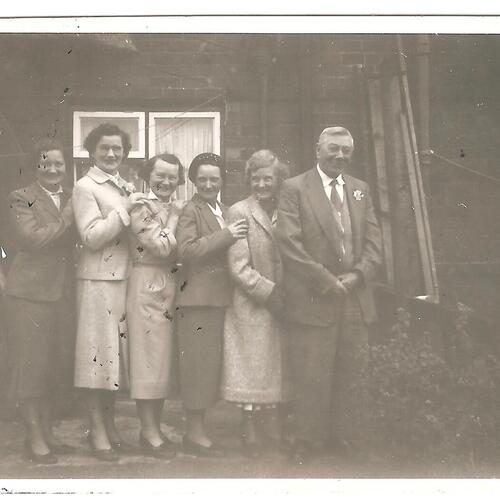
North Sedgemoor Local History Group marked its 40th anniversary in May with a ‘Somerset Day’ event at Burnham Community Centre, with the first viewing of the Bob & Winston Thomas local history archive and an exhibition exploring the area’s people, places, industry and events. Pictured: a coronation party at Highbridge in 1952.
Basildon Borough Heritage Society is a volunteer group which collects and preserves the story of Basildon’s past for future generations and is based in The Green Centre, Wat Tyler Country Park. Their collections include artefacts, photographs, historic local newspapers, mementos and memories from people of the Basildon Borough area. They hold regular exhibitions at various venues in the area as well as at The Green Centre, and give talks and walks to groups interested in local history. Their website has links to numerous downloadable articles about local figures, such as ‘Nathaniel Woodard: educationalist’ and ‘The Broadway Cinema, Pitsea, 1930–1970’. See www.basildonheritage.org.uk/basildon-its-history-and-its-people
Merton Historical Society has been advertising for a novice researcher to write a history of the society in time for its 75th anniversary in 2026. The group’s June Bulletin reported, ‘We would like to support a budding historian, who would be prepared to gather information and photos from our own Bulletins, from our website and Facebook pages, from local newspapers in the Heritage and Local Studies Centre in Morden library, from our own publications, and from our archive held in the Surrey History Centre in Woking. We would also value reminiscences by current members.’ They add that ‘the project would suit a student of any age’ and a modest remuneration would be available. If you can help, please contact mhs@merton
historicalsociety.org.uk
Various societies have been struggling recently to recruit committee members and therefore facing being wound down. In June Hatfield Local History Society emailed members to announce it was intending to disband for this reason.
Also in June, Barking and District Historical Society held its last meeting when the AGM failed to elect a new chair and officers. Outgoing chair John Blake had been in the role for 25 years. The society was founded in 1934. It will still have an online presence at Facebook (where the group’s page – see www.balh.org.uk/FYV210 – recently reached a landmark of 6,000 followers), and members in Barking were encouraged to join Chadwell Heath Historical Society (www.facebook.com/chhistorical).
Meanwhile in May the Local Population Studies Society announced a consultation on its proposal to wind up the society and its associated journal Local Population Studies in spring 2026, partly due to falling membership numbers and difficulties recruiting committee members.
Somerset & Dorset Notes & Queries (SDNQ) is a society and journal dedicated to the history of the counties of Somerset and Dorset. It has been published in an unbroken sequence since 1888, making it the oldest continuously published periodical of its kind. The group has announced that the entire run of the journal from vol. 1 (March 1888) to vol. 39 (September 2020) has now been digitised. Vols.1–30 (1888–1979) are available on FindMyPast, with vols. 31–39 (1980–2020) freely available to view at www.sdnq.org.uk. Annual subscription – for two print copies of the peer-reviewed journal – is £8. Details of SDNQ’s 2026 conference will be released soon.
The Urban History Group is holding its conference this year, on ‘The Urban Commons: Rights and Citizenship in the City from the Medieval to the Modern’, on 4–5 September at the University of Leicester. Full details via www.balh.org.uk/VRY215
Somerset and Dorset Family History Society is celebrating its 50th anniversary with its AGM and open day on Saturday 27 September at The Exchange in Sturminster Newton. Presentations will include archive film footage of everyday life in the counties. Details:
sdfhs.org
The Friends of Bradford Street (Bocking and Braintree, Essex) were formed in 1975 ‘to protect the fabric of Bradford Street, and to improve the quality of life in it for the benefit of its present and future inhabitants and the towns-people of Bocking and Braintree generally’. Over the years they have campaigned on numerous issues affecting the street and worked with the Braintree District Council, most recently to establish a separate Conservation Area covering the street. They have recently published The fulling myll commonly called Bradford Myll, by David Marsden, which provides a history of the buildings that have comprised Bradford Mill since its establishment in 1303. This has been possible because the manor of Bocking was held by the prior of Christchurch, Canterbury, and thus records relating to the original mill have survived in the Canterbury Cathedral Archives. The booklet provides details of the various owners and descriptions of the different phases of the later building. It is available for £10 + £3 p&p from dmarsden.cyclopse@btinternet.com
The Northumbrian Jacobite Society – aka The Fifteen (http://www.northumbrianjacobites.org.uk) – was founded in 2000 to promote interest particularly in the Jacobite rising of 1715. On 23–25 September it is holding a three-day programme to explore the history of the Jacobites who came through Lancashire in both 1715 and 1745; the events will include visits to Wigan, Preston, Levens Hall and
Sizergh Castle.
Archives Show more
Heritage Quay (heritagequay.org), the special collections and archive of the University of Huddersfield, has an exhibition, The Town That Taught Itself, open until the end of September, celebrating 200 years of technical and professional education in the town. In researching the exhibition, Heritage Quay has digitised the 1844–49 Register of Members of Huddersfield Mechanics’ Institute, which records around 2,800 men from the town who were members in this period. Help is sought with transcription of the data – see www.balh.org.uk/AKP213
Deptford Ragged School Archive in south-east London has a National Lottery-funded project, Educating Deptford, to create a digitised archive, exhibitions, performances and education resources for schools and local organisations and has been looking for contributors. More information at www.deptfordraggedschoolarchive.org.uk
The National Archives has announced that several new archives have received Records at Risk grants this summer, to provide support for urgent interventions to save significant physical and digital records facing immediate peril. The recipients are:
- Worcestershire Archive and Archaeology Service, which will make the factory archives of Lea & Perrins’ Worcestershire Sauce available for public research
- Hunter Archaeological Society, to digitise and archive over 2,000 archaeological reports from the Archaeological Research and Consultancy at the University of Sheffield which closed in 2009
- The Science Museum Group, for the Great North Eastern Railway Archive, Securing the fragile history of the privatised rail industry
- Explore York, to appoint the National Conservation Service to clean and repackage the records of the DeLittle Wood Type Manufactory, York, active from 1888 to 1998
Further details of these and other grant-
supported projects can be found via www.balh.org.uk/NXY214
The Preserving Local Newspaper Archives project began this year, led by former journalist Dr Rachel Matthews at Coventry University and supported by a resilience grant from The National Archives. The project is focusing on the Midlands region as a pilot study, with the aim of supporting the process of collecting, cataloguing and engaging with diverse collections relating to the provincial press. A toolkit for this will be launched at the end of the project in March 2026 and made available nationally. Further information: www.linkedin.com/company/preserving-the-local-newspaper-archive
Cheshire Archives’ new facilities in Chester and Crewe are on track for opening in 2026. In the meantime, architects Ellis Williams have created a virtual ‘fly through’ to show what they will look like inside. Watch it via www.balh.org.uk/PJT217
The Archives and Records Association (ARA) has announced that the Keeping East Lancashire in the Picture (KELP) project by Lancashire Archives has won the national ARA Archive Volunteering Award this year. KELP has brought together volunteers to make the historic photographs stored in four Lancashire libraries (and managed by Lancashire Archives) more accessible, inclusive and sustainable; 75 volunteers across four libraries, supported by a project archivist and project assistant, had given 5,489 hours of time and scanned 47,500+ images. These will be made available to people to view free via Lancashire Archives’ Red Rose Collections (edrosecollections.lancashire.gov.uk). KELP has also worked closely with eight primary schools, one secondary school and two South Asian heritage community groups to create new photographic content for the collections.
At the Community Archive and Heritage Group (CAHG)’s conference in Huddersfield in June, the winner of their Group of the Year award was announced as Our Warwickshire. The Our Warwickshire Community History website is run by Heritage & Culture Warwickshire, but at arm’s length – its focus is community involvement and engagement. The website (www.ourwarwickshire.org.uk) is both an online archive (hosting a number of images from the County Record Office and museum, along with images submitted by the Warwickshire Community) but is also an online portal to connect people with similar interests and has worked in the community to improve peoples’ digital skills and sense of wellbeing.
Museums Show more
York Castle Museum has launched an appeal for information about the city’s confectionery community. A new community-led exhibition, Sugar, Skill and Shiftwork: York’s Confectionery Workers, is set to open the museum this autumn. If you can help with stories, memories, photographs or objects, see www.yorkmuseumstrust.org.uk/community-engagement
Education Show more
The University of York announced in late June that it was closing its Centre for Lifelong Learning on 31 July. The Centre had been running for more than 40 years. A statement said: ‘This decision has been an incredibly hard one, made in response to the challenging financial climate currently facing the higher education sector. We have tried to protect this provision for as long as we can, having seen many other institutions also having to face similar difficult decisions. We have regretfully informed our current tutors and students enrolled on our evening and day courses, with offers of support and guidance on how best to take forward learning opportunities… we are truly sorry that we are no longer able to sustain this model of provision.’
A tutor at the Centre since 2011 told LHN: ‘Since teaching moved partly online, initially due to Covid, I have had the privilege of teaching students from the United States and continental Europe, as well as from across the UK. I would welcome the BALH’s view on this proposal.’
BALH is disappointed to hear of the closure of the Centre in July 2025 after 40 years of adult education provision, including numerous courses run for, and by, local historians. A fuller response will appear in the next issue.
The University of York continues to offer free online courses (www.york.ac.uk/study/moocs/) and educational activities at The Place (theplace.york.ac.uk). BALH has a partnership with online learning provider Pharos Tutors, providing two courses on local history (see www.pharostutors.com/balh).
Online news Show more
Historic England has launched its new Local Heritage Hub (historicengland.org.uk/local), which includes pages for every county, district, city, major town and national park in England, allowing users to explore aerial photos, listed buildings, archive material, videos, podcasts and local stories all in one place.
Historic Environment Scotland has been retiring some of its legacy web services. Canmore and ScotlandsPlaces were both shut down in June, with Canmore’s records of historic properties and archives now available at trove.scot instead. National Library of Scotland records formerly at ScotlandsPlaces are at nls.uk and National Records of Scotland data at scotlandspeople.gov.uk. The Scran image library is also being migrated to Trove. The National Collection of Aerial Photography (NCAP) is in the process of moving from ncap.org.uk to ncap.org.
TheGenealogist.co.uk has added more than 330,000 records of wills, covering Cornwall, Gloucestershire, the Diocese of Lincoln, East Sussex, Edinburgh, Inverness and more.
Ancestry.co.uk has released Birmingham petty session registers for 1892–1923, plus a record set of University College Hospital and Middlesex student records, 1828–1945 – and these include some records of midwives attending expectant mothers. Also recently released at the site are parish registers – scanned in colour – for Cambridgeshire and Huntingdonshire.
Findmypast and the British Library have extended their contract, meaning that the British Newspaper Library is expected to add around 70 million more pages to its digitised collections over the next five years.
The Railway Work, Life & Death website (www.railwayaccidents.port.ac.uk) has released nearly 70,000 more records of railway staff accidents in its free database. The cases cover England and Wales from 1855 to 1929. See also this issue’s Supplement for a related event.
Ulster Historical Foundation has launched A Sense of Place, a new free resource offering indexes of the Ordnance Survey Memoirs, a valuable source for 19th-century life and landscape, digitised volumes of the Place Names of Northern Ireland series, and other resources: ulsterhistoricalfoundation.com/sense-of-place/home
Wiltshire Local Network Show more
The Wiltshire Local Network, overseen by staff at the Wiltshire and Swindon History Centre, is currently going strong with over 100 members. The aim of the Network is to provide a focal point for local history enthusiasts in Wiltshire where we can come to meet, discuss, learn and share knowledge, and find out more about what’s happening local history wise around the county. In association with Wiltshire Museum, we hold meetings online four times a year.
We held our most recent study day on Saturday 10 May, the topic being Wiltshire’s garden history. We enjoyed a talk from Rosemary Pemberton, who gave us a fascinating PowerPoint tour of the 1852 garden of Colonel Baker, resident of St Anne’s, Salisbury. Nothing now remains of the garden except an ancient, listed boundary wall and some of the hothouses, which were extensive in the 19th century. We moved on to another tour, this time of The Mount, Marlborough, with Nick Baxter, learning more about its history including some very impressive sounding hedging, and the amazing views available from the top of the mound.
Draycot House was sadly lost to fire in the mid-20th century, and part of what was the estate parkland is now today’s M4 motorway. Tim Couzens helped us go back in time to see Draycot Park and Gardens in its heyday, and to find out more about the owners of the estate. Julia Mottershaw shared with us the story of Francis Faugoin, Henry Hoare’s head gardener, who worked on the gardens of Stourhead. His history was one that hadn’t been seen as being worth recording; Julia has put this right by publishing a fascinating book about him recognising the skill and value of his work.
Last but not least was Jamie Wright, who amazed us with details of the technical abilities of 18th-century garden designers in Wiltshire terms of water features, particularly how far the water could travel, along and up! Some had taken their skills into Europe.
We discovered some common threads running through the presentations which we hadn’t expected: pineapple growing and the competition to be the best at growing and collecting; plants, fruits and animals from all over the world. What vibrant, exotic places Wiltshire gardens were in the 18th and 19th centuries! Julie Davis
If you are interested in joining the Wiltshire Local History Network, please email the Wiltshire & Swindon History Centre via archives@wiltshire.gov.uk For more information visit wshc.org.uk/wiltshire-local-history-network
Good ideas to borrow… Show more
Richmond Local History Society uses Zoom to allow members at home to attend meetings. They are lucky they meet in a church which has top-of-the-range audio facilities, which makes it easy. And, where speakers give their permission, talks are recorded and then placed on the Society’s YouTube channel for anybody to enjoy. Find out more at www.youtube.com/@RLHS1985
Talks, however, need to be edited to remove the ums and the ahs. There is software available that can help with this; user-friendly options include iMovie on the Mac and Clipchamp for Windows. Simon Fowler
Victoria County History Hampshire Show more
The latest book from VCH Hampshire, Basingstoke Reinvented 1800 to 1925: from Agricultural Town to Industrial Centre, was published by Hobnob Press in June. It contains the absorbing story of the creation of engineering and clothing industries in Basingstoke after the arrival of the railway. Wallis and Steevens, a Basingstoke company, manufactured road rollers and other equipment for the national and world markets from the late 19th century, while Thornycroft produced lorries for military and civilian use. The worldwide fashion house Burberry was created by Thomas Burberry in Basingstoke from the 1850s. The book was launched at Church Cottage on Saturday 14 June (see picture, back cover). Eighty guests including Lady Portal, Dame Maria Miller and the Mayor of Basingstoke were welcomed by VCH Hampshire chair, Anna McNair Scott. The book was written by 16 members of the VCH Hampshire team, five of whom gave short talks about the book. All present had a sociable afternoon with wine and other refreshments.
This study contributes to a debate about how far manufacturing developed in southern towns after its initial establishment in the north of England and Scotland. To buy a copy (price £15.99) please visit vchhampshire.org or email contact@vchhampshire.org Jean Morrin
Letters to the editor Show more
Send your letters to: editor.lhn@balh.org.uk
Lister’s Mill remembered
I was much interested in the piece in the latest News by Malcolm and John Cowburn on Bradford’s Lister’s Mill. I was born just below it in one of the streets in fact on the map reproduced. My dad was all his working life at Lister’s, my grandfather the foreman fireman till his retirement and grandmother a velvet weaver for many years. I also published a piece in the Bradford Antiquary back in 2016 on the huge variety of social, cultural and sporting activity the mill’s staff produced.
Paul Jennings, Harrogate
Copyright question
Our society has a set of PowerPoint presentations on local history topics, usually used for shows to local groups. These incorporate news clippings and local advertisements from local newspapers, mainly from the late 19th century and from the British Newspaper Archive. We are intending to put these on our website, accessible to our members only. Will we be infringing copyright?
Richard Dyson, Keynsham & Saltford Local History Society
LHN’s editor writes: There’s no simple answer to this: 19th-century newspapers themselves are out of copyright and a recent legal ruling (see LHN150, p.32) suggests that scans of them should not attract copyright – but online gatekeepers can control access and use via contract law. The BNA also continues to claim copyright over its scans – see www.balh.org.uk/VPH216. In pragmatic terms, small clippings behind your membership wall ought to count as fair dealing for research purposes and you might decide the risk is minimal – but the risk is yours to take (or seek permission)!
BALH study day report: Placing Jane Show more
By Jane Golding & Cheryl Butler
BALH wanted to maximise the opportunity presented by the 250th anniversary of the birth of Jane Austen to invite attendees to look beyond Austen’s works and to consider how a national literary figure is deeply connected to local contexts. The study day was scheduled in May, which has been branded as Communities & Local History Month. Southampton, former home of Jane Austen, was the host venue of what was a sellout study day. The programme highlighted the value of local historians drawing from other disciplines to unlock new approaches to thinking and research to broaden perspectives by introducing fresh ideas and insights. The day’s success was shaped by the exceptional calibre of each of the speakers, who were knowledgeable, engaging and entertaining. The programme had three distinct sub-themes, explored below.
Literary Landscapes
Gillian Dow, Associate Professor of English at Southampton University, examined the role of place in Jane Austen’s fiction, reversing the perspective to consider how Austen’s works contribute to place by sustaining the literary and heritage tourism industry. While certain locations have been linked as possible inspirations within Austen’s writing, her novels do not offer detailed descriptions of places. However, through her characters’ viewpoints, we gain valuable insights into contemporary attitudes toward place and domestic spaces.
Nicola Pritchard-Pink, who has a master’s in 18th-century studies, concluded the session by examining Jane Austen’s experience of walking, as reflected in her letters and novels, alongside insights from contemporary conduct books and sketches. She explored questions such as how far Austen walked, where and when she ventured out, and her reasons for doing so. Nicola’s discussion shed light on contemporary attitudes and social expectations surrounding walking during Austen’s time.
Jane Austen Dramatised
Jo Willett, award-winning television drama producer and author, delivered a compelling account of the life and career of Sarah Siddons (1755–1831), widely regarded as Jane Austen’s favourite actor – though whether they ever met remains uncertain. Celebrated as the finest tragic actress of her time, Sarah reached the pinnacle of her career as the highest-earning performer on the London stage. Jo explored the hardships of Sarah’s early years, the gruelling realities of touring theatre companies and the prevailing prejudices against actors, especially women in the profession.
Next, and to much delight, actor Angela Barlow captivated the room with a mesmerising performance bringing Austen’s characters to life through their own words. She explored how Austen shapes her characters through their interactions, internal reflections and actions.
Letters, Journals, Household Books & Diaries
Dr Holly Day specialises in print culture and life-writing in 18th-century Britain, and presented her research on ladies’ pocket books, also known as memorandum books – annual publications designed to help women organise their daily lives. These books combined printed content with space for personal entries, offering insights into social engagements, business appointments and financial expenditures. Holly traced their evolution as a consumer product, explored how women utilised them and uncovered a fascinating connection to Jane Austen.
In the day’s final presentation, John McAleer, associate professor of history at the University of Southampton, offered a compelling account of the travels of William Henry Ridding (1786–1810), a cadet in the East India Military Service. Setting sail from Southampton aboard the Union, William embarked on a journey to Madras in pursuit of fortune and recognition. Tragically, he never returned, succumbing to illness in Madras. Through letters to his mother, Elizabeth – including journal entries written onboard ship – William’s observations and experiences shed valuable light on the broader world that shaped Jane Austen’s era.
The event organiser was Dr Cheryl Butler, a member of the BALH outreach team, who introduced the local context for each theme: Austen’s links with Southampton and the impact on her writing; her experience of theatre in Southampton and its connection with Sarah Siddons; and a review of the archive material which provided the content for the exhibition A Very Respectable Company running at Sea City Museum until the end of the year, and to which participants were invited to a private view. Dr Butler’s assessment was that every presentation was thought provoking and bought a new slant on the world in which Austen lived.
In summary, Gillian Dow’s presentation really highlighted how the ‘Austen industry’ has skewed the image of the sphere in which Austen actually lived and about which she wrote, that it was not about the huge palatial mansions – most of her characters lived in what contemporaries would call villas or Georgian vicarages. This was further highlighted by Nicola Pink with her detailed examination about the importance of walking and the countryside. The 18th century was when the importance of walking to health was being stressed. It must have been liberating for women to be out of the panniers and powdered wigs and to be able to move and climb over styles. Jo Willett’s observations about Mrs Siddons’ style and performance illustrated the difference between that and Jane’s approach to writing and yet Austen so admired her. Siddons was another woman who had to find a way to make a mark in the world and support her family. Angela Barlow gave the actor’s perspective on Austen’s characterisations. Austen’s wonderful dialogue illustrated the influence of her love of theatre, both amateur performances and professional stagings. Austen’s views on the shortcomings of the Southampton theatre must have been formed around her knowledge of theatre and performance. Angela’s presentation showed how Austen’s work so easily transitioned into stage plays, TV and film and all her adapters acknowledge they do not need to change her dialogue.
The world of pocket diaries was unveiled by Holly Day who showed how they were used as a receptacle for secrets, with personal notes and comments from their owners. It was astounding how many were produced and over such a long period. There was also the discovery that a set of surviving personal accounts of Jane Austen were actually pages from a pocket book. Those accounts… so well known and yet not known at all. Why did those pages survive? Where are the rest? Was Cassandra at work again or were the pocket books so disposable that you used them but at the end of the year you cut out the pictures, the dance moves, the enigmas and disposed of the rest? Did Jane Austen send in enigmas to be published? What was on the back of those accounts that made them worth keeping?
The day finished with the story of poor, inept William Henry Ridding, whose fleeting life was brought vividly to life by John McAleer. The poor boy was so hopeless that even with all his father’s contacts he could only just grasp that very lowest rung of the East India Company ladder. He sailed away to India as the Austens moved into Southampton; the families were known to one another and perhaps Mrs Austen and Mrs Ridding sat with the letters their sons sent from far-off spaces and exchanged bits of news and gossip.
All the papers helped people to look at Austen’s life, circle, experiences in a new way, so much food for thought. For those participants who stayed for the weekend, the Sunday programme provided guided walks of Austen’s Southampton and the links with the Royal Navy. The costumed guides brought the walks further to life with readings from contemporary letters and documents.
A short highlights video can be viewed here: https://youtu.be/Kg5WeMKt3Qg
Book reviews Show more
By Heather Falvey & Alan Crosby
Cosheston Remembered: A series of illustrated essays compiled on life in Cosheston Village, Nash & Upton, Pembrokeshire, by Cosheston Community History Project (Cosheston Community History Project 2023 186pp no ISBN) £10 plus p&p from
www.cosheston.net
This handsome book comprises over 50 essays by various members of the Cosheston Community History Project Group (CCHPG), which was formed in 2012 with the aim of having ‘a permanent reminder of earlier times before they were lost forever’. Following a brief history of the parish, an analysis of the censuses from 1841 to 1911 provides an outline of demographics, employment, migration and living conditions there in that period. Primarily a farming area, in the 19th century local industries comprised shipbuilding and a chemical works, and subsequently some locals worked at the Royal Naval Dockyard in Pembroke.
‘Places’ includes essays on the various churches and chapels, the school, shops, public houses and ‘big houses’, each different in their own way but similar to those in other communities. There was (and still is), however, one very unusual building: the Cosheston Funeral Car Tenement. Built in 1895 to reduce the cost of funerals for locals, this shelter for a hearse was funded by public subscriptions and its resident hand- or horse-drawn hearse was hand-built in 1897 by the parish council. In January 2023 it was used, for the first time in over 60 years, for the funeral of Basil James, one of the founder members of the CCHPG.
In ‘People’ the reader is introduced to many former residents, including Nicholas Adamson Roch (1816–1907), who held numerous public offices and provided land and money to build the parish’s National School; Kurt Dohrer, a German prisoner of war at a camp in Pembroke Dock, who maintained a lasting friendship with the Selby family; and Captain Edmund Glynn RN, whose letter (which criss-crosses the page) to his brother John in 1856 gives details of the village at that time.
‘Events’ covers not only those men from the parish who died in the two world wars but also recognised acts of bravery by two local men, and recreational activities in the 20th century. ‘Memories’ includes the village hall, the Women’s Institute, local traditions, cows being milked, potatoes being picked, school days and, in the 1950s, the ‘modern facilities’ of electricity and flushing toilets.
Sometimes such compilations view the past as a bygone ‘golden age’, but here in the final section, ‘Cosheston Today’, it is noted that the residents ‘realise how lucky we all are to live in such a lovely place’. The group has also compiled a leaflet of walks around the area that can be downloaded from their website (www.cosheston.net). HF
Joan Grant, It’s not Notting Hill, It’s Ladbroke Grove (the author 2024 70pp ISBN: 978-1-036901-13-4) £7.50
www.joangrantauthor.com
This booklet outlines the development of the district known as Ladbroke Grove (postcode W10), which adjoins Notting Hill (postcode W11). Part of North Kensington, it comprises four areas: Kensal, St Quentin’s, Notting Dale and Colville. Now primarily a residential area, it is crossed by the Grand Union Canal which, in the 19th century supplied coal from Newcastle to the gas works which produced ‘town gas’ to supply heat and light to homes and businesses. The latter came and went but included several laundries, motor car companies (such as Talbot) and the Pall Mall Deposit (still standing). Poor housing in the area after the First World War was transformed by the efforts of the Kensington Housing Trust and several other charitable associations, some with better results than others.
Today many people pass over Ladbroke Grove on their way in or out of London via the M4 Westway elevated section, the construction of which was thrust upon residents, many of whom had to be rehoused. Regarding health and welfare, in 1924 a birth control clinic was opened in Telford Road. In 1927 Dr Helena Wright was employed as the first doctor there and was involved in efforts to develop contraceptive devices for women.
In contrast to this pioneering doctor, some notorious men are also associated with Ladbroke Grove, such as John Christie of 10 Rillington Place, and ‘Peter’ Rachman, the unscrupulous landlord.
Migration from the Caribbean was a controversial political issue from the late 1940s onwards. North Kensington was one of the areas in which Caribbean migrants settled and provocatively it was also where Oswald Mosley established the office of his Union Movement. The author describes the race riots of 1958 and the shocking (unresolved) murder of Kelso Cochrane in May 1959, and explains that ‘However one looks at it, the Notting Hill Carnival grew out of the experiences of the black community this area in the late 1950s’. As is often the way, it was women (first Claudia Jones and then Ruane Laslett) who were determined to bring the various groups together, here in celebration of their heritage. In her booklet Joan Grant has brought to life people involved in the history of Ladbroke Grove, which is separate from, but closely linked with, neighbouring Notting Hill. HF
Robert Parkin, Memories of the New Merton Board Mills 1964–1976 (Merton Historical Society 2024 26pp ISBN 978-1-903899-86-1)
£2 + £1 p&p
Irene Burroughs, The Physic Gardens of Mitcham: Mitcham’s medicinal plant heritage (Merton Historical Society 2024 47pp ISBN 978-1-903899-87-8) £5 + £1 p&p
Merton Historical Society (MHS) has published numerous booklets of varying length and style on historical aspects of the ancient parishes of Merton, Mitcham and Morden, formerly in Surrey, now in the London borough of Merton.
In Memories of the New Merton Board Mills 1964–1976, Robert Parkin recalls his years working in those paper and board mills, having joined as an apprentice, aged 17. As well as describing his working days (and nights) ‒ there was a three-shift system from Monday to Sunday to keep the necessary processes running – he also outlines those processes and provides a glossary of terms. He comes across as a young man willing to learn, so that he could be employed in various areas of the mills, and ‘making himself available’; thus, after a year or so, he had made up his mind to ‘get ahead in the industry’.
The opportunity to do so arose when a vacancy for a ‘relief’ arose. Each shift had two reliefs to cover colleagues taking their rest days, ensuring most areas of production were maintained and covered during each shift. This meant that reliefs were able to work in the different areas of the mills, so Parkin could then see how other departments operated. He got to know the various shift managers and foremen and gradually moved up through the company, moving on elsewhere in 1976.
Two things struck me about his descriptions of working the huge machines in those fibreboard mills: firstly, the potential for industrial accidents (he does refer to some on pp. 20–21), and secondly, how much of the work would be automated now. The mills closed in the 1980s and no trace of them remains, but they live on here in Parkin’s memories and the photographs that accompany them.
This is a model publication: in addition to reviving the more distant past through documentary evidence, it is important for local history societies to capture the recent past before it disappears, and so oral histories or written memories such as Robert Parkin’s are vital.
Irene Burroughs’ booklet The Physic Gardens of Mitcham: Mitcham’s medicinal plant heritage originated in a display which she produced for the Merton Heritage Centre in April/May 2024; thus it reproduces a series of title pages/boards with associated pictures and a brief explanatory text. Since ancient times certain plants have been cultivated for their medicinal properties, and, as Burroughs explains, these useful plants became known as herbs. In England herb gardens were a feature of monastic grounds but they were also cultivated domestically. By the 18th century medicinal plants began to be cultivated on a commercial basis – and Surrey was important in this new development; indeed ‘One of the most renowned areas for growing herbs was along the River Wandle and particularly Mitcham’. Peppermint was dominant in the area until the early 19th century and then lavender took over. The quality of Mitcham’s soil was such that its lavender had an individual perfume.
Several large physic gardens which flourished in Mitcham in the 19th century are depicted and described and the different roles of local workers – men, women and children – are explained. Beautiful advertising material for the various herbs has been reproduced, together with details of their particular properties. Some of the plants were distilled for their oil, such as lavender, mint and roses, so they went through a drying process (there is a fascinating contemporary drawing of this).
Herb growing in Mitcham probably peaked in the 1880s: the ‘march’ of suburbia combined with bad harvests and pests caused its subsequent decline. The physic gardens have been commemorated over the years, primarily for their lavender, which still appears on the coat of arms of the London Borough of Merton (although ironically the variety shown is French, not English). This booklet keeps the memory alive too. HF
Arthur G Credland, John Ward (1798–1849) Master Painter: Marine Artist of Hull (East Yorkshire Local History Society no. 68 2025 88pp ISBN: 978-0-900349-68-3) £9 + £3 p&p
The East Yorkshire Local History Society celebrates its 75th year with this publication about John Ward, marine artist of Hull. The main text covers Ward’s career and works, and there are several appendices including lists of his exhibits at various institutions, a transcript of the sale of the contents of his studio (prints and paintings) on 3 February 1853, and details of public exhibitions at Hull. Following a description of the work of earlier marine painters in Hull, Ward’s career as an artist is outlined, although very little is known about his life. He was apprenticed to Thomas Meggitt, a house and ship painter, whose extensive business included gilding, japanning and interior decoration. Others in that workshop also became marine painters, but lacked Ward’s flair. There is no evidence that Meggitt was an artist; Credland suggests that any specific training that his apprentices received was from Robert Willoughby or a peripatetic artist visiting the town. Ward completed his apprenticeship and by his twenties he seems to have established his credentials with the master mariners, ship owners and merchants on whom he depended for commissions.
The formation of the Hull and East Riding Institution for the Promotion of the Fine Arts was a key development in the local appreciation of the arts. Ward contributed to the Institution’s exhibitions. He was also a subscriber to the Mechanics Institute (founded in 1825) and probably gave instruction in drawing at the Institute, both relating to his knowledge of ships and his experience in signwriting. His first datable painting is from 1821. Only 40 canvases can be identified as commissions, which were ship portraits purchased by the owner or master. Ward was also actively involved in the preparation of material which would be lithographed for assembly into a manual of marine painting. A prospectus was published in January 1843, but the enterprise was incomplete at the time of his death in the cholera epidemic of 1849; nevertheless, a large collection of these lithographs survives in the Hull Maritime Museum, together with numerous watercolour studies for the manual.
While these pictures provide beautifully executed studies of the ships of the time, the background of many of Ward’s individual paintings convey scenes of Hull’s waterfront during the period. There are also several ‘whaling paintings’ depicting ships in the Arctic. The newspaper notice of the sale of his studio contents stated that ‘his productions have been duly appreciated and admired by some of the highest officers in the navy and judges of high standing’. The excellent reproductions here of many of Ward’s paintings and drawings display his skill. HF
A Wedgwood Diary 1897–1903: A story of real life in Arnold Bennett’s ‘Bursley’, edited and with introduction by Paul Anderton (Clayhanger Press 2025 126pp
ISBN 978-1-917017-10-7) £12.95
www.clayhangerpress.co.uk
Paul Anderton, the editor of this book, died in April 2025. He was a very good friend and a great local historian, spending most of his working life in North Staffordshire and contributing tremendously with time, knowledge, understanding, enthusiasm, imagination and organisational skills to the flourishing local history culture and community of the area which he adopted as his own decades ago (he was originally from Halifax). Relishing academic argument, and with a powerful sense of honesty, fairness and justice, he was a committee social historian of the ‘common man’, and this estimable trait is exemplified by his last published work, the present book.
Naturally, the name ‘Wedgwood’ in the context of Stoke-on-Trent conjures up only one image – that of the great Josiah and his pottery empire. But, as the dates indicate, he is not the subject of this diary. Instead, it is the work of Josiphiah Wedgwood, carver and gilder (for example, of picture frames) who was born in 1818 and died in 1911. The diary covers rather less than six years of that very long life. It is in private hands, having been discovered by a friend among the papers of her deceased mother. The discoverer encouraged Paul to transcribe and edit the volume and, seeing its historical interest, he did so. One of the great strengths of the diary is that its author was just ‘an ordinary man’, who records often mundane activities and did not participate in then great events of the time or meet nationally known figures.
Or did he? Josiphiah’s life overlapped with that of Arnold Bennett, then perhaps the best-known English novelist, whose works on the Five Towns fixed an image of the conurbation and its people in the minds of readers and more widely. Fiction was becoming reality in the perceptions of many people. In his detailed introductory sections, Paul Anderton challenges some of the assumptions that have been made about Bennett’s depiction of the Potteries, and suggests that the diary tells of a real-life figure in contrast to Bennett’s fictional characters. He provides a lengthy account of Wedgwood’s family background and circumstances, working life and retirement, and domestic condition, so that we can place the diarist firmly in social and economic context. There is no evidence that Josiphiah ever met Arnold but, as Paul points out, they had many acquaintances in common.
This is a modest diary. It only covers a few years, towards the end of its author’s life, and it was not kept every day. Much of it is in the form of loosely dated summings-up. And as with just about every diary, there are subjects it does not address which we would dearly like to know more about. It is, however, an authentic first-hand account of daily life in a teeming industrial area at the turn of the 20th century, by someone who was neither well known at the time nor famous in retrospect. It has been skilfully edited with a thoughtful and thought-provoking introduction by a historian who was familiar both with the historical issues and arguments and with the period and place. Paul Anderton’s last work was fully up to his well-established standard. AC
Books for review should be sent to: Dr Heather Falvey, 119 Winton Drive, Croxley Green, Rickmansworth WD3 3QS – or contact her via reviews.editor@balh.org.uk
On the BALH website: As well as articles here in LHN and in The Local Historian, BALH publishes a wide variety of fascinating articles at its blog, www.balh.org.uk/blog – and don’t forget to watch our ten-minute talks at www.balh.org.uk/ten-minute-talks. In the latest one, Sally Kavanagh explores the legal disputes of a 17th-century family on the Isle of Wight. You can also listen to the Local History Matters podcast at www.balh.org.uk/podcast – in a recent episode, Hannah-Rose Murray discusses black American activism in 19th-century Britain and Ireland.
Holding a mirror up to our nature? Show more
By Alan Crosby
Local historians rarely appear in fiction (and certainly never make an appearance in drama), but when they do they take a (invariably) minor role in the narrative. The enthusiastic amateur detective needs to know whether there is a secret passage connecting the big house with the ruins of the monastery down in the valley, perhaps is baffled by the mysterious heraldic device written in ink on the victim’s chest but also seen in the stained glass window of the medieval church. The police, obviously, have not even thought about these vital questions, and even the heroic detective is unsure. The solution therefore lies in calling upon the knowledge of the local historian.
How they find him (for it is normally a ‘him’) is unclear. Do they reach for a handy copy of Yellow Pages and scan the lengthy list of names and addresses (and impressive letters after the names) under the heading HISTORIAN, Local. Or do they go to the library (everywhere has a library and it’s always open) and ask the librarian. She (for it is normally a ‘she’) will either have a severe hairstyle and a no less severe and disapproving expression, or she will be flustered, twittery and with a tendency to drop books and papers. But whether strict and censorious, or confused and disorganised, the librarian will know who the local historian is. There is only one of them, and she knows exactly where to find him and all about him.
The local historian is a middle-aged man. He is also a monomaniac and a terrible bore. His specialism is, let us say, the architrave moulding in the Lady Chapel, or the descent of the manor from the 13th to the 18th centuries. It’s never the prevalence of cholera in the town during the 1830s and 1840s, or the archaeology of the local coal industry, because (though we are not told this) the local historian is actually an antiquary (a concept too obscure and esoteric for the reader to grasp, or – more probably – unknown to the author). But whatever his specialism, the local historian knows exactly where to find the answer. Sometimes it’s in his own head – he knows about the secret passage because a precious piece of ancient lore has been passed down to him from previous generations of local historians, hereditary holders of the Great Secret).
Alternatively, he goes to his library and pulls an ancient leather-bound volume from the shelf (it’s an antiquarian history published in 1785). He knows exactly where to find the description of the alleged secret passage or the explanation of the heraldic device. And lo! with this invaluable information the enthusiastic amateur detective can put two and two together and the mystery is solved. The mysterious nocturnal goings-on in the ruined abbey or the subversive society with the heraldic symbol – all is made clear and the guilty are brought to justice ... though my money’s on the local historian himself, who oh-so-conveniently happens to be in possession of the vital knowledge.
Of course, we all know that in the real world the enthusiastic amateur detective would have gone to the local record office and talked to the archivist. The archivist would be a man of rather more than middle age. He (he’s always a ‘he’) would be stooping, with lank and thinning and over-long grey hair. He would be wearing an ancient tweed jacket with leather patches sewn into the elbows. When asked a question about the secret passage he’d instantly know exactly which document held the key. It would inevitably be ‘dusty’ and written on ‘vellum’ in a ‘crabbed hand’, but whoever wrote it in the unspecific past had given precisely the information that P.I. Detective needed. He’d leave the archive, and the archivist, a sinister smile twisting his thin lips, would watch him depart, before picking up the phone…
O wad some Pow’r the giftie gie us
To see oursels as ithers see us!
It wad frae mony a blunder free us,
An’ foolish notion:
What airs in dress an’ gait wad lea’e us,
An’ ev’n devotion!
(Oh, would some Power the gift give us / To see ourselves as others see us! / It would from many a blunder free us, / And foolish notion: /
What airs in dress and gait would leave us, /
And even devotion!)
BALH Outreach Team news Show more
By Joe Saunders
So far in 2025 BALH has been busy. We have run lectures in partnership with the Historic Towns Trust on Perth, Bradford, Ripon and Chester as well as talks on an American heiress in the Gilded Age and on heraldry. We have also held an online event with Historic England introducing the Local Heritage Hub, a digital hub that re-presents Historic England’s existing data and content to more localised communities nationwide; and our AGM, which was accompanied by a talk on Writing the Local History of the British Civil Wars by BALH President Professor Jackie Eales.
Since the last News we are pleased to report the success of Placing Jane – National Figures, Local Context, a conference in Southampton, as part of the Jane Austen 250 programme and Local and Community History Month. This sold-out event was an excellent gathering of local history discussing people and themes relating to Jane Austen’s life and times. A huge thank you to Dr Cheryl Butler for masterminding this event, to our team of volunteers and our Outreach Coordinator Stephen Miller for their assistance and of course to our excellent speakers for making this such a fantastic event. For a full report see page 26.
Our events will pause over the summer. We will be resuming in the autumn with a range of online talks and an in-person event, including the following.
On 11 October join us for Crossing Counties: Transport History in Herts, Beds and Bucks, a one-day conference exploring coaching inns, canals, airships, archaeology and buses. A rich journey through local transport history hosted by BALH in partnership with Bedfordshire and Hertfordshire Local History Associations. We are very pleased to be hosting this event, with thanks to our partners in Beds and Herts for all their assistance. Especial thanks to our Trustee and Membership Secretary Jonathan Mackman for bringing this all together. See more in the supplement with this issue and here: www.balh.org.uk/beds25
In October and November join us for a range of online talks of relevance to your local history studies including on the campaign to secure Votes for Women, on researching the landed gentry in Britain and the Caribbean and on a stonemason’s sense of the history of the British Isles. These are all talks we are very excited to host. A huge thanks to our Outreach volunteer and trustee Lisbet Sherlock for all her work organising them.
In December we are pleased to be hosting our annual Dymond Lecture which will be given by Dr Mike Esbester of the Railway Work, Life & Death project. See elsewhere in this issue for more.
For more on our events for 2025–6, see the supplement with this issue and keep an eye on our website for the latest information: www.balh.org.uk/balh-events
The BALH blog continues to draw in excellent research as does our popular series of online ‘Ten-Minute Talks’. We are always looking for new blogs and videos so please get in touch if you would like to share your local history research with a wide audience. We continue to be particularly looking to share ideas on ‘doing’ local history from researching to running a society. Get in touch with the Digital Team with your idea: digitalteam@balh.org.uk
We hope you enjoy the range of events and projects BALH is involved in and the materials we work to bring you as members. BALH is always looking to arrange more talks, attend more events and run more projects but requires volunteer assistance to do this (see opposite).
Notes News Issues Show more
By The BALH team
CORRECTION
Our apologies for inadvertently advertising the upcoming Crossing Counties event (11 October) as being in Taunton, given that it covers the history of transport in… Herts, Beds and Bucks. The correct venue is Barton-le-Clay Village Hall – for further details see this issue’s Supplement.
Helping local historians
BALH aims to advise and inspire local historians. To do this we share excellent research from which you can take encouragement, we inform you of events and new books and offer support in the process of doing your local history through our website, publications and events. It is in this vein that we are asking readers to help us help others with their local history. You possess a wealth of knowledge about the practicalities of local history, whether this is researching, writing, giving talks, publishing, teaching, running societies and more.
Please do get in touch if you feel you can share some of your knowledge with us in either a short, written piece for Local History News (please send your proposal to Andrew Chapman, editor.lhn@balh.org.uk), our blog and/or a recorded ten-minute talk (contact Joe Saunders, joseph6.saunders@hotmail.com).
Could BALH attend your event?
BALH attends as many events as possible but we can only do so if we are aware of them. Please get in touch with our Outreach Coordinator Stephen Miller if you are running an event and would like us to attend: outreach@balh.org.uk. We also have a stock of fliers and pencils which can be sent out. If you are interested in receiving some of these to give away then please also get in touch with Stephen. With your help we can grow awareness of the Association.
BALH publications: your group can benefit
A reminder that we offer copies of BALH publications at a generous discount for resale by member societies, if ordered in multiples of five or more. We are keen that these should also be available for sale in archive offices and museums. Please contact John Chandler, chair of the Publications Committee, for further information: jh.chandler@hotmail.com.
Ask BALH
Remember, if you have questions about local history research or any aspect of running a local history society, do send them to our ‘Ask BALH’ feature via editor.lhn@balh.org.uk and we will aim to provide answers.
Next copy deadline
The next issue of Local History News will be out towards the end of November – please note the copy deadline for that issue (No. 157) is 1 October. If you wish to promote a society event here, it must not be before December – for earlier events, which we may be able to list at www.balh.org.uk/events, contact the BALH Digital Manager, digital
New Outreach volunteers needed Show more
BALH’s Outreach Team requires new volunteers. This small team works remotely to help undertake the work of the Association and is a rewarding opportunity to contribute to the work of BALH. The role entails assisting with the organisation and running of events, education and other outreach activities. The role includes some capacity to influence the work of the Association.
The role can be what you make of it but will likely entail a couple of hours’ work a month. Experience in a similar role is preferred but we are keen to hear from anyone passionate about local history and a knowledge of how to engage others.
Please contact current chair Joe Saunders for further information. Joseph6.saunders@outlook.com