Local History News Number 88 Summer 2008
Contents
Poor Pisa Show more
POOR PISA
In May I was in Pisa, one of several towns and villages visited on a study tour of medieval Tuscany. I was the guide, leading my students along narrow streets smelling faintly of drains in the way that is so redolent of Italy, explaining the origins and development of a sequence of wonderful buildings, talking about the nature of society and politics, discussing the relationship between townspeople and country dwellers in the city republics of the twelfth and thirteenth centuries, and trying to disentangle the labyrinthine power politics of the incessant wars between Florence, Siena, Pisa, San Gimignano, Lucca and their numerous friends, enemies and neighbours. Siena was beautiful as it always is, crowded but elegant and sophisticated. San Gimignano was touristy but that does not spoil its magic, and the lovely landscapes around are a delight. Lucca was conservative, gracious, mysterious, less forthcoming—more tourists than on previous visits, but not spoiled in any way. ‘I could live here’, one of the students said, and I understood the sentiment.
But Pisa? Ah, alas, poor Pisa. How to explain the localhistory of somewhere which has one of the world’s iconic buildings, one of the top ten most recognisable structures on this earth? Is it really possible to talk about the successive city walls, the impact of the Medici conquest in the fifteenth century, the struggle for national security of the once-glorious Republic of Pisa, the changing course of the Arno, the location of the merchant palaces, the discovery of the Roman harbour complete with ships … when everyone’s mind must surely be on the Torre Pendente and what stops it from falling over? I sometimes wish, heretically, that it would fall over, and then Pisa would become an erstwhile top ten town (bad news for its economy, mind you). In truth, Pisa is pretty horrible—pretty and horrible, perhaps—and it’s ruined by tourism and its reputation. From the pickpockets and drug addicts around the railway station, to the overpriced restaurants selling poor quality food, to the teeming crowds in the Campo dei Miracoli, pretending (for the cameras of friends and loved ones) to hold up the leaning tower, or buying luminous models of the leaning tower, or purchasing scarves made in Taiwan imprinted with its garish image, Pisa is wrecked by that which is its lifeblood and its claim to fame.
Imagine it without the setpiece of four wonderful buildings which is the only thing that tourists come to see, as coaches disgorge their loads and a human flood pours through the gates in the old city wall. Without the buildings? Impossible … but that almost happened. In 1944 the Allies subjected the city to heavy air raids, attacking the retreating Germans. It’s a major railway junction, so the station was one target, but many bombs fell on the city centre. Stand on the Ponte di Mezzo and look up and down the magnificent riverside, and you see modern concrete buildings filling gaps in the line of seventeenth and eighteenth century palaces. Some incendiaries fell on the roof of the Campo Santo, the exquisite thirteenth century cloister cemetery north of the cathedral, setting it ablaze. The building, with its priceless frescoes, was almost destroyed. It’s been beautifully restored and is a haven of peace and calm and cool shade on a hot day—one of my favourite buildings anywhere. Other bombs just missed the leaning tower and the great cathedral. It’s not an episode in ‘our’ war which we hear much about, but only by a miracle was the Field of Miracles saved. So Pisa, ever after, suffers the burden and reaps the benefits of celebrity.
It is, in reality, a rather attractive place beneath the tawdry veneer, but it’s hard to strip that surface layer away, to realise that it’s a working city of a quarter of a million people, going about their daily business, having coffee, filing the paperwork, pattering away at computers, walking the dog, sometimes going to church. It has an extraordinarily long and complex history, a fascinating architectural heritage apart from the Big Four, a lively cultural and intellectual community … but all that is usually forgotten by the visitor. Like Oxford, like Stratford, like so many other celebrity places, its fame is a millstone, a curse as well as a blessing. I’d like to love it but I can’t. I’m sorry for Pisa. But it won’t stop me going there again, of course.
Association Of Local History Tutors Show more
ASSOCIATION OF LOCAL HISTORY TUTORS
The Association of Local History Tutors was established in 1981 and, as its name suggests, was intended to enable teachers of local history in further, continuing and higher education to explore matters of common concern and, among much else, to share information about courses, syllabuses and teaching techniques. In those days local history courses were growing in number, continuing education was flourishing, and there was a very active interest in the provision of local history courses in many universities and colleges. To further its objectives the ALHT has distributed a regular newsletter, held a wide range of meetings and day courses on topics relevant to tutors and teachers, and has recently created a website. Its members have especially appreciated its annual tutors’ conferences which have taken place in different parts of the British Isles—most recently in Reading and Exmoor—which have involved a magic combination of visits and exploration of localities, discussion and papers on the practice of local history, and a very warm and friendly atmosphere.
However, partly because of the reduction in the number of ‘liberal adult education’ courses in post-compulsory education over the last few years, and also because universities and colleges have relied ever more heavily on part time staff, the ALHT has recently experienced a fall in membership since its peak in the late 1990s. This means that its ability to further its aims has been compromised, while it has also been widely felt that the threats to, and pressures upon, local history in continuing education and related areas mean that a single voice for the subject is very desirable. The committee of ALHT has therefore been investigating, the possibility of following the example of the Conference of Regional and Local Historians (CORAL) and amalgamating with BALH. In March this year, recognising the great importance of the common interests of ALHT and BALH in the field of local history, the Council of BALH warmly welcomed these proposals and agreed that, in the event of ALHT making this decision, BALH would review its committee structures to take into account ALHT’s particular concerns and interests. It would also grant free BALH membership to those in ALHT who were not already members of BALH, including two issues of The Local Historian and Local History News, until January 2009.
In the light of these assurances, at its AGM at Dunster on 19 April 2008 ALHT unanimously resolved to disband and to join forces with BALH, after the necessary formal procedures have been agreed and the details of the proposal have been accepted by the Charity Commissioners. For its part BALH is delighted to welcome these new members, who represent a new source of strength for our organisation, and looks forward in the future to taking advantage of their expertise in the provision of regional conferences in particular and in the promotion of local history in post compulsory education more generally. By the end of this year BALH will have merged with the two other major national societies in the field of local history teaching—ALHT and CORAL—so that our combined voice will be much more authoritative, and the enlarged organisation will have greater resources to campaign for, and develop, local history in Britain. We are all encouraged by this prospect, and determined to meet the challenges of the future from a new position of greater strength.
Vch Hampshire (finished 1912 ...) Show more
VCH HAMPSHIRE (FINISHED 1912 ...)
The VCH began in 1899 and in the initial enthusiasm a handful of counties were completed very quickly: five before the First World War. One of these was Hampshire and the Isle of Wight, completed in five volumes in 1912. The series is still widely consulted – the four volumes available in digital form on British History Online attracted 85,000 page views during 2007.
Over the past eighteen months work has resumed in Hampshire with the longer term intention of producing a new red book series, and in the shorter term of writing the parish history sections which were only very briefly undertaken in the early days, including economic and social history, local government, public services, religious life, and buildings. The initial study area is based on Basingstoke. The initiative came originally from the University of Winchester, where Professor Michael Hicks, himself a VCH old boy from many years ago, was able to secure some seed corn funding to enable work to commence. The Basingstoke area was chosen because the university has recently opened a study centre at Chute House in the town.
The new work builds on lessons learned by the VCH from its HLF-funded project England’s Past for Everyone. The team leader is Dr Jean Morrin, who is working from the University of Winchester two days a week on the project. She has gathered together over thirty volunteers, to work on various aspects of the new histories, under her overall guidance. The volunteers meet regularly at Chute House, Basingstoke, where they have been offered training sessions on, for example, researching and note taking for the VCH, and reading sixteenth and seventeenth century wills and inventories. Jean describes them as being ‘enthusiastic about local history and keen to acquire new skills’, including reading the landscape and buildings, which they have done through a series of summer walks in the study area villages – usually ending up with a pub lunch!
The project is initially funded to run for two years, and it not only enables the VCH to revisit a county which has been off its radar for many years, but to ask questions about how to update earlier work (especially where there is another century of history and an awful lot more documents available) and to apply the lessons of EPE to the VCH. It is an exciting new venture for us all.
94 Not Out Show more
94 NOT OUT
There were two ‘firsts’ when we welcomed Ken Powls to Local History Day at Friends House in June 2008. We’ve never before given a BALH Award for personal achievement to someone in their nineties, nor has anyone come with four generations of their family to witness the presentation.
Ken Powls has lived and worked in the same area of East Yorkshire all his life. He was born in the historic market town of Howden where his family had been established for centuries. (Readers will have become familiar with the town during the recent by-election.) Ken attended Howden Grammar School (which closed in 1925), then Goole Grammar School, and spent his working life in social services, beginning as a Relieving Officer under the Poor Law, and ending as Area Manager. He was awarded an MBE on retirement.
Since then Ken has pursued his passionate interest in the history of Howden and the surrounding area. Of course he has accumulated a vast store of personal memories, but has also undertaken detailed research in a wide range of documents. He has developed a register of Howden’s properties and their past owners, and has worked particularly on the town’s retail and manufacturing activities in the nineteenth century. The diversity of Ken’s interests is demonstrated by another of his specialisms - the role of successive Bishops of Durham in shaping the Minster, and their palace and its associated grounds.
Over the years Ken has shared his knowledge and enthusiasm widely. His lectures to Howden Civic Society and his contributions to WEA classes have introduced many other people to the pleasures of local history. He has written countless articles on many aspects of Howden history. Some of the earliest were based on his experiences as a Relieving Officer, a job which revealed much about local communities, published in the Civic Society Newsletter. Howden: an East Riding Market Town, co-authored with Susan Butler, was published in 1994 and provides an authoritative modern history of the area from Anglo-Saxon times to the beginning of the 20thcentury. This was followed by Howden: the Untold Storywhich filled some gaps in the previous volume. In particular Ken developed the information on church activities, based on the burial books kept by his great-great-grandmother who was sextoness from 1783, and his grandfather, sexton from 1860. Aspects of Howden: Researching Howden’s History is a collection of previously published articles, and Ken now has a new book under way based on his extensive store of lecture notes.
As one of his referees put it: ‘Ken is what every local community needs’.
Prepared with thanks to Roger Watkins, David Neave, Bernard Nield, Ken Powls and Ron Powls
People Show more
PEOPLE
Congratulations to Dr Margaret Bonney, the editor ofThe Local Historian until the end of 2001. She has recently been appointed county archivist of Leicestershire, Leicester and Rutland. It is good to know that long experience s a local historian is a useful asset in the archive profession as well!
Congratulations also go to Professor Christopher Dyer, Director of the Centre for English Local History at the University of Leicester. Professor Dyer was awarded a CBE for ‘services to scholarship’ in the recent Queen’s Birthday Honours List. He is leading the planning for a major conference next summer organised by the Centre in collaboration with BALH to mark the 50th anniversary of the publication of W G Hoskins’ Local History in England.
We have been saddened by the news of the death in May of Dr John Marshall, aged 91. John was one of the founders of CORAL - the Conference of Regional and Local Historians, the founder and first director of the Centre for North West Regional Studies at Lancaster University, and a nationally-known local and regional historian. He first contributed to The Amateur Historian(the predecessor of The Local Historian) in 1958 and over the years wrote many articles and shorter contributions. An appreciation of John's life and work will appear in a future issue of the Local Historian.
Treasure Or Junk? Show more
TREASURE OR JUNK?
Sharing ideas, passing on information, and offering advice and encouragement are keys ways which people in local history contribute to its development. These essential tasks are performed by many recipients of BALH awards for personal achievement, and Andrew Underwood is no exception. His encyclopaedic knowledge of the history of Ampthill in Bedfordshire has provided inspiration and guidance to new historians, and he has helped instil a love of history in its residents; he was a prime mover in the establishment of Ampthill History Forum.
Because he was unable to join us at Friends House in June to receive his scroll in person, Andrew wrote to me about his early interest in local history and the people who encouraged him. Some of the fascinating detail therein is reproduced here, and in doing so we meet some other characters of local history in the mid-twentieth century.
‘My Ampthill collection began 65 years ago, on 24 March 1944, a few weeks short of my tenth birthday, on receipt of three pictures of the regicide John Okey (who had signed Charles I’s death warrant) from family friend Gordon Tibbutt, Record Officer at the Ministry of Defence, and supreme expert on Bedfordshire Nonconformity. ‘Uncle Gordon’ was researching Colonel Okey for Bedfordshire Historical Record Society Volume 35 1955, so I was introduced to the ways of modern archive research and presentation at an early age – from note-taking, typing up, filing, card indexing, to pasting up and proof reading the galley-proofs for several volumes for which he was responsible. He saw that I joined BHRS and attended its AGM – for some years by far the youngest person present.
It was Gordon Tibbutt who introduced me to Walter Henman, whose cottage was crammed with Bedfordiana. Following his death in 1956 I was able to purchase his copies of the Beds Mercury 1858 to 1896 for £3! My father disapproved of my raiding my savings account for ‘a load of old newspapers’, but lived long enough to appreciate what a wise investment it had been.
In those days Ampthill’s resident local historian was Miss George, a scholarly lady with everything carefully handwritten on foolscap paper. I don’t think she would have been happy with a typewriter! I remember her riding a bicycle, but her efforts at driving a bull-nosed Morris car were before my time.
Over the years I acquired a collection of interesting objects which I used to pass round at talks. On one occasion, at Ampthill WI, a colleague teacher who had once taught me was in the front row. Mrs ‘Maggie’ Miles had visited me at home, and wheezed to her neighbourHave you ever been into his room? Full of old junk, full of it. But one person’s junk is another’s treasure.’
Mr Underwood has written numerous articles and a considerable list of books. These include Home Rule for Ampthill (Ampthill UDC 1894 -1973), Ampthill a Goodly Heritage, 17th Century Ampthill and Hugh Reeve, and his family history Ampthill In My Bones. His history of the parish church, St Andrews’s, has gone through many editions between the 1950s and 2007. Both a pupil and member of staff at Bedford Modern School, Andrew was appointed the school’s first archivist in 1972, and in that capacity he was responsible for the preservation and cataloguing of thousands of documents and photographs, and for creating a list of every pupil known to have attended the school from the 1820s! In 1981 his history of the school was published entitled Bedford Modern School of the Black and Red. It is considered a model of how such books should be written, and is due to be re-issued by the school in September 2009, brought up to date under Richard Wildman’s direction.
Andrew Underwood’s extensive collection of material relating to Ampthill, which includes glass plate negatives, press photographs, newspaper articles, promotional leaflets, personal memories, and much more, has always been meticulously catalogued, and is now deposited in the County Record Office and Bedford Museum for the benefit of future generations.
With thanks to Andrew Underwood, Barry Dackombe, Richard Wildman, and James Collett-White
Latin For Local Historians Show more
LATIN FOR LOCAL HISTORIANS
At Local History Day, many members will have had the opportunity to buy the publications of The Latin Project, York, at its bookstall run by Ann Rycraft. The most recent publication is Before the Merchant Adventurers: the accounts of the Fraternity of Jesus and Mary (2007). These comprise the earliest account rolls of the religious fraternity which became the Company of the Merchant Adventurers of the City of York, whose impressive Hall still stands. The accounts begin in 1357 and deal with payments, loans and gifts to the fraternity. A later account (1366/7) gives details of expenditure on the hall and other buildings, as the Introduction notes. This publication is an excellent model of how to transcribe, edit and present Latin records and make them more widely known and available for the use of local historians and medievalists. The editors have given comprehensive and clear footnotes which, as they say, provide enough information to enable those with some basic Latin to read and use the documents. Some medieval accounts have a simple format, as here, which does not require a full English translation. However the editors of the York accounts have given a translation as necessary, for example, of some of the longer and more complex entries. There is also a photo of one of the parchment rolls which gives an idea of the palaeographical and linguistic challenges of working with the original material.
At Local History Day, some members of BALH discussed with Ann Rycraft the difficulties of finding a course in their locality or region where they could learn to read the Latin of historical documents. Members of the BALH Council, management and education committees are aware that such courses are not always widely available but we can offer some suggestions. Some further or adult education colleges offer GSCE Latin to adult students, although this will be classical Latin. If you want to learn Latin for medieval or early-modern historical sources, you can start by identifying a university or college in your region or locality which still offers local history courses. Dr Kate Tiller, of the BALH Education Committee, has recently researched this and an up-to date listing is forthcoming; it will be available from the UALL with a link from the BALH website. Then you can enquire if Latin is taught: this is often done in conjunction with palaeography. At the University of York medieval Latin classes are available for those enrolled for a higher degree at the Centre for Medieval Studies, though other graduates may be admitted by arrangement. Remember that some universities offer courses not just on their main campus but on other sites. The University of Kent offers a module on Latin as part of its MA in Medieval and Tudor Studies, which can be taken part-time or full-time. Palaeography and Latin at beginner’s level are taught by Dr Gill Draper as part of Kent’s Certificate in Combined Studies. This year her courses are available at the Tonbridge campus and Ashford Adult Education Centre, Kent (details in Local History News, no. 87, Spring 2008, p. 27, or from development.balh@btinternet.com). There are other possibilities for those who do not want a term-time course. Keele University runs a residential summer school. The National Archives offers an online Latin course which makes a good starting point, and they have recently added a more advanced course. Try your local U3A, Latin has been available in Salisbury for example. Your nearest record office will tell you of any other courses it knows of in the area. Shropshire Archives is offering ‘Introducing Medieval Latin’ this Autumn. If translating a particular document is impeding your research, you could pay a specialist to do it for you, again via the record office. A useful and economical self-help book is Discovering Old Handwriting by J. Barrett and D. Iredale (Shire Publications, 2001). The classic reference book is by E. Gooder, Latin for Local History: an introduction (2nd edition, Longman, 1978).
The Latin Project started life as a beginners’ Latin class organised by the York WEA from which it continued to receive encouragement and support, though it is now accommodated by the Centre for Medieval Studies, University of York. The composition of the group changes from project to project. There are many developments in adult and higher education at the moment which do affect the provision of local history courses, and BALH has responded to a government consultation on these changes. Yet if there is demand from local historians to learn necessary technical skills such as Latin, organisations such as colleges, universities, the WEA and the U3A will run courses. This is most likely to happen where a group of enthusiastic researchers commit themselves to a project which needs particular skills such as Latin and/or palaeography. Here local history societies may have a role by drawing together such groups, and BALH will try to offer such societies further advice and suggestions.
Before the Merchant Adventurers: the accounts of the Fraternity of Jesus and Mary (2007), The Latin Project, Centre for Medieval Studies, The King’s Manor, University of York, YO1 7EP (£5.50 plus postage of £1.50).
All-party Parliamentary Group On Archives Show more
ALL-PARTY PARLIAMENTARY GROUP ON ARCHIVES
BALH was represented at the first formal public meeting of the APG on Archives on 8 July. Professor Lisa Jardine chaired the meeting and guest speakers were Natalie Ceeney, Chief Executive of The National Archives, Sue Wilkinson, Director of Policy and Sustainability at the Museums, Libraries and Archives Council (MLA) and Richard Ovenden, Assistant Director of the Bodleian Library. Topics included
The joint strategy on archives to be issued in the autumn by MLA and the National Archives. This is expected to emphasise the importance of the archive sector to strategies including community cohesion, bridging the social divide, contributing to economic regeneration and supporting formal and informal learning.
The future of ‘born digital’ archives
Trust and accountability in respect of national records in the digital era
The next meeting of the Group will be in November 2008.
Margaret O’Sullivan
Who Do You Think You Are? Live 2008 Show more
WHO DO YOU THINK YOU ARE? LIVE 2008
Some 12,000 people attended the second Who Do You Think You Are? LIVE event at Olympia on 2nd to 4th May. BALH was there to meet them and to explain why understanding local history is an essential part of understanding family history.
This year's event was even bigger than the first record breaking show. It had new sections for military history and archaeology as well as talks and presentations by family history experts and TV historians. Celebrities were out in force: speakers included Nicky Campbell, Natasha Kaplinski, Tony Robinson, Alistair MacGowan, Dan and Peter Snow whilst Tom Conti was spotted seeking tips at the Anglo-Italian Family History Society stall. And of course there were the experts from the Society of Genealogists and the Federation of Family History Societies as well as Nick Barratt. John Beckett from the Victoria County History and England's Past for Everyone projects also came along to speak.
BALH were also at the first, 2007, WDYTYA Live show so we were able to note interesting differences. Both events were crowded but those who came last year seem to have included a lot more novice family historians. Like other exhibitors we found that those who came to speak to us this year were far more knowledgeable about basic issues. They were also rather more choosey about picking up leaflets: this year we gave away only about 1,000 leaflets, compared with 5,000 in 2007, and other stalls reported similar experiences. The two most popular explanations were that levels of knowledge are higher or that people have become more ecologically aware.
Many thanks to Gill Draper and Claire Cross for helping out with the stall. Next year’s event will be held a lot earlier, on Friday 27th February to Sunday 1st March 2009, again at Olympia. Put it in your diaries. And don't be shy about volunteering to help - it will get you free admission to a really excellent and enjoyable event, and help us win more members.
Living The Poor Life Project Show more
LIVING THE POOR LIFE PROJECT
Readers will be disappointed to learn that the Living the Poor Life project designed by The National Archives (TNA) in which BALH was a partner failed to secure funding from the Heritage Lottery Fund (HLF). The project was designed to open up the correspondence of the poor law commissioners held at TNA as record series MH 12. These records are currently poorly catalogued and as a result are underused.
The project spotlighted twenty areas around the country. In conjunction with local, family and other history societies and record offices it aimed to digitise the MH 12 records for those areas, make them available free of charge via the Documents Online service and to catalogue them in depth. It was an exciting project that addressed the heritage of ordinary people whose misfortunes, whether self inflicted or beyond their control, continue to resonate in the 21st century. Over 250 volunteer editors from across the country would have been working with TNA staff (and often with their local CRO and local studies library). Their work would have uncovered a mass of information on poverty, public health, pauper education and much more – a truly national heritage project with mass involvement.
The HLF announcement emphasised that 'This was an extremely competitive round with funding five times over-subscribed, as a result, there were a number of strong applications which we simply did not have the money to support.' Successful projects included over £7million for two historic landmark buildings, All Souls church in Boltonand Llanelly House in Llanelli. Compared to these, theLiving the Poor Life project was a relatively modest one requiring only £664,000 from the HLF.
Latest news: TNA is currently reviewing the project to see whether a smaller version lasting for 18 months rather than the full four years originally envisaged is feasible, with the possibility of seeking alternative sources of funding during this period.
Local History Day 2008 Show more
LOCAL HISTORY DAY 2008
‘A very successful occasion’ was the consensus at the end of Local History Day on 7 June. Members and friends of BALH came from far and wide to take part in the Association’s main event of the year, held again at Friends House in London. Thanks to the efforts of Dr Gill Draper, Events and Development Officer, a pleasant surprise was the large number of organisations and individuals represented by stalls and displays in the corridors, demonstrating the many strengths of local history.
After a welcome from the Chairman, Professor Claire Cross, Dr Alan Crosby introduced the morning discussion session on publishing local history. Dr John Hargreaves from the Halifax Antiquarian Society, and Dr John Chandler of Hobnob Press raised important issues from their wide experience, and stimulated varied and enthusiastic contributions from the floor.
BALH’s 25th anniversary year was the focus of reports from the Chairman and Treasurer to the Annual General Meeting. The following were elected to Council as Trustees of the Association: Professor Claire Cross (Chairman), Dr Paul Carter, Lt Col Michael Cowan, Mr Michael Farrar, Dr Tim Lomas, Dr Jo Mattingly, Dr Margaret O’Sullivan, Dr Ruth Paley (Hon Treasurer), Professor Edward Royle, Mrs Jan Shephard, Dr Winifred Stokes, and Dr Nigel Tringham. The President, Professor David Hey, thanked Dr David Dymond for his many years service to BALH as a member of Council, of the Management Committee and of the Publications Committee, and looked forward to his continuing association in the role of a Vice-President.
After lunch Professor Hey presented certificates for BALH Awards in recognition of personal achievement, research and publication, and for a society newsletter.
Rosemary Sweet, Director of the Centre for Urban History at the University of Leicester, gave the annual lectureentitled ‘’Mere dull description’? local history and antiquarianism in the eighteenth century’. Antiquarians could indeed be seen as the antecedents of local historians, and Prof Sweet’s discussion of their methods, and obsessions, raised pertinent and challenging questions from the audience.
The lecture will be published in the November issue ofThe Local Historian, together with the discussion papers from John Hargreaves and John Chandler; and Nigel Richardson’s award-winning article. In February you will be able to read Penelope Upton’s article.
2009
Local History Day next year will again take place at Friends House, the date is Saturday 6 June. The programme will have a similar format of, in reverse order, Annual Lecture, presentation of the BALH Awards for Local History, the Association’s Annual General Meeting, and a morning session of short talks and discussion on a topical issue.
The lecturer will be Professor Nigel Goose, Director of the Centre for Regional and Local History at the University of Hertfordshire who will be speaking about almshouses.
Please put the date in your diaries; we look forward to welcoming a large number of members and friends.
Publications Awards 2008 Show more
PUBLICATIONS AWARDS 2008
The annual BALH Publications Awards were presented by our President, Professor David Hey, at Local History Day in London on 7 June. This year there were five winners, drawn from a shortlist of eight after a judging process involving five assessors. Each year the Reviews Editor, Evelyn Lord, selects articles from the very wide range of journals and newsletters which she receives for listing in the ‘Recent publications’ section of The Local Historian. The catchment is therefore very large—in 2007, for example, there were 208 different journals and newsletters, each with (at a guess) half a dozen articles. This is a very representative selection of the work of local history societies, and individual local historians, in this country. Ever since the Publications Awards began (in 1999) we have sought to recognise the excellent research and writing which is published in the journals of local and county societies, and to use the scheme as a way of bringing some of these to a wider readership. At the same time, we hope that the awards will give encouragement to those who are maintaining quality and accessibility in local history writing, and will provide examples which might inspire others to investigate similar themes in their own areas.
This year, as always, we had a difficult task, because so many good articles appear. However, there were two clear winners who shared the honours. Nigel Richardson’s article, ‘Uppingham’s 1875-1877 typhoid outbreak: a reassessment of the social context’ (Rutland Record 26, 2006) is a detailed study not of the typhoid outbreak itself, but of the context in this small market town dominated by a major public school. The background to the outbreak, and its consequences, were discussed and particular attention given to the structure of local society—who were the protagonists when blame was to be attributed and costs of remedial action borne? It is an exemplary piece of research and an edited version of the article will be published in the November 2008 issue of The Local Historian. Sharing first place was Penelope Upton’s ‘Thomas Fisher and the depopulation of Nether Itchington in the sixteenth century’ (Warwickshire History13.4, Winter 2006/2007) which focused on a very important topic in medieval and early modern local history—rural change, depopulation and the desertion of settlements—and employed detailed and meticulous research to tease out the circumstances in the case-study village near Warwick. Thomas Fisher, painted as the arch-villain in the story since the 17th century—is shown to have been rather less ruthless than popular legend suggests, and the real circumstances to have been far more complex than one man’s vicious behaviour. It will be published in The Local Historian during 2009.
Merial Evans won an award for ‘Halifax houses between the wars, 1919-1939’ (Transactions of the Halifax Antiquarian Society ns.14, 2006), which surveyed with a highly-effective combination of fine local detail and impressive general context, the housing history of this Yorkshire borough during the troubled interwar years, when economic downturn played havoc with the housing market (la plus ça change …) and council building became a vital element in central and local housing policies. The article used local government records, often dismissed as being dull or tedious but in fact a very rich source of evidence which can be particularly rewarding to the local historian. Betty Longbottom, in ‘Bradford’s municipal baths and wash-houses’ (Bradford Antiquary 3rd ser 10, 2006) also used the records of the City Council and other local government bodies to tell the story of this important element in the extension of hygiene and cleanliness to the working classes in the later nineteenth and early twentieth centuries.
Barbara Allison’s article, ‘How large was your village in the seventeenth century’, appeared in Oxfordshire Local History (8.1, Summer 2006) and took a topic which is often avoided by local historians—how, until the arrival of reliable figures with the 1801 census, is it possible to determine the size of a community and its demographic changes? It is a very important question, since much else depends on it—analysis of housing provision, landscape change, poverty—and because it is a key to making effective comparisons between communities. Barbara took the seventeenth century evidence of taxation returns, the Protestation Returns and other possible sources and demonstrated how these could be interpreted, using simple mathematics, to give a convincing demographic framework. It is unusual, in a local journal, to find an article which focuses so effectively on methodology—I hope that in due course a full article on Barbara’s work can be published in The Local Historian.
We congratulate the five award winners, and also the editors of the respective journals. It is interesting that three of these journals—those for Rutland, Oxfordshire and Warwickshire—have also won awards previously, highlighting (I think) a flourishing world of local history research and writing in those three counties, but also pointing to the role of editors in maintaining a really high standard of publishing. I know that I reflect the views of all the assessors this year when I say how impressed we were by the quality of the articles, and the journals, and that we look forward to another year’s judging (reading the articles is one way of diverting our attention from Yuletide excess).
Cross-channel Local History: From Coventry To Boulogne Show more
CROSS-CHANNEL LOCAL HISTORY: FROM COVENTRY TO BOULOGNE
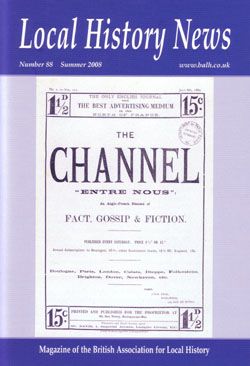
The Cross-Channel Community History Network has recently held two symposia to mark the end of one-year initiative aimed at forging strong and lasting working relationships between archivists, professional and local historians and volunteer researchers in Kent and Pas de Calais. This was funded by the EU under Interreg III. Research from this initiative has resulted in a travelling exhibition of the findings and an accompanying catalogue of documentary sources from archives on both sides of the channel. The first symposium was held in Chatham at the University of Greenwich and the second at Wimille, near Boulogne. You may have seen the first symposium reported on BBC South East. Gill Draper and Dr Emma Hanna from the University of Greenwich will be holding at day school at the Tonbridge campus of the University of Kent on 8 November 2008. This will be based on the findings reported at the first symposium and entitled The Channel ‘Entre Nous’: An Anglo-French Résumé of Fact, Gossip and Fiction. Further details from Gill Draper on balh.development@btinternet.com
At the second symposium several short papers were given in English and French on the links between south-east England and the Nord-Pas de Calais. At Boulogne the papers included ‘Les Phares Romains de Boulogne and de Douvres : un pont de lumière’. There were also review and comparisons of ceramics, jewellery finds and place-names from Kent and the Pas-de-Calais as evidence of Anglo-Saxon migration. Moving on chronologically, Professor Charles Giry-Deloison (Université d’Artois) explored the school and seminaries of the Pas-de-Calais as places which provided refuge, education and training for English Catholic children and priests from England in the sixteenth to eighteenth centuries. M. Daniel Leunens, Président de l’Association Memoire d’Audresselles, spoke about an Englishman, Les Merridew, who in the late nineteenth century owned bookshops as far apart as Coventry and Boulogne.
It is intended that funding will be sought for a longer project to maintain the cross-channel links between French and English local history societies, archivists and academics. The aim will be to involve a wider geographical region, perhaps from Oxford to Suffolk.
News From Archives Show more
NEWS FROM ARCHIVES
The Archives Awareness campaign takes place this year throughout November. The theme is ‘Community participation’ with the strapline ‘Take Your Place in History’. Watch out for events advertised locally in your area, and visit www.archivesawarenes.com for further information.
Shropshire Archives and the National Trust, Attingham Park, are presenting five sessions on Monday afternoons beginning on 22 September, on ‘Life below stairs: researching the history of servants’. Material from the archives will be used to explore the history of domestic servants, and Attingham Park will provide a case study for servants’ family history, and the hierarchy within a country house. The final session will be held at Attingham Park. Shropshire Archives, Castle Gates, Shrewsbury SY1 2AQ
Events are planned this Autumn by Hertfordshire Archives & Local Studies to raise awareness of an important local archive collection, and to raise funds for its purchase. The Delme Radcliffe Archive has been in their care since 1949 (with further deposits in the 1970s) and is now available for purchase, offered by the owners at a fair price in recognition of the cataloguing and conservation work that has been undertaken by Hertfordshire over many decades. The Radcliffe and Delme-Radcliffe families of Hitchin Priory held substantial estates in Hertfordshire and other counties, and were important traders with the Levant in the 18th century. The archive therefore has local, national and international significance. Hertfordshire Association for Local History has made a generous donation of £1000 to the appeal.Contact S Flood, HALS, http://www.hertsdirect.org/libsleisure/heritage1/HALS/
Documents recently deposited at Sheffield Archivesinclude George Bassett’s original apprenticeship indenture from 1832. He was apprenticed to William Haslam, a confectioner and fruiterer of Chesterfield. Ten years later George Bassett established the firm famous for liquorice allsorts and jelly babies, which is still going strong. These are important acquisitions for the archives as they tell the early story of one of Sheffield’s business pioneers and most famous manufacturing firms.archives@sheffield.gov.uk
Chester Imagebank has been awarded funding from Connecting Chester to purchase a new system to manage the historic image collections online. This will allow the backlog of donated images to be added, and permit improved information to be available about the images held. www.chesterimagebank.com
After more than four years the project ‘e-mapping Victorian Cheshire: Cheshire’s tithe maps online’ has been completed. 479 tithe maps for the county and their accompanying apportionments have been digitised, and can be compared directly with Ordnance Survey maps of c 1875 and c 1919, modern mapping and aerial photographs of the area. The project was funded by the Heritage Lottery Fund, and made possible by the support of volunteers, Cheshire Information Services and DigiData Technologies. To see this innovative site for the presentation of archives online go to http://maps.cheshire.gov.uk/tithemaps/
Online ‘Learning Journeys’ can be taken via the Ten Generations website or through the sites of the London archives, such as Camden Local Studies and Archives Centre, who supplied the material. Archives, local studies and museums in the capital can be explored to discover ‘London Life since 1700’. Some ‘Journeys’ tell the story of a particular part of the capital, or focus on a theme, such as education or health. ‘Great Days Out’ take you to Hampstead Heath, or London Zoo.www.tengenerations.org.uk www.camden.gov.uk/localstudies
News From Museums Show more
NEWS FROM MUSEUMS
HackneyMuseum is recording the changes to Hackney on the run up to the 2012 Olympics and Paralympics, and how local people feel about them. The project is called ‘Mapping the Change’. One element will be the recruitment of volunteers to act as ‘community observers’ who will keep a record of the changes over the next four years from their own personal viewpoint. The Hackney Terrier is the newsletter of Friends of Hackney Archives.archives@hackney.gov.uk
Two exhibitions currently at Chertsey Museum look at contrasting aspects of Runnymede’s past. ‘Shifting Sands’ looks at Runymede’s industrial past and its impact on the local landscape. Developments altered the largely rural area prior to the 17th century by the building of the Wey Navigation in the 1650s, and the coming of the railway in the mid 19th century, to sand and gravel extraction in the 20th century. The exhibition runs until 27 September. ‘Bully Beef & Bullseyes’ is available until Spring 2009. The Discovery Zone has been transported back to the 1940s to explore life on the home front in Runnymede during the Second World War.
www.chertseymusuem.org.uk
A group of writers, bloggers, photographers and artists have got together through the Friends of Dulwich Picture Gallery to ‘re-brand the image of a comfortable south London suburb’. Dulwich on View is the result of this tough assignment, and can be seen onwww.dulwichnview.org.uk
The Ulster Museum Picture Library has an extensive range of images of works in the collections, which make a valuable and versatile resource. As well as fine and applied art, archaeology, and natural history, there are over 50,000 historical and topographical photographs of people and places, events and industries.www.ulstermusuem.org.uk
Cheltenham Art Gallery & Museum is holding an exhibition from 30 August to 7 December of drawings and sketches of Cheltenham from the 1790s to the present day. It features many rarely seen items form the Museum’s reserve collections, including works by artists who either lived in or visited the town. Drawings that were produced as book illustrations or as sketches for topographical prints will be displayed, whenever possible, alongside their final product. Cheltenham Local History Society Newsletter 61. www.cheltenhammuseum.org.uk 01242 237431
A recent ‘School Report’ from the Friends of The British Schools Museum, Hitchin, has an article about two samplers stitched by girls at Kelvedon British School. Edith Young made hers when she was in Standard 5, aged 11, in 1887. She has been traced through census returns from childhood with her father (a coachman), mother and three sisters, to her adult life as General Domestic Servant in Chelmsford. Alice Pattern went through the same curriculum a few years before Edith. www.hitchinbritishschools.org.uk
The National Mining Museum for England, Wakefield, first opened 20 years ago as the Yorkshire Mining Museum. In 1995 it was granted national status, and with support from the Department for Culture, Media and Sport, and from the Heritage Lottery Fund, has been developed to the splendid site that welcomes visitors today. On 11 – 14 September areas not normally accessible to the public will be available on Heritage Open Days. From 13 Oct to 11 Jan there will be an exhibition by North-East artist Tom Lamb called ‘My Mining Days 1946-69’. Tom began working at Craghead Colliery aged 14, and documented his fellow miners and working environment in his art. www.ncm.org.uk
News From Libraries Show more
NEWS FROM LIBRARIES
Recent developments at Slough Library’s Local Studies Collection have centred on their heritage website which was launched two years ago and contains a wealth of local history material. It began as a home for over 20,000 pages of the local newspaper The Slough Observer, between 1883 and 1929. Coverage includes not only Slough and surrounding villages, but also Windsor, Maidenhead, and in some years also Beaconsfield and Uxbridge. Visitors can browse the site, but the work of volunteers has provided indexed births, marriages and deaths columns, and has begun a names and subject index for the Sough, Windsor and Maidenhead areas. This is a continuing project, and more volunteers are always welcome. Slough History Online also has over a thousand photographs, and a small collection of secondary history written by researchers who have used the collections. Shortly there will be a new facility called ‘My Story’ where memories of living and working in Slough can be added. www.SloughHistoryOnline.org.uk
Birmingham Stories is a partnership project betweenBirmingham Central Library and the School ofEducation, University of Birmingham. The aim is to extend an awareness of the diverse histories of the city in its many voices and cultures, making research on archive collections more available to the public. Through 2008 there are talks, discussions, presentations and workshops based in community libraries and other local venues. The history of a city is an ongoing archive of voices and events, and this project will uncover many previously unheard stories. The website contains a wealth of information, advice and resources. An online public gallery space entitled ‘Faces and Places’ is there for people to add their own knowledge and experience. Free learning guides include ‘Archives as social knowledge’, ‘How to research black history’, ‘How to create a learning package’ [local history societies might be interested in that one if they are thinking of exploiting their own materials in that way'>more..., and much more.www.connectinghistories.org/birminghamstories.asp
Guided Visits: Report And Preview Show more
GUIDED VISITS: REPORT AND PREVIEW
READING UNIVERSITY LIBRARY
Many will remember the Huntley & Palmer's biscuit factory beside the main line railway at Reading. From 1822 Huntley supplied biscuits to the stagecoaches. He hit on the idea of selling his biscuits in small tins, to prevent breakage. Palmer, a Quaker, became a partner in 1841. It was Palmer who funded and endowed a School of Arts and Sciences in the 1860s.
Our visit on 28 May, one of the rainiest days of a wet week, was to the University's rare book and archive collection at their Museum of Rural Life recently relocated (from Whiteknights Park) to the restored and much enlarged Victorian mansion built by Waterhouse for Alfred Palmer's family in 1882.
Thanks to impeccable directions everyone arrived comfortably on time for the morning talk on the Archive Collection. Being a small group of eight we were able to handle a range of material selected by archivist Verity Andrews. Dorothy Wordsworth's firm business letter to William's publisher, Longmans, was backed up by Longmans ledger from the 1820s, showing print runs, annual sales, net profits (50% to Wordsworth until the 4 vol Poems became 5 vols, at which point his share increased to two-thirds). The university holds the complete Random House group archive, including Chatto, Hogarth, Cape, Bodley Head. They have the Ladybird and a vast collection of other publishing and printing records. They also have the Astor papers (Cliveden is just along the Thames). We turned the pages of their visitors' book in some awe, admiring the present Queen's age ten signature under those of her parents and above a double page spread of famous names from Churchill to Joseph Kennedy. Huntley & Palmer's biscuit archive sounded a bit ordinary by comparison until Verity Andrews showed us a letter presenting two iced Christmas cakes to the Scott expedition, a note scribbled on it to save them for the celebration that never came.
One of the splendours of the afternoon with the librarian Fiona Barnam's rare books collection was a first edition of The Grammar of Ornament by Owen Jones. Jones designed advertising and packaging material we had seen from the Huntley & Palmer archive. Robert Hooke's Microcosmography, 1665, was one of the many antiquarian treasures. From the large private press collection we looked at books by Morris, Eric Gill and Robert Gibbings. Gibbings was the senior lecturer in wood engraving at Reading in the 1930's. His collection is held by the university, as is the composer Gerald Finzi's personal library. This we visited in the windowless secure stack built in the gardens of Palmer's house, where Fiona Barnam also showed us a wealth of other material.
Our thanks to both speakers and to the university for a just about perfect day out, apart from the heavy rain through which we all drove home.
Jan Shephard
STRATFORD UPON AVON
Saturday 27 September 2008
The next guided visit in the 2008 programme will be to Stratford upon Avon. We are delighted that Warwickshire Local History Society have kindly arranged this visit to give an insight into the life and death of the great playwright and poet. In the morning we will visit the Shakespeare Centre Library that houses the collections of the Shakespeare Birthplace Trust and the Royal Shakespeare Company. The afternoon walk will be to Holy Trinity Church where Shakespeare and his family are buried, via the Guild Chapel and the medieval Grammar School where William is thought to have gone to school. Time at the end of the day will enable individuals to add a riverside walk, observation of the major buildings works at the Royal Shakespeare Theatre , or perhaps a drink at the ‘Dirty Duck’ …frequented by many famous actors.Early booking recommended!
News From Ireland: Memories And Commemoration Show more
NEWS FROM IRELAND: MEMORIES AND COMMEMORATION
During November 2007 the town of Dietkirchen in Germany restored and rededicated a Celtic cross erected in May 1917 to the memory of 45 Irish soldiers who died in a prisoner of war camp which stood between there and Limburg. No trace remains today of the 24ha camp which held up to 12,000 prisoners of war. It is believed that the soldiers died from battle injuries or disease, most of the remains being interred in other military cemeteries. The 3 metre high Celtic sandstone cross, one of the few of its kind in mainland Europe, had deteriorated significantly after 90 years of weather exposure and was in a very fragile condition. The local community held Irish folk festivals and concerts and raised £7,000, the Royal Munster Fusiliers' Association and other military associations raised a further £7,000 and the Irish Government contributed £3,500. The names of the 45 soldiers engraved at the base of the cross had become illegible and have now been re-entered on a new bronze plaque. The first name is that of 40-year old Frederick Kelly, the first man to die in the camp (20 December 1914): Dietkirchen town council have named a new street overlooking the graveyard in his honour. Speaking after the rededication ceremony, Bernhard Eufinger, for the town of Dietkirchen, said that the cross should serve as a symbol of reconciliation but also as a reminder of the immeasurable suffering of the two World Wars.
Galway Cathedral was the setting on Saturday 3 November for an ecumenical service at which the Galway dead of the First World War were remembered. Those present included representatives of the Irish and British governments, the Ulster Unionist Party, and the Galway city and county councils, all of whom were led into the cathedral by an Army colour party. After the service a plaque was unveiled. Speaking to the Irish Times after the service and unveiling, the British ambassador, David Reddaway said that these ceremonies were symbolic not just of the community honouring the bravery of so many men from Galway who died in the First World War, but of changing times—they commemorated extraordinary sacrifices not just by the men but also by their families who, because of historical and political circumstances, could not mourn publicly at the time with the support of the community. He suggested that in Galway that day they had seen history turn a page and that the Irish people can now look back on that period in their history with the pride which it deserves and publicly recognise that their grandfathers, great-grandfathers and other family members faced extraordinary hardships and acquitted themselves with honour and amazing bravery.
In February 2008 Roscommon formally acknowledged for the first time the First World War dead from the county, with a trip to Flanders by a delegation led by leaders of Roscommon Town Council and the County Council. At 330 young men from County Roscommon were killed during the war, and the delegation visited five cemeteries. A wreath of poppies was laid at the round tower in the Messines Irish Peace Park which commemorates 69,947 men of the 16th Irish Division and the 36th Ulster Division who died or were wounded in Flanders and of the 10th Irish Division at Salonika. Speaking after the wreath laying ceremony, John Tiernan (Roscommon County Manager) said that the day was filled with emotion and reverence—it was fitting, he said, that the people from their county should come and pay their respects. John Kelly (mayor of Roscommon) said that few of them had understood what happened in Flanders, as these things were not taught in school—he was proud to be there on behalf of the people of Roscommon to honour their First World War dead.
During November at Foxford, County Mayo, Noel Dempsey, the Minister for Transport, unveiled astatute of Admiral William Brown, founder of the Argentine Navy, ending a year of commemoration marking the 150th anniversary of his death. The Argentine Embassy, Argentine Navy and Irish Naval Service were represented at the ceremony. During the unveiling, the minister said that Brown was one of Mayo's greatest sons and revealed that in Argentina there are not only some 500 statues of Brown, but also that two towns, a thousand streets, a sizeable city and several football clubs are named after him.
The Irish Registry of Deeds first opened in 1708 and is one of the old continuously-operating offices in the state. Established under the Registry of Deeds Act 1707, it moving to King's Inn Quay in 1805 and is now located in Henrietta Street, Dublin, part of the King's Inn complex just described. The Registry of Deeds Act 1707 was one of a set of penal laws controlling Catholic landownership, and provided a comprehensive system of registration of deeds and conveyances affecting land. Registration is based on a memorial filed in the Registry of Deeds which now contains the history and provenance of all deeds registered since 1708—currently some five million separate memorials. These are an invaluable source for genealogical research as they contain all property transactions in Ireland (and are of special value for the 18th and 19th centuries). Some of the leading figures from Irish history who have signed these memorials include Jonathan Swift, Wolfe Tone, Henry Grattan, Daniel O'Connell, William Butler Yeats, Lady Gregory, William Cosgrave and Eamon de Valera. The present registry was the third and final public building designed by the leading Dublin architect James Gandon, and is the only one not to have been destroyed or reconstructed.
The Natural History Museum in Merrion Street, Dublin 2 celebrated its 150th anniversary in 2007 … but unfortunately it has been closed since major structural problems were discovered in August 2007 and is unlikely to reopen until 2010. Begun in 1856 as the Museum of the Royal Dublin Society, the present Natural History Museum opened to the public in 1857. It is a zoological museum containing very extensive collections of world wildlife, with over 10,000 animals, and it is also a major scientific institution holding internationally-important research collections. It became part of the National Museum of Ireland in 1877.
In March 2008 (on board the Jeanie Johnston, a replica of a famine-era sailing ship) Seamus Brennan, Minister for Arts, Sports and Tourism, and Martin McGuinness, Deputy First Minister for Northern Ireland, launched an all-Ireland central database of genealogical records in Dublin. The website, sponsored by the Irish Family History Society, holds more than 8.6 million birth, baptismal and marriage records ranging from 17th to the 20th century, drawn from state and church records. Some 22 county centres have made their databases available online and it is planned to add others. However, the on-line service is commercial, and inquirers are charged €10 for each piece of information. This has drawn criticism from Olivia Mitchell, the Fine Gael opposition spokesperson for arts, sports and tourism, who argues it was totally unacceptable that Irish citizens should be charged for accessing their own family records assembled at public expense.
additional editing by Alan Crosby
A Bibliography Without Equal Show more
A BIBLIOGRAPHY WITHOUT EQUAL
CASTLES, TOWN DEFENCES AND ARTILLERY FORTIFICATIONS in the United Kingdom and Ireland: a bibliography 1945-2006 compiled by John R. Kenyon and published by Shaun Tyas (2008 740pp. ISBN 978-1900289-894) £35
This remarkable book is the fruit of many years work by John Kenyon, one of the country’s foremost experts on castles and related defensive structures, beginning in the 1970s when he was working at the library of the Society of Antiquaries in London. Part of it was published in 1978-1990 in three volumes by the Council for British Archaeology, but the CBA then decided that the remainder, a composite volume which was to include all the existing works together with updates and additional post-1990 material, was not for them. The present work is a mammoth bibliography, which the compiler modestly claims is unlikely to be complete, but he does admit that it probably includes over 99 per cent of key material and perhaps 95 per cent of all published material. The breadth and scope of the trawl is outstanding, because the aim has been to ensure that nothing of any significance has been omitted, so that very numerous local publications (for example, articles in local journals and booklets published by local societies) have been included. It is inevitable that material has gone unnoticed—for instance, a discussion of the medieval castle in Manchester in Michael Morris’s Medieval Manchester (1983) is not included. That’s really beside the point, for John Kenyon is only human and cannot be omniscient. He asks for readers and users to inform him of any omissions, and generously gives his email addresses for them to do so.
The bibliography is arranged in a clear and logical fashion. The first 86 pages comprise a general section which covers all books and articles dealing with castles in an unspecific fashion—that is, overviews, wider analyses, architectural discussions and castles as part of broader-based histories. Even taken on its own this section will have special value, being the definitive bibliography on the subject. I can imagine it being invaluable to students, researchers and the compilers of reading lists.
This is followed by a county-by-county gazetteer of published material, taking every traditional county in (respectively) England, Wales, Scotland and Ireland, and giving for each a general section on works relating to the county as a whole, to groups of castles, to districts within the county, or to general works on the county. After that every specific work on a particular castle within that county is listed in alphabetical order of castle name. I use the word ‘castle’ here for convenience, but it is an essential element of this work that it does not artificially demarcate between castles, town walls, town ditches and ramparts, other forms of defensive structure, and for example, artillery emplacements or semi-fortified country houses. No less significant is that it includes ‘possible’ castles, or reports which postulate the existence of defences. It is also very wide in its chronological scope, extending to twentieth century structures.
It’s unlikely that the volume will be bought by many individual local historians, but it should be a compulsorypurchase for all local studies libraries, record offices and other institutions with history collections. It’s a magnificent labour of love and dedication, and a worthy monument to John Kenyon’s endeavours. If you are interested in the castles, fortifications and other related structures for your place, county or region, or in the subject in general, there are many treasures to be identified within its 740 pages.
Happy Change Show more
HAPPY CHANGE
Early Years: recollections of life in Sturminster Newton in the early nineteenth century by Robert Young, edited and with an introduction by Alan Chedzoy.
Dorset Occasional Papers Series No 1: Dorset Record Society 2008 £4.
This is the first of a proposed new series published by the Dorset Record Society; a 22 page booklet too short for a major Record Society volume but of sufficient content and interest to be worthy of more than just an article in a journal.
Robert Young ((1811-1908) was a tailor from Sturminster Newton. He wrote his skilful observations of his early memories at the remarkable age of 97, shortly before World War One. Writing in a small exercise book, his quirks in grammar and spelling irregularities have been maintained but the editor has altered the punctuation to ensure that sentence construction and meaning are clear.
In his Early Years he provides a vivid and personal account of social history in a small cloth making town, his descriptions adding colour to any early census returns. An exceptional, self-educated man who was a Dorset dialect poet and minor writer, he knew both Thomas Hardy and William Barnes. Even so, such memoirs from someone of ‘relatively humble station’ (Alan Chedzoy) are rare and provide a fresh insight into life in Sturminster Newton. A gentle, attractive personality with a lively sense of humour, his optimism shines through, at a time of radical innovation. He observed that ‘wonderful changes are taking place in the world’ and saw Victorian progress as a positive factor, in education, public health and in the abolition of cock fighting and badger baiting. The railways were not only a means of carrying people rapidly but provided ‘a happy change’ for the animals who no longer suffered six days on the droving roads.
His earliest memories were of the peace celebrations in 1815 when ‘a party... began firing at the image of the very great tyrant [Napoleon'>more..., & after being well riddled with shot, was taken down & placed on a pile of faggots’ and so the ‘great murderer’ was cremated. One of his last memories appears to be an early reference to the motor car which ‘regardless of life rushes onwards with dangerous speed’. Wonderful characters are brought to life with humour: old constables, a Welsh medium, Billy Sweet with his toad in his pocket. There is no direct reference either to national or local politics but as a methodist he suffered prejudice and welcomed the Temperance societies which were combating ‘the dens of ruin’ and filling ‘our unions with paupers’. His basic humanity is always apparent and he is thankful that labourers no longer toil twelve hours a day for just ‘six shillings the week’.
The text is enhanced by charming 19th century photographs; one minor quibble which I found disconcerting and initially confusing was the placing of the illustration captions at the top of the page, but this apart, I hope that this booklet will be widely enjoyed both by inhabitants of Sturminster Newton and indeed social historians generally. Robert Young’s ‘Early Years’ are a delight and Alan Chedzoy’s excellent booklet, fully indexed and referenced and very good value, is hopefully the first of many such ventures from the Dorset Record Society.
Inspiring Show more
INSPIRING
I recently wrote a letter to the local paper (if you’re reading this, dear editor of the Lancashire Evening Post, yours is a great newspaper and I would certainly welcome a double-page spread about my next book, with a breathlessly enthusiastic review). The aforesaid daily (except Sundays) publication carried an article about one of Preston’s greatest buildings, the Roman Catholic church of St Walburge, situated approximately three hundred yards from my house, and known far and wide for its spire, which at 309 feet is the third highest in the British Isles after the cathedrals of Norwich and Salisbury. This spire is sans pareil. It soars breathtakingly into the sky, slender and needle-like, built of white limestone which reflects and absorbs the light, so sometimes it’s grey, sometimes gold, sometimes pink, sometimes silver. It pierces the clouds and shines luminous against a black stormy sky when the suns rays catch it. You’ll gather that I love it dearly ... but a junior reporter from the LEP got it all wrong. The church at the foot of this superb spire is threatened with closure, together with ten other Catholic churches locally, because despite a huge influx of Poles the congregations are dwindling and the cost of upkeep is too great. The reporter, in an article highlighting this misguided proposal, was overcome with enthusiasm and said that the spire was the highest in Europe.
Well, naturally, I had to protest! Preston is unquestionably a great city and all that, but it cannot possibly make such preposterous claims. Not least, as I said in my letter, I have been up the highest spire in Europe, and a terrifying experience it was. The minster at Ulm in southern Germany has a spire which is 530 feet high. I, a foolish youth in those distant days, cheerfully accepted the challenge. There are 786 steps. I felt increasingly weary (after all, it’s one-sixth the height of Helvellyn) but much worse was the growing sense of insecurity. The steps became narrower, the spire began to vibrate perceptibly in the high winds, the same winds then howled through the openwork lattice of the upper reaches, and the last stretch involves a sort of cage, perilously placed at about 520 feet. Imprinted on my mind is the view, which was simply extraordinary—it felt as though half of Europe was at my feet, the Danube was a slender ribbon far below, the Alps and other mountains, unknown then and now, were molehills along a vast horizon. I think this was a photographic snap, for I shut my eyes as though a camera shutter had passed, and then with pounding heart and jelly-like legs began the painstakingly slow descent. What seemed to be several hours later my friend and I reached the bottom and headed immediately for the next stop on our itinerary, avery large beer in a glass held with a shaking hand.
From the window of the room in which I type this I can see the spire of St Walburge’s. It’s a May evening, and the spire is catching the sinking sun—it’s a lovely dark gold and pink colour, warm and glowing. I look at it and think of Ulm which is an unimaginable 221 feet higher—only a bit more and they could have walked to the moon! Now I’m certainly a lot older and in theory a good deal wiser … would I climb the spire of Ulm at my age? Well, maybe not—but a 76 year old friend of mine not long ago abseiled down the spire of St Walburge’s to raise money for the local hospice, and I am ashamed to think of my own timidity. So perhaps I would do it again—but there’d have to be the same reward … a very large beer (undoubtedly in a glass held with an even more shaking hand).
Notes News Issues Show more
NOTES NEWS ISSUES
Running your Association. The Management Committee met on 19 April when David Dymond and I both stood down. Subject to formal ratification by Council, two new members will join the committee, bringing previous experience with CORAL and ALHT. The business included:
changes in the structure and organization of the Museums, Libraries and Archives Council (MLA) affecting its agencies in the regions that needed to be monitored; BALH might wish to comment publicly when the situations becomes clearer
an All Party Parliamentary Group on Archives (APPG on Archives) had been formed, with BALH as an official associate member. This will press the importance of archives, something not mirrored in the political agenda despite the popularity of local and family history
payment of subscriptions by direct debit was being explored
a new edition of Researching and writing local history by David Dymond was ready but a publisher, production process, storage and distribution had to be arranged.
Publications What and how to publishcontinues to occupy our attention. With the changes at Phillimore we have now to hold existing stock in house and can sell directly to members but have no access to the more lucrative retail market. As your former General Secretary I had many years friendly and productive co-operation with Noel Osborne, their managing director and his staff (and sometimes the odd acerbic exchange it has to be said). Noel tells me that Phillimore is now a division of The History Press. Phillimore will continue as a satellite office with a smaller staff to commission and publish local and family history. They are still in Chichester but sadly work from a Business Centre and not the former splendidly named Shopwyke Manor Barn
Noel has become Chairman and expects to spend time list-building and commissioning new books. Our congratulations are due on his appointment for the current year as Master of the Worshipful Company of Stationers and Newspaper Makers. Some will recall that he was instrumental in introducing us to Stationers Hall, as the venue for the Annual Lecture and what was to develop into Local History Day.
Awards The first profiles of those who received Awards for personal achievement at Local History Day on 7 June are published in this issue and will continue through the year. Also in the issue the annual cycle starts again with the nomination form for personal achievement in the coloured centrefold. Do please note the instructions so that there is a level playing field. A citation of about 200 of the nominator’s own words is intended to mean just that.
Jeremy Paxman What have the, one presumes, inoffensive local historians of Glamorgan done to upset Jeremy Paxman? In the suggestions book of the London Library, the scourge of politicians but not until now of local historians, asks whether there is a need ‘any longer to devote acres of shelving to storage of ancient - and not so ancient – periodicals’ [such as Glamorgan’s'>more.... I hope that the London Library dismisses such a question and continues to shelve material from Glamorgan, and indeed from more local societies who may now care to persuade them to subscribe and widen the sum of accessible knowledge of local history. You will be glad to hear that the Library is an Institutional Member of BALH and receives our own quarterly material (report Daily Mail 8 May 2008).
Latin plural No getting away from this – Katherine Barker tells us about a local history forum held on 17 May by the Dorset History Forum in Blandford Forum, cleverly evading the plural form by calling it Forum 3. Beat that! (Dorset History Forum The Digest no1, Mar 2008)