January 2020 Reviews
Reviews
Wulfhere’s People A Conversion-period Anglo-saxon Cemetery At Wolverton, Milton Keynes Show more
By by A.J. Hancock and R.J. Zeepva
(Buckinghamshire Archaeological Society Monograph Series 11 155pp 2018 ISBN 978-0-9957177-4-9) £18
In 2007-2008 archaeological excavations on two sites in Wolverton revealed the largest Anglo-Saxon cemetery of the ‘conversion period’ so far examined in Buckinghamshire. The cemetery was in use from the later-sixth century into the second half of the seventh century and comprised eighty inhumation burials, four of them double; two cremation burials with urns; and a possible further two disturbed cremations. The graves were randomly scattered across the excavated area and no indications of cemetery boundaries were found, although the full extent of the cemetery was not determined. The excavators suggest that the location of the cemetery may have been influenced by local routeways and was probably associated with the contemporary enclosed settlement at Wolverton Turn to the west of the site. From their excavations the authors have crafted an insightful profile of Wulfhere’s people, a settled agricultural community whose lifestyle was demanding, enduring diet, malnutrition and work-related disorders, infectious diseases, and poor dental health. Osteoarthritis was common among males and older members of the community, whose life expectancy ranged between 36 and 50 years of age, with a tendency for women to live longer, although the dangers implicit in childbearing left them particularly susceptible to death before reaching the age of 35.
Linen may have been favoured over wool for garments, men wearing a belt at their waist, and women a chatelaine of light iron or copper-alloy chain, from which were suspended purses, keys and workboxes. Jewellery tended to be found in in non-adult and female burials; buckles and seaxes in non-adult and male graves; and combs and buckets in male and female burials. Two complete copper-alloy caskets or workboxes were found, both with women, one of which carried a runic inscription that might be read as a personal name, ‘Buga’, or as ‘byge’ meaning a bend, or a ‘bent thing’, as was the rounded profile of the object.
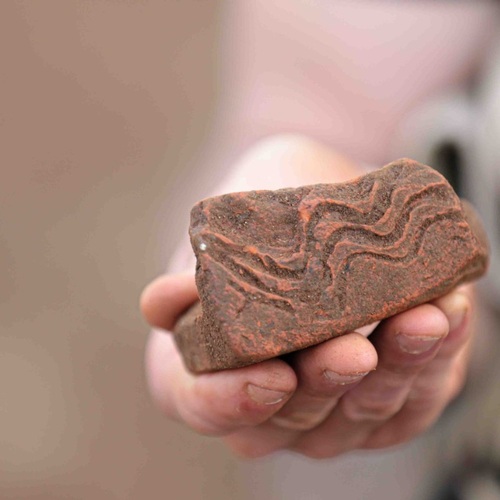
Few weapons were found, but most carried knives as multi-purpose implements. However, the pattern-welded sword in Grave 2174 must have been a prized and valuable possession that evidences some relatively wealthy individuals in the community, as does the female inhumation in Grave 2360, among whose grave goods was a barrel padlock, suggesting that she had items to be kept secure. We perhaps see glimpses of wider contacts in the incomplete iron penannular brooch found in a child burial, a rare and relatively sophisticated item whose affinities look westwards towards Wales. Similarly, the find of a copper-alloy mount with a relatively unusual concentric floral millefiori decoration represents a hanging bowl, a high-status object with ‘Celtic’ associations. An intriguing group of items, described as objets trouvés include fossils and geological specimens, none of which was locally provenanced. The significance of these items is a matter of speculation, but taken together with other items that include a boar’s tusk and a Neolithic arrowhead, they are often presumed to have served as amulets.
Spatial groupings within the cemetery were not much in evidence, but a row of five graves at the north corner of the cemetery may represent a group of related individuals, while to the south-west of the site a unique feature comprised four burials ranged neatly around a four-post structure, one on each long side. While it may be presumed that there was a relationship between the four burials, and respect for what the structure represented or contained, the arrangement is enigmatic. A further burial of particular interest is Grave 2088, the female occupant of which had been decapitated, but this had been done post-mortem, after decomposition of the body had started. This is not readily explained, although this reviewer is reminded of instances in early medieval literature where such actions may be associated with combatting the troublesome dead. I would have welcomed more discussion and mapping of this community’s place within the wider pattern of Germanic incursion into the area, the nature of the relationship between the newcomers and the Romano-British population, and the emerging socio-political geography of the area. As the DNA sampling of Inhumation 2167 reminds us, the genome analysis leaves open the question of whether this individual’s lineage reflected the arrival of the Anglo-Saxons in eastern England, or was mostly derived from preceding Romano-British populations.
In A4 paperback format, comprising 144 pages on high-grade paper and including 120 illustrations, all of good quality, the excellence of the volume is matched by a text that is comprehensive and written in a manner accessible to specialist and non-specialist alike. This is a fine publication that gives real substance to the Anglo-Saxon community buried at Wolverton and is good value for money!
John Hunt is an Honorary Research Fellow in the School of History at the University of Birmingham. His most recent publications have included Warriors, Warlords and Saints: the Anglo-Saxon Kingdom of Mercia (2016), Lordship and Monastic Patronage in Twelfth and Thirteenth Century Staffordshire: the Honor of Tutbury and its neighbours (2017) and with forthcoming articles on Berkswell Church in Warwickshire and Lichfield’s medieval urban growth.
Newcastle At War 1939-45 Show more
By Craig Armstrong
(Pen and Sword 2019 215pp ISBN 978-1-473867-50-5) £14.99
The strength of this book is that it is extremely well researched, both at local and national level, and contains a wealth of detail which is admirable. There is no doubt that it will appeal to those in Newcastle who are interested in the history of their city. The key aspects that perceptive readers would expect to find in a wartime urban history are included and are covered in extensive detail. Air raid precautions, both pre-war and wartime, are well presented. Air raids and their catastrophic impact are listed in great detail as is rationing, the patriotic activities of residents involved in charities and fund-raising for wartime goals, and the role of women. Unusually, conscientious objectors and the military tribunals which dealt with them, usually the preserve of studies on the Great War, are included here and were dealt with very well.
Armstrong does not merely trot out the outdated rallying cry of a country, or in this case a city, pulling together with everyone united in pursuit of victory. He also presents the seedier side of life. Here we find references to criminal activity, some of it inevitably of a sordid nature, and corruption in high places, warts and all. We are brought face to face with the problems of civil defence morale and with the feeling that the war was leading to a moral decline among the city’s inhabitants. He has also done well to include a discussion of the ambivalent attitude displayed by some residents towards foreign ‘aliens’ who had arrived in pre-war Newcastle having escaped persecution in Europe. It is not a creditable tale. A particularly strong feature is the very thorough and often moving accounts of the sacrifice made by military personnel from the city. Their stories are told in detail, whether they were lost at sea or serving with the Army or RAF in far-flung places, from France, Norway and North Africa to the Far East, and over the skies of Britain. The same is true of coverage of civilians who died as a result of German air raids. These accounts will, I am sure, have a particular resonance with local people.
I enjoyed reading this book, which will be a worthy addition to any bookshelf in Newcastle. However, for me the drawback of the book is its structure. A year by year approach has led to great deal of repetition, both within each chapter and between chapters. This is an inevitable result of the lack of a thematic approach, where the various key strands of wartime life could have been unified and presented in a more coherent manner. As it is these key themes appear several times in each chapter, interspersed with others, likewise repeated and with little appreciation of context. This lack of context is reinforced by the fact that there are very few secondary sources listed in the endnotes. Consequently, although this book will appeal to a local readership it is not a model that I would recommend other local historians to follow. It is well illustrated, although it uses a lot of photographic material from newspapers which does not always appear to good advantage. Both the endnotes and index are well done.
Paul Rusiecki is a historian specialising in the twentieth century. His work covers the whole spectrum of people's experiences—social, political, military, economic and religious. He has written extensively on the military history of Essex in both world wars.
Top Secret Worcestershire Show more
By Stephen Burrows and Michael Lynch
(Brewin Books 2018 ISBN 978-1-85858-581-9) £14.95
Top Secret Worcestershire outlines the pivotal role that secret locations in the heart of the county played in the defence of Britain against the German threat during the Second World War. The introduction provides a useful overview of the development of radar technology in the years before the war, focusing on its discovery in the mid-1930s and the scale of government investment that this prompted. It also provides the non-local reader with an insight into Worcestershire, introducing the key locations which are explored in detail in the five main chapters. One of these was the small, picturesque village of Defford, important in the development of radar technology as well as becoming an RAF station in 1942. Any visitor to this part of the county will have noticed the ‘golf balls’ that can be found amid farmland, close to the National Trust property of Croome Court, but how this location developed from an aircraft training centre into a vital element in the telecommunications network is well covered. Separate chapters cover the development of RAF Pershore during the war and beyond as well as how Malvern was used as a centre for vital telecommunications developments which extended the use of RAF Defford.
Throughout the book the authors’ passion for the topic is evident. It is well researched and contains a wide range of interesting accounts from individuals connected to the area about the sites that the book explores. This is impressive when the secret nature of the topic is considered. However, too often the authors list facts that have been uncovered as opposed to using them to formulate a readable, coherent account. At times the narrative is therefore hard to follow and lacks a degree of analysis which would have been explained the importance of key events and placed them in the wider context of the conflict. As a resident of Worcestershire I was also disappointed with the admission of an index. When the publication arrived I was intrigued to see if important sites such as the Spitfire test site at Perdiswell were outlined. This was not the case but the lack of an index meant that navigating the book was not as easy as expected.
Clearly, the book has a niche focus, only really covering RAF Defford, RAF Pershore and the Malvern telecommunications research. If you have a connection to these locations or live near one of the sites, this book will be of interest. For someone like me, with limited knowledge of the science behind radar and telecommunications, the authors attempt to explain the significance and development of these technologies, but the text becomes a little too technical in places. However I found the final chapter of the book to be a real highlight. ‘Endings’ outlines what has become of the various locations mentioned—not only the main sites such as Defford, but also pubs that workers frequented (such as the ‘Monkey House’) and smaller sites like the bunkers at Broadway. This, with the impressive array of images in that section, gives the reader an overview of how sites that are perhaps regularly visited have developed over the last 70 years.
Andrew Trickett is a history teacher in a Worcestershire secondary school.
Banbury’s People In The Eighteenth Century: From Records And Accounts Of The Overseers Of The Poor 1708-1797 And Other Lists And Sources Show more
Edited by Jeremy Gibson
(Banbury Historical Society vol.36 2019 395pp ISBN 9780900129353) no price available
This volume is a testimony to the prodigious industry of Jeremy Gibson, who has been at the forefront of research into the history of Banbury for over sixty years. This time he offers us insights into the minutiae of aspects of the local government of Banbury during the eighteenth century, with the records of the overseers of the poor being the most significant source. This remarkable volume has value at various levels. Of course, it explores local documents which are of particular interest to local people or those who have had associations with Banbury. The evidence of names which emerges is of potential interest to family historians because it enables us to identify important local families in a political sense but also other people who became entangled with the administration of the poor law as they experienced personal challenges. It provides an excellent model of how to explore local life, in the way that it draws other sources to complement the overseers’ records to create a vigorous perspective on life in Banbury.
Beyond the specifically local interest, however, this publication has a much wider potential. Professor Alan Everitt always argued that judicious exploration of sources in a variety of places would enable us to develop an enhanced understanding because disparate small items of evidence, when assembled together, have much greater value and significance. My first example is the fact that these records show that on seven occasions between 1773 and 1793 the vestry held meetings in local inns—the Three Tuns, the Crown, the Red Lion and the Reindeer. These are seven brief references but fifty years ago, in my research into Croydon’s inns, I identified two occasions when their vestry convened in an inn. At that stage I used this as a small indicator that, in their role as community buildings, this was part of the wider function of such establishments. Half a century later Banbury has provided comparable evidence, thereby guiding me that this might have further potential.
Four other unusual references caught my attention. In 1724 a payment of 16s was made for the cost of a soldier’s wife ‘lying in’ at the Reindeer. This is a compassionate act which might warrant further research or wider comparison. In 1771 there was a discussion which led to a cessation of funding for the billeting of troops in the town. This reflected a wider public concern, demonstrated by countless petitions in The National Archives, which led ultimately to the decision to construction military barracks in the 1790s. At the end of the century in December 1796 the overseers discussed raising four soldiers for the king’s army, during the protracted war with France. Banbury was well aware of what was happening abroad because in 1792 a public meeting was held at the White Lion where prominent citizens made a public declaration of loyalty to George III, implicitly recognising the destiny of Louis XVI. One point of comparison with modern times reveals that the overseers were just as agitated about what might be seen as wasteful expenditure as their modern-day counterparts. In 1795 there was debate about the propriety of local money being spent on taking two prisoners from Banbury to Newgate Prison in London. Clearly the prisoners had to be transported and someone had to pay ... the age-old debate about budgetary responsibility!
This is a valuable resource for local historians, whether historians of Banbury or historians with a much wider appetite for what was happening in eighteenth century provincial England.
Trevor James’s research into the inns of Croydon was published in the Surrey Archaeological Collections vol.68 (1971). Until recently he was editor of The Historian and he has been an adult local history tutor since 1971.