The Amateur Historian Volume 1 Number 11 April May 1954
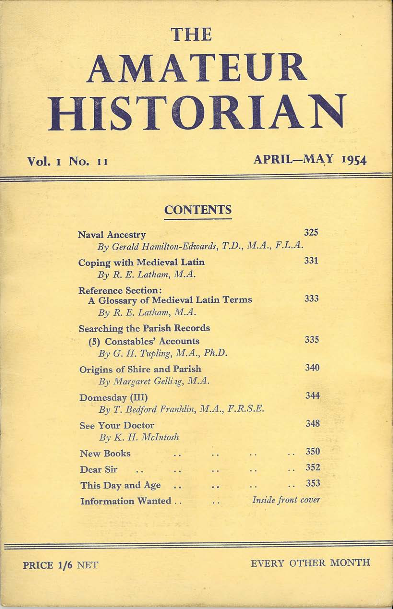
Contents
Naval Ancestry Show more
By Hamilton-Edwards, Gerald
pp 325-330
Review of, and commentary on, naval records as potentially useful sources for the family historian. The author recommends a number of types of primary and secondary sources, including biographies and journals; Admiralty records, especially baptismal certificates; Admiralty dispatches, which can include substantial detail on individual naval actions; bounty papers; Samuel Pepys' records of the 17th century navy; captains' letters; and lieutenants' letters.
Coping with medieval Latin Show more
By Latham, R.E.
pp 331-335
The Amateur Historian was publishing a series of articles by R.E. Latham on the use of medieval central government records, and this short introductory article was included as a further assistance to those who had no training in the Latin which was the only language normally employed for such documents. It explains the procedures which might be used to tackle medieval sources written in Latin and including a glossary of medieval Latin terms. There is a detailed description of some of the major differences between classical Latin and medieval Latin grammar and vocabulary and notes on the creation of Latinised forms of words from other languages such as Norse and English.
Searching the parish records: (5) constables' accounts Show more
By Tupling, G.H.
pp 335-339
Explanation of the origins of the office of constable, beginning with his role as a local maintainer of the peace and overseer of the military responsibilities of the community, and continuing with analysis of a range of civil responsibilities which the office acquired in the 16th and 17th centuries. The article provides detail of such tasks as ensuring that the able-bodied were equipped with armour and weapons (13th century), organising military training and drilling, produce lists of men able to serve (16th century), purchasing and maintaining arms and equipment, enlisting the local militia (18th century), enforcing local laws (including the supervising or administering of basic punishments) and collecting rates and taxes. Examples from local records are quoted. (see also 01 07 198-202; 01 08 234-237; 01 09 269-272; 01 10 301-304; 01 12 361-364)
Domesday Part III Show more
By Franklin, T. Bedford
pp 344-347
Investigation into economic and related patterns in Northamptonshire, as shown by the Domesday Survey. The evidence indicates that the county had large forested areas but the central fertile river valley included intensive agricultural activity. This evidence is placed in the context of geological patterns, which shows that farming was less well-developed in areas of heavy loam or clay. The author comments on the adverse effect of the invasion of the county in 1065 from Northumbria, and the slow recovery of many villages and towns from this devastation. Extensive detail is given by Domesday on the number of people involved in working the land (see also 01 09 261-267; 01 10 297-300).
See your doctor Show more
By McIntosh, K.H.
pp 348-349
The writer advises local historians to consult with local doctors (about historical research!) because the latter often have intimate knowledge of an area, its dwellings and its families.
[Hide]

Hugo Javier Freitas


Laura Yeoman