The Amateur Historian Volume 1 Number 12 June July 1954
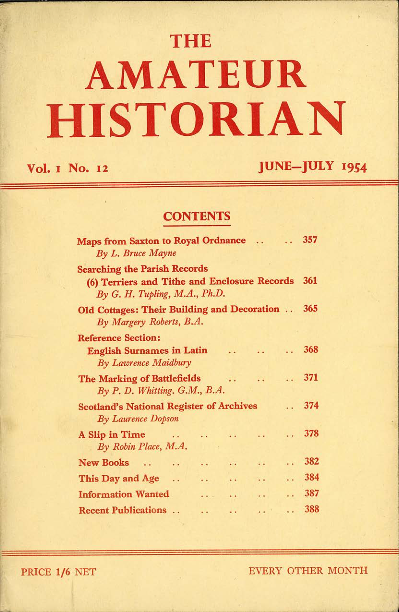
Contents
Maps from Saxton to Ordnance Survey Show more
By Mayne, L. Bruce
pp 357-360
General discussion of the use of maps in local history research. The article refers to the 16th century county maps of Christopher Saxton, who worked under royal patronage, and John Speed, whose maps showed hundreds and often included town plans. John Ogilby worked in the later 17th century and concentrated on route maps, which included distances and a range of annotations and extra information. Other mapmakers considered include Kitchin in the 18th century, whose plans included extensive detail of houses and castles, Lyte and Hollar. However, the major change came in the late 18th and early 19th centuries, with the establishing of mapping by the state under the auspices of the Ordnance Survey. The author traces the ancestry of the OS back to the Jacobite rebellion of 1745, when the English army demanded more accurate maps of the Highlands.
Searching the parish records (6): terriers and tithe and enclosure records Show more
By Tupling, G.H.
pp 361-364
The last of Tupling's series on local parish records, this article begins with a description of the content and potential value of glebe and other terriers. These were inventories of land and goods belonging to rectories and vicarages in each diocese, and they were usually inspected during bishops' visitations. Inventories of lands and ancillary detail about the use and value of the estate were often prepared. The extensive detail available about glebe lands often illuminates agricultural practices in both enclosed and unenclosed areas. Tithe records (NB not the material associated with the 1836 Tithes Commutation Act) may give detail of the clergy's income as well as lists of tithe rents in the parish. There may be descriptions of the activities of each occupier, often with maps or plans, and these records often contain extensive detail on crops, types of stock raised, and wages (see also 01 07 198-202; 01 08 234-237; 01 09 269-272; 01 10 301-304; 01 11 335-339).
Old cottages: their building and decoration Show more
By Roberts, Margery
pp 365-367
Discussion of the construction of wattle-and-daub cottages. Daub was mixed from lime, horsehair, sand and cow dung and laid onto the timber skeleton of the cottage with its wattles of hazel stakes. The exterior was then whitewashed, although regional differences in colour are noted. The practice of modelling or marking the plaster, known as 'pargetting', is described - it was very prevalent in the eastern counties and a number of surviving examples are noted.
English surnames in Latin Show more
By Maidbury, Lawrence
pp 368-371
Glossary of the Latin forms of English and Norman-French surnames. Such forms are rarely encountered in documents after the mid-16th century, but before then were very common, as clerks translated from English into Latin. They are particularly, though not invariably, associated with occupational surnames such as Smith, Baker, Carpenter and Weaver (see also 01 10 312-314).
The marking of battlefields Show more
By Whitting, Philip D.
pp 371-373
Description of the process and methodology involved in marking and commemorating battlefields, including detail on siting, types of memorials, and access to these sites.
Scotland's National Register of Archives Show more
By Dopson, Laurence
pp 374-377
An account of the work of Scotland's National Register of Archives, which produced lists based on regional and local collections, and publishes outline catalogues and other finding aids for various collections. Some of the collections discussed include examples of property registration in Scotland; legal documents; monastic records; agricultural records; and accounts, diaries and journals.
A slip in time Show more
By Place, Robin
pp 378-381
Explanatory account of various archaeological techniques for examining pottery, and especially the process of dating sites and identifying the period in which pottery was made. The author identifies and explains in some detail the main types of pottery likely to be found during archaeological excavations, including analysis of shape, size, decoration, rim, neck, and handles: i) primary Neolithic (simple round bottomed vessels); ii) early Bronze age (Beaker culture, with more complex decoration); iii) middle Bronze Age (food vessels, flat-bottomed vessels and burial urns); iv) late Bronze Age (bucket and barrel urns); and v) early Iron Age (complex decoration, some vessels made on potter's wheels)
[Hide]

Hugo Javier Freitas


Laura Yeoman