The Amateur Historian Volume 2 Number 1 August September 1954
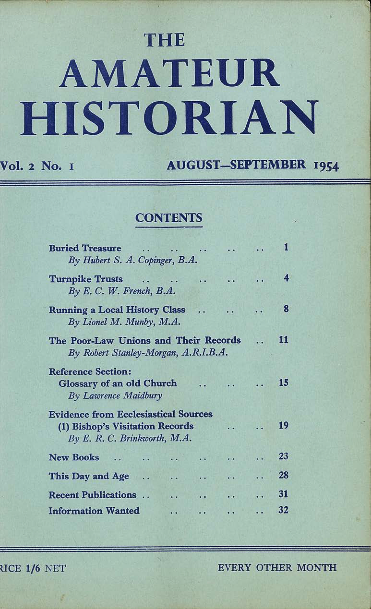
Contents
Buried treasure Show more
By Coppinger, Hubert S.A.
Antiquarian discussion of coins as a source of historical information which then considers the importance of reporting chance finds and gives indications of the then law on treasure trove.
Turnpike trusts Show more
By French, E.C.W.
pp 4-7
Brief general introduction to the history of turnpike roads, 'an outdoor and indoor hobby of absorbing interest', which refers to milestones, bridges and toll houses. The second half of the article lists (but does not expand upon) possible sources of documentary evidence including the records of turnpike trusts, annual abstracts of trust accounts, local acts of parliament, and maps, as well as secondary sources such as transactions of a local historical society.
Running a local history class Show more
By Munby, Lionel M.
pp 8-11
In this article Lionel Munby explains how local history societies may set up courses for research, in order to develop their activities beyond straightforward winter lectures and summer expeditions. He suggests that the choice of tutor is crucial, and that societies which are really serious should contact a university extra-mural department or the WEA. He explains the ways in which classes can undertake group projects and the arrangements for administration and organisation which may be required, including an outline of a course progression over several years of research and writing.
The Poor Law Unions and their records Show more
By Stanley-Morgan, Robert
pp 11-15
A review of the main characteristics of the post-1834 and pre-1929 New Poor Law, which mentions the relevant legislation and concentrates especially upon the types of records which were generated. These are summarised as follows: i) general memoranda from the Poor Law Commissioners to all unions; ii) printed memoranda addressed specifically to one union; iii) records of disputes which were dealt with by the Commissioners; and iv) records of the Poor Law Board of Guardians including minute books, account books, punishment and misdemeanour books, medical records, records of emigration, removal and settlement; baptism and burial registers; education records and administrative records.
Glossary of an old church Show more
By Maidbury, Lawrence
pp 15-18
Short glossary of terms relating to the architectural features, furnishings, monuments and decorations which may be found in a medieval or early modern church.
The records of bishops' and archdeacons' visitations Show more
By Brinkworth, E.R.C.
pp 19-22
The first in a series of articles collectively entitled 'Evidence from ecclesiastical sources' [note that the title as printed reads archbishops' rather than archdeacons' courts]. After a clear explanation of the purpose and characteristics of visitations, the article explains in careful detail the procedures which were followed at these events. It introduces the main types of business which were dealt with and places these in their social context (for example, disorderly alehouses, the duties of the parish clerk, behaviour in church, and observance of the rules of consanguinity in marriage). The article gives numerous examples of these typical offences and discusses ways in which the visitation courts dealt with the offenders. Some suggestions for further reading are given at the end (see also 02 02 50-53; 02 03 82-86).
[Hide]

Hugo Javier Freitas


Laura Yeoman