The Amateur Historian Volume 2 Number 10 February March 1956
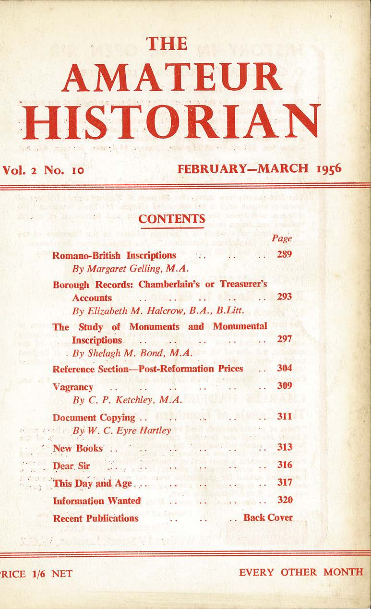
Contents
Romano-British inscription Show more
By Gelling, Margaret
pp 289-292
Descriptive account of the text of inscriptions found on Roman sites in Britain. The article, which includes many examples, covers tombstones; military inscriptions; altars and their dedications; graffiti on wall-plaster, tiles and other media; writing tablets; maker's marks; and inscriptions from buildings and monuments. The article interprets some of the inscriptions by showing how the text provides a good deal of valuable information about the circumstances of its creation or the individual commemorated.
Borough records: chamberlain's or treasurer's accounts Show more
By Halcrow, Elizabeth M.
pp 293-296
The article briefly covers the pre-1835 (i.e. pre-Municipal Corporations Act) accounts kept by borough officers, suggesting that these very valuable records should be read in conjunction with other sources such as the contemporaneous minutes, and using some examples from Newcastle-upon-Tyne shows some of the types of information which accounts contain. Much of the discussion concerns the nature of municipal finance before 1835, indicating how revenue and expenditure were accounted and how money was raised. The extreme and often eccentric diversity of expenditure is considered, and it is emphasised that almost every aspect of urban life will be reflected in a properly kept set of accounts of the period (see also 02 09 265-267).
The study of monuments and monumental inscriptions in churches Show more
By Bond, Shelagh M.
pp 297-303
General discussion of the interest and historical value of the inscriptions in churches and of the style and artistic aspects of monuments. The article notes that only a small proportion of church inscriptions have been transcribed [1956] and that there is much scope for such exercises: suggestions as to possible methods are listed. A description of the main characteristics of inscriptions follows (language; genealogical detail; verses and recitations of the achievements of the deceased; local historical information; the character of the person commemorated) and there is a note about the importance of identifying the sculptor. The article also covers brasses, mural tablets and more ambitious architectural monuments, and lettering styles and forms.
Vagrancy Show more
By Ketchley, C.P.
pp 309-311
Description of the vexed question of vagrancy and the legislation which guided local policy concerning vagrants between the late medieval period and the early 19th century. The article considers legal definitions of vagrancy and the punishments and penalties which were applicable under the law. Other topics mentioned include: the problem of lunatic vagrants; vagrant children; children born to vagrants and their place of legal settlement; penalties for those who harboured vagrants; methods of searching for, apprehending and imprisoning vagrants; and a brief note of medieval views of the problem (see also 02 09 268-270; 02 11 334-336; 02 12 357-361).
Document copying Show more
By Hartley, W.C. Eyre
pp 311-312
Explanation of how to copy documents using a home-made version of a 'reflex copier', a device which relies on the production of a negative image on photographic paper. The article is of interest as an indication of the problems faced by the researcher in the distant days before photocopying.
[Hide]

Hugo Javier Freitas


Laura Yeoman