The Amateur Historian Volume 2 Number 12 June July 1956
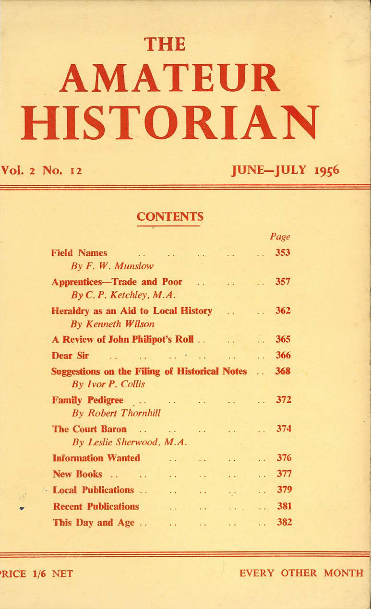
Contents
Field names Show more
By Munslow, F.W.
pp 353-356
Introduction to the subject of field-names which, it is argued, are an essential part of any village or parish history. Munslow gives a very brief history of fields but then focuses on sources, emphasising the importance of the tithe 'award' and maps [with some misconceptions about their purpose], estate maps and plans, and enclosure awards. Other possible sources are listed. The concluding section deals with interpretation of names, suggesting that reference to the English Place-Name society volumes may be useful as well as various dialect dictionaries and glossaries. The absence of published studies on the subject is noted. The article is illustrated with a redrawn version of a 1623 plan of Harpenden, Hertfordshire.
Apprentices - trade and poor Show more
By Ketchley, C.P.
pp 357-361
A detailed account of the legislative context within which the apprenticeship system operated, defining different types of apprentice and explaining the circumstances and terms of apprenticeship agreements. The article divides apprentices into two categories, the first being those 'in trade' and subject to the Statute of Apprentices of 1563, and the other the pauper apprentices who were bound under the Old Poor Law of 1598 and 1601. Both categories are considered and the detailed regulations by these and subsequent statutes are summarised. The article includes examples of apprenticeship indentures for both circumstances, from Bitton, Gloucestershire (1779 and 1713): these are transcribed in full. Possible sources of information for apprenticeship (and in particular the likely types of parish record on the subject) are noted briefly (see also 02 09 268-270; 02 10 309-311; 02 11 334-336).
Heraldry as an aid to local history Show more
By Wilson, Kenneth
pp 362-365
The article, which is intended to be read in conjunction with the author's previous article (02 08 232-234), discusses the development of formal aspects of heraldry associated with the founding of the College of Heralds in 1483 and the implementation of the visitation procedure. It covers a range of examples of heraldry in different types of buildings, such as church bosses, stained glass windows and tombs; stone carvings on castles and houses; furniture and domestic utensils; civic heraldry; and monuments. There is a short explanation of some of the interpretations to be placed upon heraldic devices and their possible historical context.
Suggestions on the filing of historical notes Show more
By Collis, Ivor P.
pp 368-372
Beginning with the suggestion that the article 'may help the amateur to keep his notes in order', Collis sets out his method for note-taking, explaining layout, headings and style of pages of notes and how to keep them in order.
Family pedigree Show more
By Thornhill, Robert
pp 372-373
Description of the author's personal method of compiling and indexing or referencing notes and pedigree material for his own family, based on an alphanumeric system determined by Christian names of individuals.
The court baron Show more
By Sherwood, Leslie
pp 374-376
Explanation of the origins and development of courts baron and the structure of manorial courts in general, with notes on the various officials who participated in the system of manorial administration. Their respective tasks and the procedures followed in the courts are described and there is a detailed account of the formal business which preceded the court. Several oaths are transcribed and there is a very brief reading list.
[Hide]

Hugo Javier Freitas


Laura Yeoman