The Amateur Historian Volume 2 Number 4 February March 1955
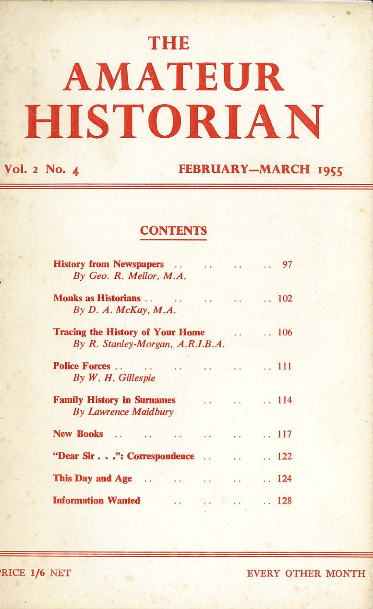
Contents
History from newspapers Show more
By Mellor, George R.
pp 97-101
Arguing that newspapers are a particularly detailed and vivid source for local history from the 18th century onwards, Mellor reviews with illustrations from newspaper articles and items the range of material which is potentially available. He gives particular attention to the value of advertisements, suggesting that contrary to popular opinion these may often be more truthful than the reports on the news pages! Some of the themes which newspapers can illustrate are noted and there is information on how to locate copies of old newspapers in libraries and elsewhere. A short list of references and handlists is appended.
Monks as historians Show more
By McKay, D.A.
pp 102-105
General discussion of the medieval and earlier monastic chroniclers and their importance and reliability as historians. The article considers the doubtful veracity of much that they recounted, including the mixing of fact and fiction and the tendency towards repeated plagiarism of earlier chronicles. In contrast, it is pointed out, there is a high degree of reliability in the work of certain writers such as Bede and Matthew Paris. The process of chronicle compilation and writing is outlined and there are very brief biographical accounts of Bede, William of Newburgh, William of Malmesbury and Matthew Paris. A few titles for further reading are listed.
Tracing the history of your home Show more
By Stanley-Morgan, Robert
pp 106-110
Article which outlines the main sources for house history, a subject which later became a major area of interest to amateur historians. The subjects noted include interior design; inventories; correspondence; architectural details; building plans; other maps and plans; census returns; title deeds; manorial records; taxation records; and the resources of the British Library and British Museum (NB almost all the suggestions relate to larger and more substantial properties).
Police forces Show more
By Gillespie, W.H.
pp 111-113
Outline description of the origins of the police force, noting in passing the types of records which they might have kept. Much of the article is concerned with the present-day (1955) organisation of the police in England and Wales. The article notes tartly that 'memoirs of police officers are not as a rule a useful source. They have mostly been written by retired C.I.D. officers to catch the sensational market and give highly coloured accounts of the cases passing through the writer's hands'.
Family history in surnames Show more
By Maidbury, Lawrence
pp 114-117
Discussion of the development of surnames in the medieval period, beginning with a review of how Anglo-Saxon personal names were formed, with the increasing use of a second name, and then continuing with a description of the early medieval methods of naming in which the 'to-name' is added to the Christian name. The article then reviews the gradual adoption of hereditary surnames from the 13th century onwards. There is reference to the vagaries of surname-spelling until modern times, and to the possible meaning of surnames, with mention of those deriving from occupations, parentage and place-names.
[Hide]

Hugo Javier Freitas


Laura Yeoman