The Amateur Historian Volume 2 Number 5 April May 1955
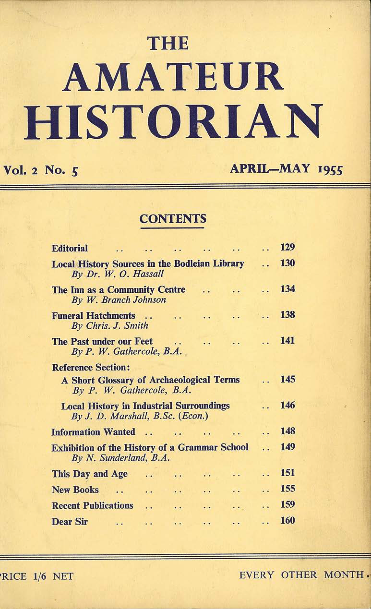
Contents
Local history sources in the Bodleian Library Show more
By Hassall, W.O.
pp 130-133
Brief account of the value of the Bodleian Library, Oxford, for local history research. Little detail is given but the article mentions printed works and its role as a copyright library; antiquarian collections; monastic cartularies; catalogues to manuscript collections; printed catalogues; records of the diocese of Oxford and its archdeaconries; college archives; and access arrangements.
The inn as a community centre Show more
By Johnson, W. Branch
pp 134-137
Account of the ways in which local inns and taverns were used for purposes other than drinking and accommodation. The article notes that many myths and yarns have grown up about older inns, and must be treated with extreme caution, but that the following activities or uses of the building may be encountered: signing of oaths; tax collecting; holding of inquests; meetings of courts, even at quarter sessions level on occasion; official enquiries; excise officers were based there; postmasters and letter receiving; meetings of e.g. turnpike trustees; parish vestry meetings; billeting soldiers; public meetings and protest meetings; schools; offices for benefit and friendly societies; dinners and feasts; gentry clubs and societies; and theatrical performances. Each is illustrated with a short example from the Home Counties, and possible sources for such evidence are noted briefly.
Funeral hatchments Show more
By Smith, Christopher J.
pp 138-140
An article, intended to form part of an occasional series on the 'byways of heraldry', Smith gives a descriptive account of funeral hatchments, which originated in the Netherlands and became very popular in England in the later 17th century. They are boards, usually diamond-shaped, which carried the painted arms of a deceased person of status, and they are now often found in parish churches. The article explains the growth of the fashion during the 18th century and notes their decline almost to extinction by the late 19th. Heraldic procedures and rules are considered and the styles are noted. The reasons for the widespread loss and destruction of hatchments are identified.
The past under our feet Show more
By Gathercole, P.W.
pp 141-144
An introduction to archaeology, which seeks to explain what archaeologists do, why they excavate, and how they try to date the objects which they find. The article is informal and anecdotal but includes a brief note of the landscape history of Britain as it was then [1955] perceived and some eyewitness accounts of excavations attended by the author. A short list of books for further reading is included.
A short glossary of archaeological terms Show more
By Gathercole, P.W.
pp 145
Single-page glossary of 28 terms ('artefact' to 'typology') appended as separate section after the previous article (02 05 141-144) which introduces archaeology to the general reader.
Local history in industrial surroundings Show more
By Marshall, J.D.
pp 146-148
Arguing that many local historians choose not to look at urban and industrial subjects and localities, Marshall suggests that there is much potential in such topics and that plenty of interesting and valuable sources are available. He then discusses some of these and elaborates upon the type of themes which might be investigated: business history and the history of industries of major importance to the town; railway history and its links with industry and towns; the use of newspapers as a key source; corporation archives; private and institutional records (which 'the enthusiast with a tactful approach and the right connections will pillage'); and the resources of the central library.
Exhibition of the history of a grammar school Show more
By Sunderland, N.
pp 149-150
Account of an exhibition on the history of Queen Elizabeth Grammar School, Darlington (founded 1563) which was held in 1954. The article lists the main categories of documentary material which were available for display, including the original charter, photographs, old textbooks, administrative records, licenses for schoolmasters and sport memorabilia.
[Hide]

Hugo Javier Freitas


Laura Yeoman