The Amateur Historian Volume 2 Number 6 June July 1955
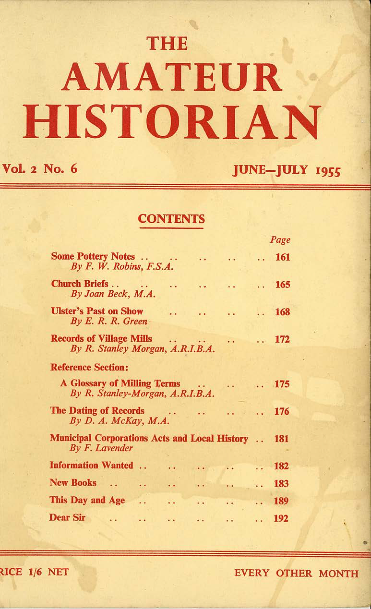
Contents
Some pottery notes Show more
By Robins, F.W.
pp 161-164
In the second of an occasional series on archaeological topics, Robins discusses the main pottery types to be found from the Roman period through to the early Middle Ages, with brief notes on the different appearance of the characteristic styles, shapes, marks and glazes, and the types of vessel produced. The article is roughly chronological and there is a very short bibliography.
Church briefs Show more
By Beck, Joan
pp 165-167
Short account of the development of church briefs, the appeals for assistance for worthy causes which were publicised from the pulpit and followed by a collection among the congregation. The system expanded from the mid-16th century and reached a peak in the late 17th and early 18th centuries. It was finally abolished in 1828, having become cumbersome, expensive to administer and recognisably inefficient as a means of helping causes. At a time of social change, furthermore, it was no longer relevant or appropriate. As well as providing funds for church repair and the restoration or replacement of churches damaged by fire and flood, the system also embraced many individuals suffering unexpected or heart-rending misfortune.
Ulster's past on show Show more
By Green, E.R.R.
pp 168-171
Account of the origins, organisation, content and effectiveness of an exhibition on local history which was staged at the Royal Ulster Society Show in Belfast in the summer of 1954.
Records of village mills Show more
By Stanley-Morgan, Robert
pp 172-175
Based almost entirely upon records of watermills, the article discusses a few potentially useful sources without any detail, and is preceded by a review of the history of watermills. The technology is outlined, including notes on the use of water-power for a variety of early industrial processes, and there is a helpful one-page glossary of terms.
The dating of records Show more
By McKay, D.A.
pp 176-180
Summary of the main elements in the development of the English calendar and of dating methods for historical documents. The article begins with an account of the variability of dating over the past 1000 years, including the difference between Old Style and New Style dating and the use of different dating systems in different countries. It then explains the procedure for dating by regnal years and the idiosyncrasies inherent in that system. There is a detailed account of the calendar change and the introduction of the Gregorian system in England in 1752. Other dating systems employed by the Church and by the Romans are described and there is a useful summary of the use of saints' days, religious feasts and other events in the annual Church calendar.
Municipal Corporations Acts and local history Show more
By Lavender, F.
pp 181
Note which points out that many published sources assume that the 1835 Municipal Corporations Act reformed the government of all the boroughs which then existed, but that although it dealt with 284 such places no fewer than 110 other and almost invariably minor boroughs were for various reasons not within its scope. The 1883 Act, which followed a Royal Commission of 1880, covered these places and it is suggested that the Commission Report of that year would be a valuable source for local historians.
[Hide]

Hugo Javier Freitas


Laura Yeoman