The Amateur Historian Volume 2 Number 8 October November 1955
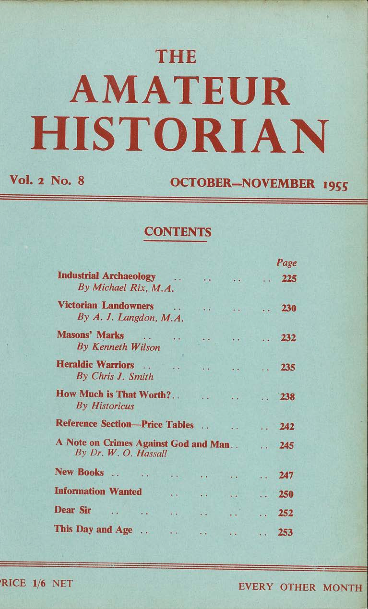
Contents
Industrial archaeology Show more
By Rix, Michael M.
pp 225-229
Pioneering article (1955) introducing what later became one of the main areas of new academic research and writing, and of popular involvement, in the world of local history. Rix notes the importance of Britain's industrial history and gives special attention to Coalbrookdale and its significance in world terms. He refers to many examples of structures, buildings and districts where fine industrial monuments survived and which demanded to be looked at with different eyes - the article notes that these sites often have great beauty as well as intrinsic interest. The article concludes with a short account of societies and other organisations working in the field, and suggests, presciently, that 'there are still many monuments to be scheduled, many books to be written and much field work to be done before industrial archaeology can begin to take its rightful place among the studies of these islands'.
Victorian Landowners Show more
By Langdon, A.J.
pp 230-231
Basic introduction to a source which in the early 1950s was little-used - the 1873 Return of Owners of Land. The article describes the background to the preparation of the Return and the types of information which it contains, and then notes some contemporary reactions and evidence for errors and exaggerations. Three late Victorian analyses which used the 1873 returns (Bateman 1883, Caird 1878 and Brodrick 1887) are identified as particularly useful.
Masons' marks Show more
By Wilson, Kenneth
pp 232-234
Masons' marks are a well-known feature of many parish churches and other buildings, although in reality they are often little understood. The article describes the procedures for employing masons and other craftsmen on buildings in the Middle Ages and notes the peripatetic nature of their work, moving from project to project. The identification of their presence by the use of distinctive marks is then considered, and it is suggested (with an example from the Vale of York and Craven area) that if enough evidence is obtained it should be possible to plot on maps the 'routes' or movements of particular masons.
Heraldic warriors Show more
By Smith, Christopher J.
pp 235-238
Discussion of the heraldic role of supporters, the figures which in a coat of arms stand on either side of the shield as though guarding it. The article notes non-human supporters such as lions but most of it is devoted to consideration of the knights, soldiers and other uniformed or armoured figures which commonly appear. Many examples of specific figures are quoted, including some which have modern (late 19th-mid-20th century) themes on recently-granted coats of arms.
Topography and maps Show more
By Historicus
pp 238-244
The author suggests that new methodologies for local history using maps and plans can offer benefits over more chronological studies. A topographical study may reflect economic and social factors, as well as changes in population, if taken with a study of geological influences such as water resources and building materials. Village studies must be made in conjunction with an investigation into the factors which affected agricultural development, field shapes, and settlement patterns. Reconstruction of the settlement site can best be achieved by consulting estate plans, which may show field systems; county maps, perhaps showing fields and buildings; pre- and post-enclosure maps; tithe maps, with details of ownership, usage and acreage; and highly-detailed modern maps.
A note on crimes against God and man Show more
By Hassall, W.O.
pp 245-246
Short note on quarter sessions records as a useful source for local history, with reference to the availability of published extracts, calenders and lists.
Protestation Oaths - answer Show more
By Resker, F.J.R.
pp 251
Short note concerning the 1642 Protestation Oaths, giving a background and the text of the oath.
[Hide]

Hugo Javier Freitas


Laura Yeoman