The Amateur Historian Volume 3 Number 2 Winter 1956-7
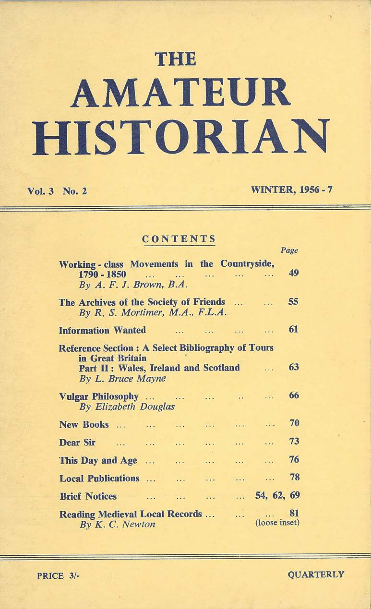
Contents
Working-class movements in the countryside, 1790-1850m Show more
By Brown, A.J.F.
pp 49-54
A study of rural labour movements, beginning with the period of the French Revolution and arguing that the reasons for discontent at that time were mainly economic rather than political - prices were rising faster than wages - and that in England and Wales a widespread growth in the extent and seriousness of rural poverty is apparent from studies of farming communities and analysis of overseers' accounts. Other sources suggest that changes in working practices generated discontent: labourers were often hired on a piecemeal basis, rather than on a long-term contract, and there are suggestions that increasing mechanisation of agriculture led to widespread dissatisfaction. The author refers to the growth of well-organised rural trade movements, and the influence of national movements such as Chartism, which attracted considerable support in smaller towns. The failure of Chartism possibly affected rural communities more than urban ones: the author suggests that more aggressive and direct displays of discontent, such as incendiarism, were one consequence.
The archives of the Society of Friends Show more
By Mortimer, R.S.
pp 55-61
Summary of the main contents of the Quaker archives, beginning with an explanation of the organisation of the Society of Friends: i) the London Yearly Meeting, which functions as the governing body of the movement; ii) local congregations, known as 'preparative meetings'; iii) the monthly meetings, made up of several preparative meetings; and iv) the quarterly meetings, embracing several monthly meetings. The main categories of records which have been meticulously kept over the last three centuries and more are: i) records of 'sufferings'; ii) central archives; iii) local archives, including deeds and property records, registers, administrative papers including minutes of meetings; and iv) registers of births, marriages and deaths.
Science in the service of archaeology Show more
By Mayne, L. Bruce
pp 63-66
An account of a scientific project which aimed to locate the causeway used by King John's baggage train when crossing the estuary of the Wellstream (The Wash) in 1216, and which was therefore, it was hoped, the scene of the famous loss of the jewels.
Vulgar philosophy Show more
By Douglas, Elizabeth
pp 66-69
Short study of almanacs and their contents, with discussion of their origins and development.
Reading medieval local records Show more
By Newton, K.C.
pp 81-94
Study of the chief characteristics of medieval handwriting and suggestions on how to decipher medieval documents. The author focuses on court hands, which were the specialised scripts generated by the law courts from the 12th century onwards. He suggests that developments in handwriting are relatively easy to identify by period, and so are often essential in the dating of a document. The article provides examples of i) abbreviations, including tables of signs and marks; ii) signs of contraction and suspension; iii) modification of letters; iv) abbreviation by superior letter; and v) runes. The article is extensively illustrated, with examples of original documents and translated texts (NB this article was subsequently reprinted: 07 03 88-91)
[Hide]

Hugo Javier Freitas


Laura Yeoman