The Amateur Historian Volume 3 Number 3 Spring 1957
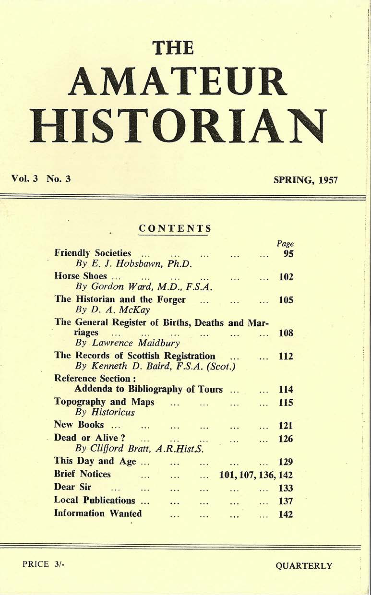
Contents
Friendly societies Show more
By Hobsbawm, E.J.
pp 95-101
A study, by one of the most influential radical historians of the mid-20th century, of the friendly societies which were originally established in the later 18th century to allow 'common' people to save for sickness or funeral benefit. Many societies soon became complex and more ambitious social organisations, with clearly-defined rules and regulations, and were often based around trades and crafts. Thus they often evolved into nascent trades unions. They were given legal recognition in 1793, and this ensured that their funds could be protected at law. Sources for information on friendly societies include literary records and discussions; industrial histories; parliamentary papers; periodicals and newspapers; directories and surveys; society pamphlets; and original documentary records such as rulebooks, reports, minute books and balance sheets. Hobsbawm advises on a methodology, including research into the founding of societies at local level and preceding methods of protection for working men. Geographical location (both urban and rural), rates of expansion, membership figures, regional variations in membership patterns, and the operating procedures of individual societies are other themes which are suggested as being worthy of investigation.
Horse shoes Show more
By Ward, Gordon
pp 102-104
The article traces the origins of horseshoes from archaeological and other evidence, suggesting that they were first used in about 100 BC. Ward comments on the characteristics of commonly found examples and some of these are illustrated.
The historian and the forger Show more
By McKay, D.A.
pp 105-107
An analysis of the forging of documents, separating the motives into two main categories: i) those who forged documents to benefit themselves; and ii) those who forged them deliberately to delude historians. Early examples of the first type include medieval forgers who sought to guarantee their tenure of land by creating a false title - monastic houses often forged these documents as spurious evidence of long-term ownership, but in other cases the written version 'confirmed' what had previously been accepted on the basis of oral evidence. Such false land charters became commonplace, although closer investigation often reveals inconsistencies or invented names. Examples of the second type are also quoted: these, too, show evidence of clumsiness and inconsistency, even though in the past they were frequently accepted as genuine.
The general register of births marriages and deaths Show more
By Maidbury, Lawrence
p 108-112
A description (1954) of the General Register Office [GRO] procedures for the civil registration of births marriages and deaths, a system instituted in July 1837 and now familiar to most family historians, but much less well-known when this article was written. At that time the records were kept at Somerset House and Maidbury describes the process by which one might investigate the records, as well the pitfalls that might be encountered when searching for genealogical material.
The records of Scottish registration Show more
By Baird, Kenneth D.
pp 112-114
Brief description of the system for civil registration of births, marriages and deaths in Scotland, as a potential source for local and family history.
Dead or alive? Show more
By Bratt, Clifford
pp 126-129
Suggestions for ensuring that local history societies thrive and flourish, including guidance on running successful meetings, recruitment of new members, outings ('field days') and publishing.
[Hide]