The Amateur Historian Volume 4 Number 2 Winter 1958-9
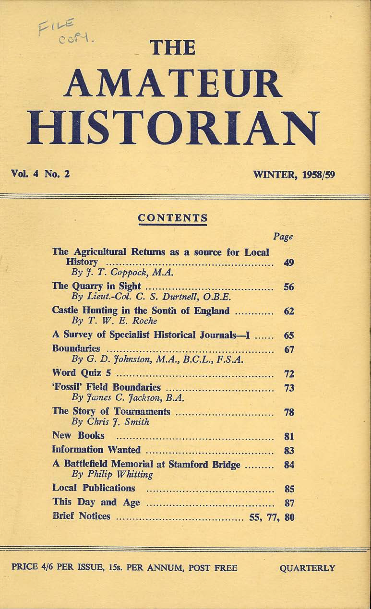
Contents
The Agricultural returns as a source for local history Show more
By Coppock, J.T.
pp 49-55
Analysis of ways in which the annual agricultural returns from 1866 onwards may be used by local historians. The returns detailed livestock numbers and crop acreages, and although the original documents were destroyed the summary totals were retained by the Ministry for Agriculture. The author warns that some of the figures are open to differing interpretations and have inherent ambiguities, but suggests that they indicate the effect of topography and geology on crops. They may also prove useful in studying regional differences. Farms were often spread over a number of parishes, but changes in crop variations are shown in considerable detail. Weaknesses in the data were caused by differing collection methods in different areas and there were occasions when collecting officers were forced to provide estimated figures.
The quarry in sight Show more
By Durtnell, C.S.
pp 56-61
Research case-study, tracing the name Durtnell, with suggestions for genealogical researchers who might want to investigate the period before the 15th century. Includes explanations of how to use manor court rolls (especially with regard to land transfers); militia rolls; feet of fines; wills and other probate records; deeds; and family histories.
Castle hunting in the south of England Show more
By Roche, T.W.E.
pp 62-65
The first section of a two-part study of castle sites and the history of castles, which are defined as fortified dwellings and buildings constructed in the 500 years after 1066. The author recommends the use of maps and guides to locate these sites, backed up with extensive fieldwork. Basic structures and construction techniques are outlined, including the simple motte and bailey, keeps, moats and defensive walls - a number of examples are mentioned. Various designs are discussed and analysed, including the development of gatehouses and 'chains' of defensive emplacements. Finally the author notes the destruction of many fine examples during the Civil War (see also 04 03 95-97).
A survey of specialist historical journals - I Show more
By Munby, Lionel M.
pp 65-66
In this, the first of an occasional series, Munby assesses the journal Medieval Archaeology, noting its aims and objectives and describing the contents and articles in typical issues. The journal is surveyed mainly in terms of how it might be useful to local historians.
Boundaries Show more
By Johnston, G.D.
pp 67-72
An article defining the concept of boundaries, including discussion of defensive lines; the sea; rivers; roads; undefined boundaries of unknown origin; artificial boundaries; county boundaries; detached parts of administrative divisions; and legislative boundaries.
'Fossil' field boundaries Show more
By Jackson, James C.
pp 73-77
A study of the existence of 'open field' cultivation in northern and upland Britain. The evidence was, in the early 1950s, regarded as very limited, but the author discusses the evidence from the Derbyshire Peak District where there were surviving areas of highly distinctive field patterns, in which long narrow enclosures were bounded by drystone walls. He suggests that this developed as bundles of the original medieval arable strips were enclosed to form new fields. The postulated original strips followed patterns characteristic of those in lowland areas further south - in particular, they form an elongated ÔSÕ shape, possibly due to the ploughing techniques used. This shape itself persists in some of the enclosed fields studied, and can be contrasted with the straighter field boundaries which were 'artificially' formed by enclosure commissioners in the 18th century.
The story of tournaments Show more
By Smith, Christopher J.
pp 78-80
Description of the medieval tournament, including the techniques which were used to organise them and the shift in emphasis and motivation, from military practice to the decorative and spectacular pageant.
A battlefield memorial at Stamford Bridge Show more
By Whitting, Philip D.
pp 84-85
Account of the planning and construction of a memorial which commemorates the battle of Stamford Bridge (Yorkshire) in 1066 between Harold II of England and Harold Hardrada of Norway.
[Hide]

Hugo Javier Freitas


Laura Yeoman