
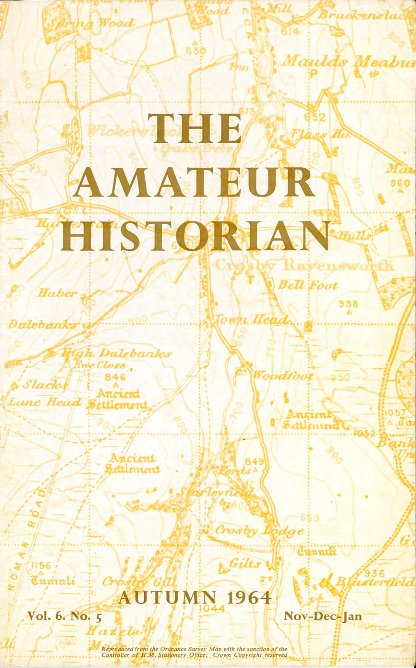
The Amateur Historian Volume 6 Number 5 Autumn 1964
Contents
Parish registers and population history I Show more
By Wrigley, E.A.
pp 146-150
A study of the demographic potential of parish register data in the period 1538-1837, which saw the general transition in England from an essentially rural and agrarian society to a more industrialised and urbanised one. The article concentrates on the use of birth and death rates to trace population change. It is suggested that, despite the considerable difficulties in ascertaining long-term figures, much information can be obtained by analysing change and trying to correlate trends with other external factors - for example, comparing birth and death rates with weather and climatic variations, the quality of the harvest and price indexes. Wrigley commends the use of family reconstitution techniques, and gives a simple methodology to introduce this type of research in the context of demographic analyses (see also 06 06 198-203).
A source on land ownership: the land tax returns Show more
By Grigg, David
pp 152-156
A study of the use of land tax returns for analysing changes in land-holdings in the 18th and 19th centuries. The returns show all the occupiers of land in a parish and the tax which they paid, which was calculated in proportion to acreage. The article shows how these returns can be used, for example, to show differences between the nature of landownership across an area, or the decline over time in the place of the yeoman farmer. Grigg outlines some problems which will be faced in using the land tax returns: i) that documents can be either assessments or returns; ii) that early land taxes were based on assessments often made several years previously, so that they do not give a true contemporary picture; and iii) rents per acre might vary within a single parish, so that a direct relationship between tax levied and acreage may not be present. The author then discusses the value of the records, suggesting that they may i) indicate the changing fortunes of smaller landowners; ii) allow the distribution of ownership and tenanted properties to be mapped; iii) highlight fiscal aspects of problems and disputes which occurred during enclosure; and iv) emphasise the relative or absolute dominance of major landholdings and great estates.
Eminent local historians: I Canon C.W. Foster of Timberland,Lincolnshire, 1866-1935 Show more
By Stenton, Doris M.
pp 157-162
Biographical article on Canon Foster, one of Lincolnshire's most eminent historians of the late 19th and early 20th centuries.
Organisation of biographical material for use in village histories Show more
By Iredale, David A.
pp 163-165
A case-study of one approach to the researching and writing of a village history (the example used is Barnton in mid-Cheshire) explaining how the history was written by tracing biographical details of the local inhabitants from a wide range of primary and secondary sources.
The beginning of the village Show more
By Thirsk, Joan
pp 166-169
In this response to a query regarding open field village systems, Thirsk suggests that villages underwent many changes after their foundation, as they evolved into mature settlements; she notes in particular the changing land use which may have characterised village communities, and the development of nearby 'daughter' settlements.
Nottinghamshire 'Achievements': a note Show more
By Watson, C.H.B.
pp 169-170
Discussion of the use of funeral hatchments, which were carried in funeral processions and subsequently mounted in local churches. They represented status symbols among the wealthy and often featured mock heraldic designs. Many hatchments, most of which dated from the 17th and 18th centuries, were lost in the mid-19th century as clergy stripped church interiors to create a more austere and simple impression, but the author identifies examples from the county and notes the restoration of some recently-discovered hatchments. Searches for others have been undertaken and a number of other survivors located.
[Hide]

Hugo Javier Freitas


Laura Yeoman


