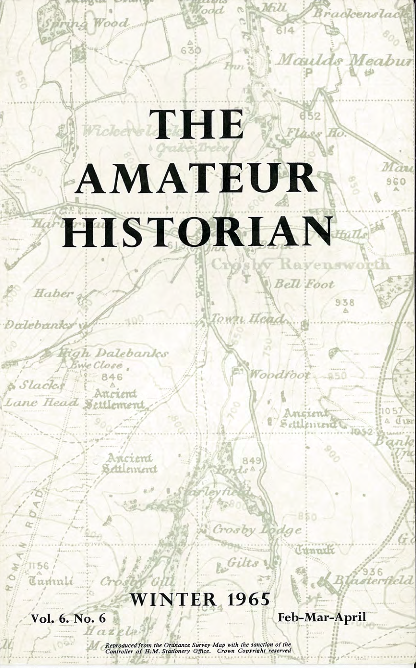
The Amateur Historian Volume 6 Number 6 Winter 1965
Contents
Amateur study of local history Show more
By Skipp, Victor
pp 182-185
A response to the debate on definitions and methodologies in local history and to the suggestion, made in a previous article by John Marshall, that studies should be either regional or should be restricted to narrowly-defined 'topics'. The author advances the case for co-operative exercises, while agreeing that much adult education in local history is concerned with the simple approaches of compilation of factor and transcription of primary material. He shows that adult education in Birmingham, organised in classes which, for example, study parish history, does take account of contextual issues, as well as promoting in-depth research. He suggests that, with care, this type of class is well suited to making important contributions with a high academic quality.
Wives to market Show more
By Yarham, E.R.
pp 188-191
A study of the practice of selling wives, which is popularly supposed to have been a relatively widespread phenomenon and which achieved particular notoriety after Thomas Hardy used it as a key episode in The Mayor of Casterbridge. The article refers to a number of well-attested examples, as well as to the evidence supplied by Hardy. Originally regarded in popular custom as at least a semi-legal practice, it was formally declared illegal in the late 19th century.
Documents in the Public Record Office: 1. Personal records of officers of the British Army Show more
By Godfrey, Michael
pp 192-197
A study of the very extensive collections of army records in the Public Record Office and other national repositories, covering the period from the establishment of the modern army in 1660 to the 20th century. The types and categories of material are described in some detail. Lists of officers in the new regiments were published regularly, along with biographical notes. The army records are comprehensive and, from the middle of the 18th century, generally enable researchers to trace the careers and movements of officers. After 1793 records become much more detailed and include evidence of recommendations for commissions, promotions and pay. From the early 19th century the records of retired officers were kept, giving full career information, and in the mid-19th century the proper keeping of internal regimental records became standard procedure.
Parish registers and population history II Show more
By Wrigley, E.A.
pp 198-203
Continuing his investigation into the use of parish register data in demographic analysis, Wrigley highlights the problems which arise because of the very widespread loss of or incompleteness of registers in the Civil War period and the early years of the Commonwealth. He also refers to other reasons for inconsistencies and irregularities in the keeping of these records, such as high mortality rates due to epidemic disease (when burial registers may not have been properly kept), the numbers of dissenters and Catholics in the parish (potentially resulting in under-registration) and the problems caused by local baptismal customs. Wrigley describes the important work of the Cambridge Group and the work of parish register transcription which was undertaken under its auspices. He describes a number of approaches to the construction of parish demographies and explains the 'family reconstitution' method (for use where records are complete) in contrast to simple counting procedures which may be unavoidable in areas with poor records (see also 06 05 146-150).
[Hide]

Hugo Javier Freitas


Laura Yeoman