The Local Historian Volume 38, Number 2 May 2008
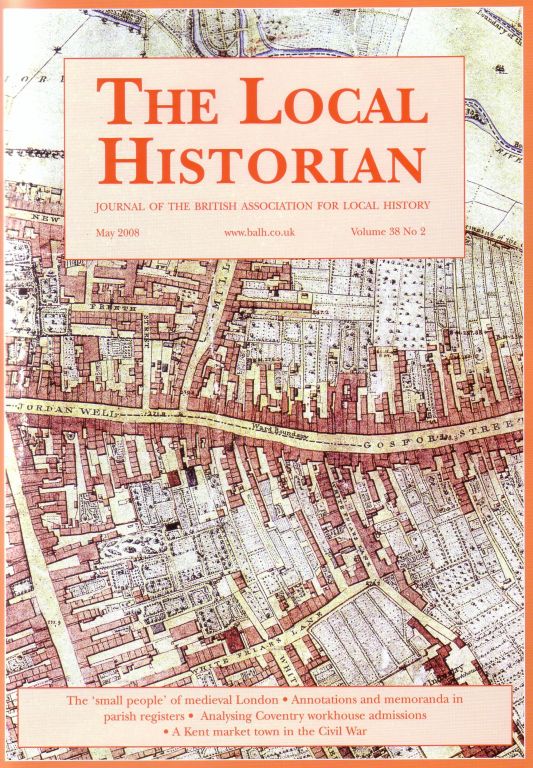
Contents
Editorial Show more
By Alan Crosby
There is little resemblance between Chairman Mao and John Beckett, director of the Victoria History of the Counties of England (known to most of us as the VCH), but both have produced a Little Red Book. The Chinese version has a significantly larger print run, and may have had a greater influence on global history, but both enshrine thoughts, beliefs and attitudes which are very much of their time. The VCH volume is entitled The Little Big Red Book and it has been published to celebrate the 75th anniversary of the adoption of the VCH project by the Institute of Historical Research at the University of London. There is a compendium of information, ranging from a list of all contributors to VCH volumes 1990 .. 2007, via a summary contents list of all Big Red Books and new popular volumes published in that period, to a series of short essays on the history of this extraordinary and idiosyncratic English institution since 1933. It is attractively illustrated with portraits of luminaries, maps, and photographs reflecting themes covered by recent VCH work. There are also testimonials from figures associated with culture and history, including Boris Johnson, a trustee of the Oxfordshire VCH who, by the time this appears in print, may have other matters on his plate.
Its appearance is timely in other ways, for the VCH has been undergoing far-reaching changes and will surely continue to experience further reshaping and reappraisal during coming decades. The most significant, and one with a long ancestry, is the perpetual challenge of finding sufficient funding to carry on the work. This is hardly news, but the evergrowing costs of such a project, and the evergreater complexity of the administrative and organisational frameworks which lie behind any such enterprise, have for many years presented the VCH and its editors with permanent insecurities. That, sadly, shows little sign of changing, and we might cynically feel that to the Rt. Hon. Hazel Blears, Secretary of State for Communities and Local Government, who suggests that By working with local volunteers, the Victorian County History is helping local people to discover, record and take pride in the history of their communities, the volunteer element has obvious financial attractions. And yet the volunteers working on current projects represent a fundamental and very welcome reorientation of the focus of the VCH, which began in the 1960s and 1970s with the inclusion in the Red Books of extended general essays on social, cultural, political and religious topics, essays which in some instances could be published separately as accessible introductions to key themes in local history.
This refocusing, with the adoption of less daunting and more popular works which parallel the traditional (and essential) specialist topographical compilations, has now continued into the production (under the auspices of the Englands Past For Everyone project) of attractive and readable paperback books on particular places, regional themes, and key topics within communities, thus, the volume on Bristol looks in depth at migration and ethnicity over the past millennium, while that on Codford is a popular history of a smaller Wiltshire community. The VCH will never escape either the legacy of its own late Victorian origins (and that is no bad thing) or the burden of fundraising, but it has shown in recent years a welcome ability to adapt and be flexible. That, far more than any sentimental attachment to a great institution, is what has allowed it to survive and flourish in the early 21st century. Floreat VCH!
Searching For The Small People Of Medieval London Show more
By Caroline Barron
In this paper, which is the text of her paper given at Local History Day 2007, Caroline Barron, the foremost authority on medieval London and its government and society, looks at the experience of the small people of the city, the inhabitants who were not among the decision makers and leaders of urban society. She focuses on the ways in which historians have been able to find out about these groups, and analyses the problems faced by researchers. Documentary sources tend, as in other societies and periods, to over emphasise the elites and those higher up the ranks of society, so that many of the small people are less evident. Caroline Barron explained that, despite these limitations, there is much that can be gleaned, directly or indirectly, from court records and the archives of city government. She shows how the underclass was far from homogenous, and that within it there were numerous subtle gradings and rankings and many distinctive groups who, either through their own selfdefined identities or because of the way they were regarded by others, were readily traceable in the historical record. Her analysis focuses on three such identifiable groups, the prostitutes, lepers and vagrants, but it also considers more briefly the situation and circumstances of other groups, such as the largest of all, the women of medieval London. Her detailed investigation of the three specific groups shows, for example, how the citys courts and local decision making bodies such as portmotes treated these people, with a range of possible action which extended from physical punishment or humiliation, via banishment, to relative toleration and regulation. The use of the options changed with time and economic circumstances. The article is packed with detailed examples and weaves together the social, political, cultural and economic strands into a fascinating account of the people of the capital in the Middle Ages.
The Abstracts And Brief Chronicles Of The Time: Memoranda And Annotations In Parish Registers 1538 - 1812 Show more
By Steve Hobbs
Parish registers are perhaps the most important single source for family historians, and have been exploited extensively by local historians who can make use of their evidence for demographic analysis and related statistical presentation, as well as family reconstitution and social investigation. However they may also be a rich source of anecdotal and incidental evidence, because many incumbents and parish clerks used register volumes to record memoranda, legal transactions, diary type entries about local events and conditions, and biographical notes concerning individual parishioners. This means that they may, in some circumstances, be turned from a relatively straightforward record of baptisms, marriages and burials into a local chronicle which illuminates our understanding and greatly extends our knowledge of individual communities. In this paper, which uses examples from Wiltshire, Steve Hobbs discusses this role, looking at the variety and range of information which can be gleaned from the registers. He divides his discussion into several key themes: the registers themselves; charity and the Poor Law; the church and its fabric; the benefice, glebe and tithes; agriculture and weather; demography; incumbents; parish clerks and parishioners; and miscellaneous items. These themes are illustrated with numerous quotations from specific registers, and the potential value of the material for different types of research (social, economic, cultural) is highlighted.
The Vanishing Unemployed, Hidden Disabled, And Embezzling Master: Researching Coventry Workhouse Registers Show more
By Rosemary Hall
Analysis of workhouse admissions is an important aspect of any investigation into the social impact of the post 1834 Poor Law. Using these sources, researchers have looked at the effect of workhouses on, for example, women, the elderly, children and vagrants. As with much else under the system created by the 1834 Poor Law Amendment Act, admission registers were extensively standardised under the auspices of an interventionist and prescriptive central authority in London. Nevertheless, there was some scope for local variation, while the historical legacy of the Old Poor Law and its institutional frameworks could not be dismissed readily. Furthermore, the reliability of registration and other bureaucratic administrative procedures was partly determined by the assiduousness, and indeed the calibre and honesty, of the officials who maintained the records. In this detailed study of the large workhouse in the City of Coventry, Rosemary Hall identifies a range of factors which influenced the reliability of the registers. Coventry was a pre 1834 Poor Law Union, formed by the combining of city parishes for Poor Law purposes, and for thirty years it retained a degree of exemption from the provisions of the 1834 Act, which led to a different quality of record keeping. One of the masters was found to have been dishonest and to have embezzled funds, casting doubt upon the quality of his records, but the most important factor was the changing terminology. Differing descriptions of paupers and the reasons for their admission require careful interpretation if statistical error is to be avoided. The article considers groups such as unmarried mothers, deserted wives and children, and shows the potential for detailed local study of other such workhouse registers.
A Kent Market Town And The Great Rebellion: Bromley 1642 - 1660 Show more
By Patricia Knowlden
Great events and the overarching national themes of politics and constitutions used to be the very stuff of history, but today much more attention is paid to how these big issues impacted locally. Indeed, for many historians the national events and developments are seen, to a considerable extent, as the sum of many local decisions and local factors. This study of the experience of the market town of Bromley, Kent, during the 1640s and 1650s discusses how the Civil War and the Commonwealth period affected, or did not affect, local people and the community as a whole. Patricia Knowlden begins with a description of the locality in the early 1640s, including its commercial activities, and then looks at the importance of the bishops of Rochester, the manorial lords, and their relationship with the town and its people. She then looks at the townspeople, identifying key figures who were prominent in local affairs, before analysing the significance of taxation and tax records, one of the main causes of political controversy in the run up to the war. Later sections consider the extent and orientation of local involvement in the war itself, and the impact of proximity to London, while a final section gives a perspective on the continuance of daily life despite the momentous events happening down the road in the capital. This detailed and accessible local study could serve as a model for others investigating their local community in this turbulent and exciting time.
[Hide]Reviews
Leominster Minster, Priory and Borough c 660 -1539 Show more
By Elizabeth Gemmill
A Woman in Wartime London: The Diary of Kathleen Tipper 1941 - 1945 Show more
By Elizabeth Roberts
Killerton, Camborne and Westminster Show more
By Elizabeth Roberts
Church & people in a Victorian Country Town Barton Parish 1830 - 1900; Lincolnshire Parish Correpondence of John Kaye Bishop of Lincoln 1827-53; The Barony of Glasgow a window on to church and people in the nineteenth century; A Northern Catholic Communit Show more
By Evelyn Lord
The Jacobite Invasion of 1745 in North West England Show more
By John Sutton
Medieval Devon and Cornwall, Shaping an ancient countryside Show more
By Graham Winton
LEOMINSTER MINSTER, PRIORY AND BOROUGH c660-1539 by Joe and Caroline Hillaby (Friends of Leominster Priory/Logaston Press 2006 292pp ISBN 1 904396 56 9) £10 from FLP Townsend House, Luston, Leominster HR6 0DZ
The striking achievement of this book is that it offers a highly detailed account of Leominster’s minster, priory, and town, from the first foundation of the minster in the seventh century to the demise of the priory in the sixteenth, firmly set within the framework of local, regional, national, and even international events and influences. There is always a strong sense of place, and indeed the priory’s strategic location in the often-troubled Marches of Wales is shown to have been a key factor in its history.
The book opens with the story, based on the twelfth-century Life of St Mildburg, of the conversion by Edfrith, monk of Northumbria, of Merewalh, ruler of the people west of Severn, in about 660. Merewalh then endowed the minster, so the foundation is part of the wider pattern in which royalty played a key role in the conversion of the English people. Leominster’s early history as an important religious centre and repository of saintly relics is explored, with a detailed discussion of the contents and likely Leominster provenance of the Anglo-Saxon prayer book, now in two manuscripts in the British Library, against the background of the tenth-century monastic reform movement. The prayer book is used as evidence of local saintly cults, of Roman influences in the region west of the Severn, and in support of the possibility that, by the early eleventh century, the foundation had become a nunnery. The Domesday evidence for the great manor of Leominster is discussed in the context of its ranking in the pattern of local land ownership.
A new set of influences was brought to bear with the re-foundation of Leominster in 1123 by Henry I as a dependency of his great Cluniac abbey of Reading. Leominster’s history was ever after bound up with that of its mother house. The Romanesque monastic church does not survive, but the authors draw on the results of archaeology and comparisons with other periapsidal churches in England and on the Continent to evoke its likely appearance. The architecture is described in terms of liturgical function, Cluniac monastic observance and Leominster’s role as a pilgrimage church. The detailed account of the architecture of the nave, the part of the church which served the needs of the parishioners and which does survive, is again enriched by comparisons drawn with other Romanesque churches in the region and beyond. The discussion of the (now mainly lost) cloister and conventual buildings emphasises the functions of the separate buildings, the priory’s obligations to its servants and relations with the local community, and the working of the home farm.
The development of the market town is set clearly in the context of the promotion of trade by the Crown and ecclesiastical landlords in the twelfth and thirteenth centuries. The nature of burgage tenure and Leominster’s economic base in wool, cloth and leather, its government and parliamentary representation are addressed. The development of the nave of the church and establishment of the parochial lady chapel are seen as evidence of the growing civic pride of the burgesses in the later medieval period, while written evidence, such as that in the Hereford bishops’ registers, is used to show increased assertiveness in their relations with the priory.
A special strength of the chapters on the agricultural economy is the separate treatment of different locations within the priory estates, allowing discussion of their separate topographies and deployment of resources. The post-Black Death practices of leasing estates, commuting labour services, and favouring sheep farming are explained, tendencies common among larger landowners in the later middle ages. The impact of the demographic decline of the fifteenth century on the success of market towns in Herefordshire is explained as the context for the experience of Leominster. There, it is suggested, the fifteenth-century architectural features in the parish church speak of relative prosperity and even new confidence on the part of the borough elite, due to Leominster’s continued success in producing good-quality wool, manufacturing cloth, and stock farming.
The book concludes, as it must, with the priory’s inauspicious demise at the Reformation. But the Epilogue, describing the descent of the lordship of Leominster thereafter, emphasises the continuities with its grander past, and in particular it is pleasing to note the adaptation of the Edfrith tradition to become the foundation legend of the borough.
The authors make use of every scrap of available evidence to add to the rich tapestry of Leominster’s history. Perhaps the jewel in the crown is the Anglo-Saxon prayer book; but the written source material - including unpublished material from both local and national repositories - ranges far beyond this. Of special value are the extracts of the halmote rolls used to elucidate the management of the priory estates in the fourteenth century. Archaeological investigations, architectural features, artefacts, studies of the townscape and standing buildings are all brought into play to illuminate the functions of the priory and the growing importance of the town. The book is enhanced by generous use of black and white and colour plates (of special note are the reproductions of sections of manuscripts, and of the remarkable capitals in the nave), plans, maps, aerial photographs, figures, and tables.
This book will surely appeal to local people wanting to learn more about the history of their church and town, and indeed local initiatives have been highly important in the project. But it will also be enormously informative to anyone seeking to deepen their understanding of medieval monasteries and their associated communities. The book gives a very clear sense of the manifold connections of an important religious house: its relations (sometimes stormy) with its parishioners and townspeople; its responsibilities to its servants; its links with the bishop of Hereford, its local patrons, and its mother house; and the often far-flung cultural influences that inspired its architecture. Those involved in the production of this splendid book – above all its authors, but its supporters and sponsors – should be very proud of its achievement.
reviewed by Elizabeth Gemmill
My Dear Brother: the letters of Thomas and Henry Hookham 1830-1899 from schooldays in Princes Risborough Bucks, to later life in London and in Christchurch New Zealand Show more
By Pamela Horn
A WOMAN IN WARTIME LONDON The Diary of Kathleen Tipper 1941-1945 ed. Patricia and Robert Malcolmson (London Record Society 2006, xix+202pp ISBN 0 90095241 5) £20
Kathleen Tipper was born in south-east London in 1919, and began her diary for Mass Observation in July 1941. She was still alive when Patricia and Robert Malcolmson were editing the diaries with sensitivity and care. They therefore had the considerable good fortune of being able to seek both clarification and advice on various matters, including which people she wished to be named and which she preferred to remain anonymous. She was also able to fill in the details for those times when her diary was not written; for example there were no entries for 1943. In January the family was bombed out of their home. They had gone to the air-raid shelter and, when the ‘All Clear’ sounded, they emerged to find their house gone—all they possessed was what they had stood up in. They were rehoused in a requisitioned house and received a government grant to buy household goods, but it was totally inadequate to cover all that had been lost. Later in that year Kathleen’s mother became very seriously ill with cancer, which had been diagnosed in 1938, and she died in November. It is therefore not surprising that Kathleen did not feel able to write in her diary in such difficult times. Her subsequent contribution also shows the value of oral evidence being used to expand and clarify a written account.
This is a wonderful diary, which makes fascinating reading. Kathleen Tipper wrote interestingly about everyday life in far from ordinary times. She combines details about work, food, friends, with comments on the wider world events. She followed the progress of the war with close attention, relying on radio, film newsreels, and newspapers. There is not room in a brief review for her many pithy quotations, but her view of General de Gaulle is typical of her far-from-rosy assessment of some politicians: ‘It is obvious that he is a most high-handed and violent man, even if he is the saviour of his country’ (February 1945). She could be quite caustic about her fellow-Londoners. She noted the presence of large numbers of American soldiers: ‘London was seething with them, with their girls in tow. I wonder what those girls will do when the Americans go home and the British soldiers come home battle-weary and hard-up. I am afraid they won’t get taken about in such style then’. A continuing thread in the diaries is her unswerving admiration for the British forces, which found practical expression in her voluntary work in a YMCA canteen for service personnel. It would be a great pity if this compelling book were to be seen only as being of interest to historians of London. It is of value to all social historians of the twentieth century.
reviewed by Elizabeth Roberts
The Poor Law in Ireland 1838-1948 Show more
By Dick Hunter
KILLERTON, CAMBORNE AND WESTMINSTER The political correspondence of Sir Francis and Lady Acland 1910-1929 ed. Garry Tregidga (Devon and Cornwall Record Society 2006 viii+180pp ISBN 0 901853 48 8) no price
During the period covered by the documents in this volume, there was a complex realignment of British politics, with the near-collapse of the Liberal party and the rise of Labour. For those not familiar with these political complexities Garry Tregidga provides a comprehensive introduction to this collection of letters and election addresses. The Aclands, important landowners in Devon, were closely involved in both local and national politics. Francis was MP for Camborne, then for Tiverton, and finally, in the 1930s, North Cornwall. Eleanor stood unsuccessfully for Exeter in 1931. Before the First World War both Sir Francis and Lady Acland were supporters of female suffrage (but not of the militant suffragettes). In a letter to the Women’s Liberal Federation News in November 1911 Eleanor wrote, ‘We all agree that militancy … has created an atmosphere unfavourable to the grant of women’s suffrage; this is because militancy has made the Women’s Suffrage Movement appear to be one of sex-antagonism. Whereas it really is one of sex-comradeship’. This moderate and considered attitude is typical of the tone of most of the letters, whether written by Francis or Eleanor. There are a few exceptions: in 1911, when Asquith failed to give him the government position he wanted, Francis began a letter to his wife ‘Damn, Damn, Damn’. In another, in 1917, when Asquith had failed to thank him for a letter, he began ‘Asquith is a pig’. In the 1920s both the Aclands were part of Lloyd George’s inner-circle and were involved (without success) in trying to create a new Liberal party.
There were frequent tensions between the policies of the national Liberal party and the concerns of Liberals in the South West, with Francis Acland trying, not always successfully, to square the circle. In his address to the electors of Camborne in 1910 he supported Home Rule for Ireland and added ‘I hope also to each of the other parts of Great Britain full control of its own local affairs’. But he was unable to bring this wish to fruition, and there was a growing feeling of alienation among local people because of the dominance of London and ‘metropolitanism’. During the First World War, West Country Liberals appear to have been most concerned with ‘The Drink Question’. Other issues also troubled their non-conformist consciences, such as the government proposal for farmers to work on Sundays. Sir Francis was, of course, aware of these issues, but he was much more concerned with national ones such as education and social reform. He was never likely to become the leader of embryonic Cornish nationalism. This volume provides many insights into both national politics and West Country history in the period 1910-1929. It probably requires some prior knowledge and understanding of both topics if the full value of the book is to be realised.
reviewed by Elizabeth Roberts
Rothley and The Abolition of the Slave Trade: the mutual endeavours of Babington, Gisborne, Wilberforce and Macaulay Show more
By Kate Thompson
CHURCH AND PEOPLE IN A VICTORIAN COUNTRY TOWN Barton Parish 1830-1900 by Dinah M. Tyszka(Barton-on-Humber WEA 2006 136pp ISBN 0 900 959 21) unpriced; LINCOLNSHIRE PARISH CORRESPONDENCE OF JOHN KAYE Bishop of Lincoln, 1827-53 ed. R.W. Ambler (Lincoln Record Society vol.94 2006 lxiii+464pp ISBN 1 090150 3797) £30; THE BARONY OF GLASGOW A window onto church and people in the nineteenth century byPeter Hillis (Dunedin Academic Press 2007 256pp ISBN 978 1 903765 79 1) £35; A NORTHERN CATHOLIC COMMUNITY IN 1823 A Report to Rome ed. JohnDunne (Leeds Diocesan Archives 2007 no ISBN 40pp) £4
In the nineteenth-century there was of course a great variety of religious denominations: as religious toleration gained ground, so the Roman Catholics re-established themselves, the nonconformist chapels proliferated and, as the 1851 religious census illustrates, more unusual denominations emerged, such as the Mormons and Seventh Day Adventists. Although the local community had many choices of where to worship on a Sunday, the Church of England remained central to parish life (but not necessarily community life), and was the Established Church.
The role of the Anglican Church in a small Humberside market town is discussed by Dinah M. Tyszka inChurch and People in a Victorian Country Town. Barton-on-Humber was divided into two parishes, St Peter and St Mary. St Peter’s was where the better-off lived, while St Mary’s catered for the poor. Inexplicably, the two parishes were served by one vicar, although there were numerous curates, and each church had its own set of churchwardens. Both churches were heavily restored in the nineteenth-century, and the book describes this process in detail, as well as giving detailed biographies of the vicars. An introduction discusses contemporary religious trends and disputes, and shows how this impacted on to Barton-on-Humber—thus, a ritualist curate fell foul of the vicar in 1842. There is a great deal of information in this book, mostly well-handled. Perhaps some of the most interesting material is the extracts from the late nineteenth-century visiting registers of the vicar Charles Moore, and his curates. These give an intimate picture of the parishioners as seen through their eyes.
George Uppleby, vicar of Barton-on-Humber 1834-1851, corresponded regularly with his bishop, John Kaye of Lincoln (1827-1853). Kaye’s parish correspondence has been collected and edited by Rod Ambler, and published in the Lincoln Record Society series. Kaye was a reforming bishop with a great concern for the pastoral care of the parishes that were his responsibility. The letters deal with topics such as pluralism, timing of services, clerical residences, clergy stipends and the role of the clergy in the life of the parish. This collection is a valuable addition to the documents on the Church of England in the nineteenth-century.
The 1851 religious census returns for Barton-on-Humber showed that more parishioners attended the Wesleyan Methodist chapel than the two parish churches, but the same census showed that in the Barony of Glasgow the Wesleyan Methodists had less influence, their attendance amounting to a mere 0.6 per cent, whereas 30.4 per cent attended one of the various versions of Presbyterianism, 7 per cent a Roman Catholic church, and 1.4 per cent an Episcopalian. In his examination of church and people in the Barony of Glasgow, Peter Hillis shows that in total only 44.8 per cent of the population attended any church on census Sunday, a trend away for active religion which began to emerge in the early nineteenth-century. He broadens the discussion on nineteenth-century religion in Glasgow away from the 1851 census by using a great variety of local church records, census enumerators’ books, newspapers, probate records and family papers to examine the social and employment status of nineteenth-century congregations, within the economic context of a place sometimes known as the ‘second city of the Empire’. The book is packed with material and includes five appendices; one of which contains biographical notes of the management of six churches. There are 32 tables, 3 charts, and 30 illustrations. This is admirable, but the detail distracts from the central arguments on the relationship of class and gender to religious affiliation, and the book falls between two stools—it is neither an academic monograph nor popular history. However, anyone interested in Scottish history and nineteenth-century religion will be rewarded by reading it.
Much more restrained in tone is The Northern Catholic Community in 1823, based on a report sent to Rome by Bishop Thomas Smith. Edited by John Dunne, the Latin text of the report is reproduced, followed by an English translation, and a commentary on the document. The introduction gives details of the life and career of Bishop Smith, Vicar Apostolic of the Northern District (which covered the area from Cheshire to the Scottish border). Bishop Smith had two major concerns when writing his report: one was the relationship with the Jesuits, and the other was Catholic Emancipation in England and its practical implications—a shortage of priests, chapels and money. The report placed the northern district in its geographical context, estimated the number of Catholics in the district, gave details on three northern colleges, and four convents, and the number of clergy. The whole is a partial account of a nineteenth-century Catholic community, but nevertheless an important document in an under-explored section of church history in England. This quartet of books illustrates the diversity of religious experience in nineteenth century Britain and indicates that there are still many local themes to be explored, for which these will supply useful material and comparative examples.
reviewed by Evelyn Lord
Codford: wool and war in Wiltshire Show more
By Pam Slocombe
THE JACOBITE INVASION OF 1745 IN NORTH WEST ENGLAND by Jonathan D. Oates (Centre for North West Regional Studies, University of Lancaster 2006 144pp ISBN 1 86220 179 X) £12.95
This book is a major contribution to eighteenth century local studies. It furnishes an in-depth analysis of the impact of Prince Charles Edward Stuart’s dramatic incursion into the four north-western counties of Cumberland, Westmorland, Lancashire and Cheshire at the head of a 5000-strong Jacobite army in the closing months of 1745. While giving a basic and very lucid narrative of the Jacobite advance and retreat through the region from the siege of Carlisle in early November to the ‘battle’ of Clifton Moor on 18 December 1745, the author is primarily concerned to provide a survey of the responses of the local inhabitants to such an unexpected military presence in their midst. The conclusions of his exhaustive investigation are tentative but nevertheless extremely revealing for the light shed on both the degree of support for the Jacobite invasion as well as the strength of sentiment for the Hanoverian establishment in the vital north-western battleground.
Not unexpectedly, in view of what we know from many previous studies of the Forty Five, Dr Oates finds that the Jacobites of the area did not turn out to fight for the Stuart cause in significant numbers, though he confirms a ‘spontaneous mass outbreak of Jacobitism’ at Ormskirk on the night of 25 November 1745 when 200 local Catholics made a brief vociferous appearance in favour of the prince. But, in his own words, this was ‘the only one to occur’ and was quickly suppressed. Even in Manchester, reputedly a staunch Jacobite stronghold, only 25 known recruits joined the prince’s colours, a dismal turnout even if supplemented by the 163 additional volunteers who were drawn from the hinterland and merged with their Mancunian fellows in the ‘Manchester’ regiment. Nevertheless, while militant Jacobites were thin on the ground in the region during the Forty Five, Dr Oates is perhaps unduly pessimistic when he concludes that the region’s attachment to the Stuart cause ‘was virtually nil’. In Lancashire at least Jacobitism had been a vibrant force since the 1690s, furnishing a substantial number of recruits for the Jacobite army led by Thomas Forster in 1715 and remaining—as Dr Oates himself admits—a strong influence even after the failure of the last Jacobite rebellion thirty years later. Poor Jacobite response in this county in 1745 was surely due more to the precipitancy of the ‘Rash Adventurer’ in launching his insurrection without adequate pre-planning and devoid of the crucial backing of French troops, than to the lack of an effective local power base to sustain the operation. The Jacobite potential was there; it simply was not mobilised properly.
By contrast to the lacklustre reaction of the people of the North West to Charles Edward’s presence, Dr Oates shows that loyalty to George II proved much more strong and assertive than is commonly supposed. This is undoubtedly the most valuable aspect of his investigation. We are familiar with the weak performance of the Cumberland and Westmorland militia, the pusillanimity of the Carlisle city fathers, and the cowardice of absconding government officials when confronted by the Jacobite invaders; but less well known is the sturdy resistance offered by the Liverpool Blues or the intelligence provided about Jacobite movements by loyal citizens such as Dr Henry Bracken, a physician of Lancaster, to say nothing of expressions of civilian support for George II’s government by means of loyal addresses before the rebels even ventured into England. In view of these loyalist demonstrations it is difficult to disagree with Dr Oates that ‘the local status quo was stronger than the internal Jacobite threat’ during the scare, a sober and chastening lesson for all modern Jacobite sympathisers, including the reviewer! Jonathan Oates’s book is a pioneering work, well-written, exhaustively researched and immensely stimulating.
reviewed by John Sutton
Jewish London an illustrated history Show more
By Christopher French
MEDIEVAL DEVON AND CORNWALL Shaping an ancient countryside ed. Sam Turner (Windgather Press 2007 169pp ISBN 10 1-905119-07-0 and 13 978-1-905119-07-3 161) £19.99
This is another superb book from Windgather Press—a thoroughly enjoyable read, well structured, containing a wealth of information and sources, and with illustrations and photographs of very good quality. The book demonstrates the techniques and methods available to reconstruct past landscapes and the communities that shaped them and, although about Devon and Cornwall, it will be relevant to all local historians in providing examples of questions that should be asked of documentary, field and archaeological sources in other areas. The book explores the elements that make up the landscape of the South West, telling the story of changes between 500 and 1700 and suggesting a series of revolutions, which transformed the structure of the rural landscape, how people experienced the landscape in which they lived, and how they imbued places with symbolic and cultural meaning.
The late Harold Fox’s foreword is an excellent summary of the development of landscape studies including a synthesis of all the contributions in the book. Each chapter makes a significant contribution towards our understanding of this complex landscape, with coverage of such topics as chapels, crosses, castles, mines, open fields and intricate patterns of hedges and winding lanes. The period covered witnessed far-reaching economic, political and cultural changes which impacted upon the rural landscape, such as the reorganisation of the countryside into open fields, conversion to Christianity, later medieval enclosure, post-Conquest castle-building, and extensive tin-working.
Palaeoenvironmental perspectives focus on the development of the distinctive medieval landscape of the region, characterised by dispersed settlement and sprawling hamlets, with a mixture of open and enclosed field systems. These features, although their origins are unclear, seem to have existed before the Conquest and a regionally-distinctive form of agriculture, ‘convertible husbandry’, is known from manorial records by the thirteenth century. But evidence suggests continuity of land use from late prehistory until significant changes in the eighth century, which links with a fascinating and controversial chapter on Cornish strip fields, opposing the traditional view of the ‘Celtic landscape’. It suggests that the earlier medieval landscape contained small farming communities organised into hamlets whose fields were common, open and subdivided into strips. From the thirteenth century the advent of externally-driven and commercially-founded processes stimulated hamlet disintegration and engrossment.
An exploration of the medieval castle within the historic environment questions the purely military rationale by placing castles in their wider landscape context—social, economic and symbolic. It suggests differences between those castles in urban settings and those on rural estates, and discusses the symbolic image of castles such as Tintagel and Lutyens’s Castle Drogo. The concluding chapter on ‘Imagined landscapes’ explores ways people visualised and understood their environment and those of others. The relationship between landscapes and seascapes, magic, ritual and fate were physically intertwined with symbolic meaning, such as the reordering of the medieval landscape to conform to the Christian mindset.
reviewed by Graham Winton
Women in Thirteenth Century Lincolnshire Show more
By John S Lee
MY DEAR BROTHER The Letters of Thomas and Henry Hookham: 1830-1899 from Schooldays in Princes Risborough, Bucks to later life in London and in Christchurch, New Zealand ed. Sandy Macfarlane (Buckinghamshire Archaeological Society: Buckinghamshire Papers no.10 2007 96pp ISBN 978 094900325 6) £5
This meticulously edited volume of letters traces the fluctuating fortunes of the Hookham family over almost seventy years, mainly through the correspondence of two of the sons, Thomas and Henry. When the correspondence began in the 1830s the family was enjoying modest prosperity through the ownership of a renowned London circulating library and associated literary assembly. However, with the rise of competing circulating libraries, their enterprise declined until its eventual collapse in 1871. This created great financial hardship for the elder brother, Thomas, who had remained with the firm, as well as for his mother and one of his sisters. By that date Henry had become established in New Zealand as a schoolteacher and was able to send small cash remittances up to his own death in 1898.
During the 1830s the two boys were at school, and the first half of the book describes their daily life, with the majority of the letters written by or to Henry. Of particular interest are the accounts of the education he received at John Stratton’s private school in Princes Risborough. The letters mention the subjects studied, Henry’s relations with the Strattons father and son, his leisure interests and the books he read. He was a keen student of radical politics even in his teenage years, and took that enthusiasm with him to New Zealand when he emigrated in 1865 with his wife and children. Also mentioned in the early letters are events in the local community, such as the departure from Princes Risborough in May 1835 of ’60 persons to Manchester’, where they were to seek employment; ‘and there to go 60 more next week. We think it will be a great relief to the parish’. More frivolous matters are included, such as Henry’s request to his father in February 1837 for ‘a Flag, and, an iron stick for my Hoop … Tell Tom that I am much obliged to him for his attention to my Hyacinths’. This related to the family’s preoccupation with hyacinth-growing and keen competition among them to produce the best blooms.
The final third of the book consists of letters written between the 1860s and the late 1890s. They are of less interest to the wider readership, discussing as they largely do Thomas’s perennial financial problems, the health and welfare of various family members, and similar matters. Henry has surprisingly little to say about life in New Zealand beyond his own immediate domestic concerns and his preoccupation with political matters and with chess—in 1879 he became New Zealand’s first chess champion and earned extra cash in his retirement by writing a chess column for the local newspaper. The main value of this book therefore lies in its account of middle-class boys’ education at a small provincial private school at the beginning of Queen Victoria’s reign. It also reveals the importance of family networks and the precariousness of business life for proprietors who failed to keep up with the times.
reviewed by Pamela Horn
Wiltshire Water Meadows: understanding and conserving the remains of a farming and engineering revolution Show more
By Tom Williamson
THE POOR LAW IN IRELAND 1838-1948 by Virginia Crossman (Studies in Irish Economic and Social History 10 2006 71pp ISBN 978-0-947897-02-4) £6-95
This is the latest in a pamphlet series on major themes in Irish history containing a concise review of the present state of historical knowledge and a critical bibliography. Crossman has published extensively on the subject and is presently analysing poor relief in post-famine Ireland. In this study she shows why the Poor Law was introduced, and how it operated and changed during the nineteenth and twentieth centuries. The focus of research in recent years has shifted from institutional and administrative questions (often in the Great Famine period) to the experiences of being poor and the strategies people adopted to survive—as well as exploring regional variations in relief to assess differences in application of the law.
The pamphlet examines the making of the Irish Poor Law, its application during the Great Famine, and the operation of the law in post-famine Ireland. Differences between Ireland and England are highlighted. For example, although the workhouse test was mandatory in Ireland, applicants could, in the absence of a law of settlement, claim relief from any Irish board of guardians and, so long as they were destitute and there was room in the workhouse, guardians were obliged to admit them. The Irish Poor Law was designed to be minimalist and was extended in 1847 to enable boards to give outdoor relief to those unable to work due to age, disability or ill health, together with orphans and widows with two or more legitimate children. Research has revealed wide contrasts and variations in practice; for example, a number of Ulster boards displayed an aversion to outdoor relief during the Famine.
In post-famine Ireland Poor Law Commissioners aimed to improve Poor Law medical services, and sought to organise provision for large numbers of pauper children. The system was expanded with new responsibilities for public health in the 1860s and 1870s, and guardians were subsequently given discretionary powers to build and maintain improved housing for rural labourers. Studies have explored the radicalisation of Poor Law politics, with the decline of landlord influence, Crossman arguing that it provided a platform for nationalists to promote campaigns for land reform and home rule While the growing use of discretionary powers proved advantageous for those who could prove their eligibility, a tendency to assess entitlement on the basis of behaviour rather than need resulted in exclusion of marginal groups such as vagrants and prostitutes. Tracing the evolution of the Poor Law in the twentieth century, Crossman outlines differences in practice after partition. Historians find more extensive records of Unions in Northern Ireland, safeguarding the records of a disliked and discredited system having been a low priority in the Irish Free State.
Crossman signposts further research into the decision-making process, in particular issues of entitlement and eligibility, and the process by which the poor sought relief. Local studies are needed to reveal regional characteristics in both the pre- and post-Famine periods. In offering an accessible summary of the issues and principal research findings Crossman has provided a valuable source for those wanting to acquire a better grasp of the subject, and those who may undertake local research.
reviewed by Dick Hunter