BALH Annual Awards Recipients 2020
While Local History Day had to become a virtual event this year, this did not stop our annual recognition of achievements in local history.
Individual awards
Brian Austin, Somerset: research, publishing and teaching on the history of Weston-Super-Mare and district for 50 years, including rescuing historic manuscripts
Brian Austin [Weston-super-Mare, Somerset]
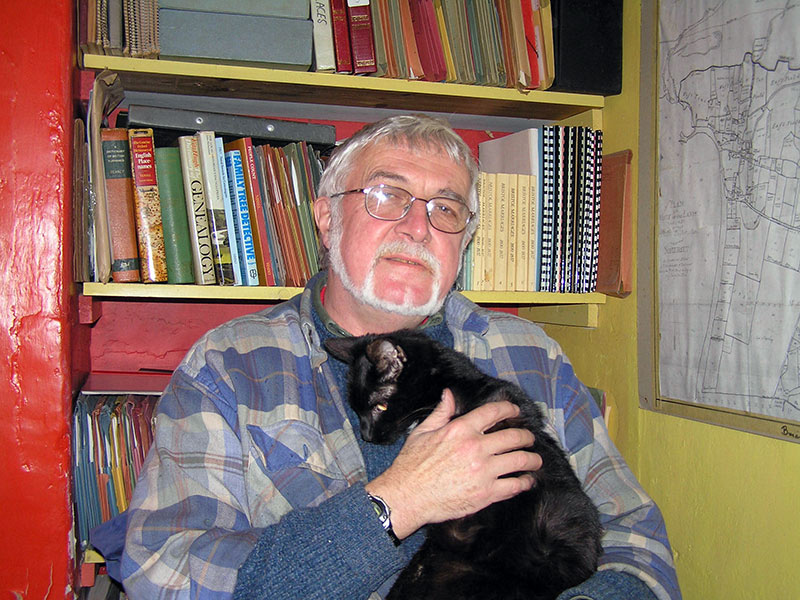
Brian Austin (and friend)
Brian Austin has made a prolific contribution to the local history of Weston-Super-Mare and district, for well over half a century. His research interests were sparked by his family roots there, and his first major project documented the history of the Weston. Numerous appearances on local TV and radio, and over 300 newspaper articles are just some of the ways his knowledge and enthusiasm are shared. He has also rescued valuable documents, including petty sessions records, and 189 volumes of council records in a flooded cellar. Brian’s passion for cricket has led to the histories of four local clubs, and of 400 Victorian cricketers. He was commissioned to write a musical play to mark Weston’s 150th anniversary. Brian Austin is a man of many talents which he continues to apply to local history.
www.wsmfhs.org.uk
Brian Buss, Surrey: revitalised Horley Local History Society and continues to serve on the committee in his 94th year; research and writing on many local topics
Brian Buss [Horley, Surrey]

Brain Buss working hard at his research
Brian Buss joined Horley History Society in 1990, and vitalised it with his enthusiasm. He has served as both Chairman and Newsletter Editor, and is still a committee member. Brian has researched and written a number of local history books, including Horley in Wartime, and The History of Public Houses in Horley. Numerous research booklets of his are deposited in the library for others to use.
Horley Local History Centre, based in Horley Library, was established in 1990, with Brian as the prime founder. Its success meant that other Surrey Libraries followed their lead. Twice a week Brian still joins others to help at the ‘history desk’ to answer queries, typically generous with his knowledge and enthusiasm.
www.horleyhistory.org.uk / @HorleyHistory
Barry Jolly, Hampshire: promotion of local history of Milford-on-Sea through local and national journals, events and exhibitions
Barry Jolly (Milford-on-Sea, Hants)

Barry Jolly
Barry has been a significant influence on the Milford-on-Sea Historical Record Society. As editor of the society’s biennial journal Occasional Magazine he has raised standards of scholarship, as well as contributing articles himself, and via the Research & Discussion Group he has encouraged others to publish their research.
Barry’s own work on naval history has been published in national journals, and has led to revisions in the reputations of Milford Admirals Cornwallis, Man and Peyton. In 2019 he was a key member of the planning team, as historical expert, for a major exhibition at St Barbe Museum & Art Gallery in Lymington, The Command of the Seas – the Navy and the New Forest against Napoleon, a fascinating example of demonstrating the local context of national history.
www.milfordhistory.org.uk
Robert Ovens & Sheila Sleath (joint award), Rutland: outstanding contributions to the history of the county through activities and publications of Rutland Local History & Record Society
Robert Ovens and Sheila Sleath (Rutland)
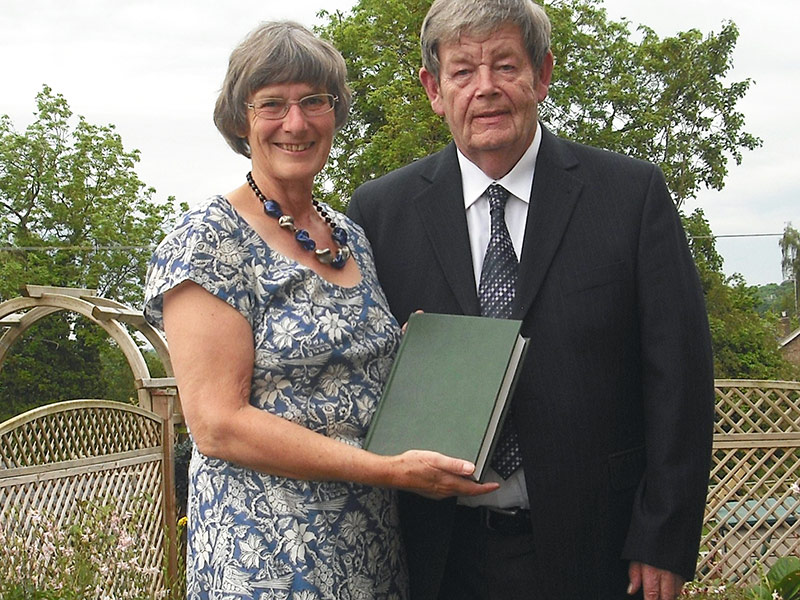
Sheila Sleath and Robert Ovens with copy of The Heritage of Rutland Water presented to HM The Queen
Robert Ovens and Sheila Sleath, childhood friends form the village of Belton. Amongst their many and varied contributions to the Rutland Local History & Record Society, two joint achievements take pride of place. A masterful compendium Time in Rutland : a history and gazetteer of the bells, scratchdials, sundials and clocks of Rutland was published in 2002, and The Heritage of Rutland Water in 2007. The latter is a multi-disciplinary volume they compiled and edited, covering the construction of the reservoir, the history of parishes affected, and the archaeology and natural history of the area.
The Society has gained enormously in reputation and status from the unstinting contributions of Robert and Sheila.
www.rutlandhistory.org / Facebook robert.ovens.9
Bill Reed, Wiltshire: creating an exceptional oral history archive that has transformed understanding of local history for local people and visitors to Malmesbury
Bill Reed (Malmesbury, Wiltshire)
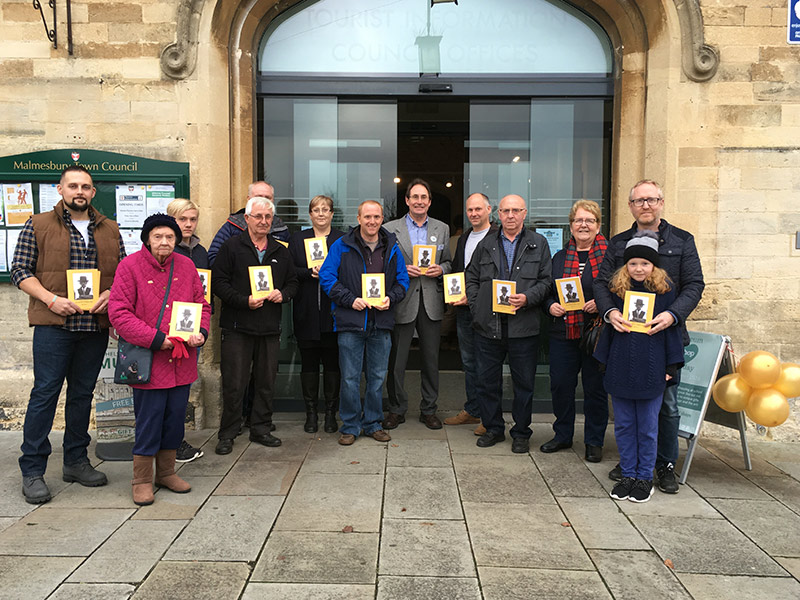
Bill Reed (centre in grey jacket) with relatives and descendants of Harry Neal at the launch in December 2018 of his book The True Story of the Murder of Harry Neal. Photo by Sharon Nolan, Chair, Athelstan Museum Malmesbury
Bill Reed has created a very special oral history archive that has changed the understanding of local history for both visitors and local people in Malmesbury. Since 2015 Bill has recorded voices in the town and surrounding villages that provide an enduring source for 20th century life there. His technical skill and engaging style as an interviewer has produced high quality material. ‘Malmesbury Voices’ is hosted by the volunteer-run Athelstan Museum, where the recordings are available to visitors and play an important part in their interpretation of recent history. Bill has written three books, and done numerous local radio broadcasts and other outreach activities using the recordings.
www.athelstanmuseum.org.uk / www.malmesburyhistorysociety.org.uk / @athelstanmuseum
Society newsletter
Essex Society for Archaeology and History
An attractively-produced Newsletter which regularly includes a letter from the President, topical news items and snippets culled from other journals and newspapers, brief notes on historical topics, Society information, and short book reviews, as well as letters from readers.
This attractively-produced quarterly Newsletter is exactly what is needed for a county society and makes maximum use of the opportunity provided by 24 pages.

Essex Society for Archaeology and History
It regularly includes a letter from the President, as well as topical news items and snippets about aspects of Essex history culled from other journals and newspapers. There are also brief notes on historical topics, too short to make full articles but full of interest. Society information is of course provided, with full details of forthcoming events, and there are short book reviews, as well as letters from readers. Like all good Newsletters, it is both a handy reference and a way of maintaining contact with the membership. It also serves as a historical source in its own right – well worth keeping for your local history collection and definitely not destined for the WPB!
Long articles
The David Hey Memorial Article 2020: Brian Hodgkinson, ‘The Holland Causeway and Bridge End Priory: piety, people and communications in the Lincolnshire Fenland’, Lincolnshire History & Archaeology vol.50 2018
A detailed case study, making use of a wide range of primary sources, which looks at a key link in Lincolnshire’s medieval communications network (and which remains a major artery today). The paper shows how the small priory at Bridge End near Sleaford tried to manage the burden of upkeep.
This detailed case study makes use of a wide range of primary sources, and is the product of extensive documentary research demonstrating the author’s very considerable expertise.

Lincolnshire History & Archaeology
It looks at a key link in Lincolnshire’s medieval communications network, which remains as a major artery today, and shows how the small priory at Bridge End near Sleaford tried to manage the considerable burden of upkeep. In addition to giving a detailed history of a particular (and little-known) religious house the paper clearly reveals a first-hand knowledge of the geography of the area, and is wisely cautious about its conclusions. The assessors felt that this was a very strong overall winner for the award.
Neil Wiffen, ‘Supplying the army: the contribution of Essex to provisioning the forces of Edward III, c.1337’, Essex Journal vol.54 no.1 (Spring 2019)
A stimulating study of the local impact of national events during the Hundred Years War, focusing on the requisitioning of supplies and showing who in Essex provided what the king demanded
This is a stimulating study of the local impact of national events during the Hundred Years War, focusing on the requisitioning of supplies and showing who in Essex provided the resources which the king demanded.

Essex Journal
One of the assessors, noted that ‘this author writes with infectious enthusiasm ... He sets his topic in context and makes very good use of both secondary and primary sources both in print and manuscript’. The records used are challenging, but Neil Wiffen showed considerable ingenuity in investigating how far the demand for food supplies for the army was fulfilled in Essex. He questions his evidence, but makes solid and sound conclusions. This is an exemplar of how a paper might be used as a model by readers elsewhere seeking to explore the same topic.
Ian Hancock, ‘Forestry between the Tyne and the Derwent 1770-1870’, Hexham Historian no.28 (August 2018)
A detailed study of how deliberately-planted commercial woodland long predated the establishment of the Forestry Commission in 1922, its commercial and geographical rationale, and the ways in which it dramatically altered the landscape of the southern part of Northumberland
This is a detailed study of how deliberately-planted commercial woodland long predated the establishment of the Forestry Commission in 1922.

Hexham Historian
The author looks at the economic and geographical rationale, including the significance of parliamentary enclosure, and discusses the ways in which plantations dramatically altered the landscape of the study area in south Northumberland. He is very knowledgeable about forestry and the geography of the area about which he is writing, and makes good use of primary sources. A sub-theme of particular interest is the ways in which the demand for different kinds of timber for shipbuilding or local mines affected the types of trees planted. It is a specialised but accessible and innovative piece of work.
David C. Neilson, ‘The operation and achievements of the Winchester pavement commissioners 1770-1866’, Hampshire Studies vol.73 (2018)
The task of improving the urban environment in late 18th and early 19th century Britain often fell to commissioners rather than municipal corporations; this very detailed study examines the achievements of the pavement commissioners for Winchester and demonstrates the impact they had on the town’s infrastructure, health and environment.
The task of improving the urban environment in late 18th and early 19th century Britain often fell to commissioners rather than municipal corporations.
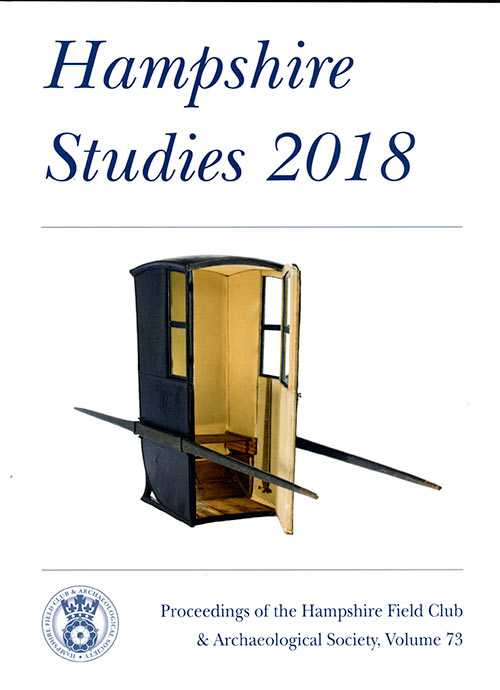
Hampshire Studies
This very detailed study, based on meticulous research in the documentary sources, describes the history of the Pavement Commissioners for Winchester, a body which functioned separately from the ancient corporation. In its concluding sections, the paper demonstrates the impact of their work over almost a century on the town’s infrastructure, health and environment. Bodies such as these have been much neglected by historians and it is good to see that imbalance being redressed.
Short articles
Winner: Caroline Adams, ‘The influence of the early modern gentleman on the changing landscape of West Sussex’, West Sussex History no.87 (Autumn 2019)
This paper takes a broad brush approach, looking at a wide range of landed estates in West Sussex and assessing the impact upon the county’s landscape of the creation and development of parkland and woodland in the centuries before the better known ‘designed’ landscapes of the 18th century.
This paper takes a broad brush approach, looking at a wide range of landed estates in West Sussex and assessing the impact upon the county’s landscape of the creation and development of parkland and woodland in the centuries before the better known ‘designed’ landscapes of the 18th century.
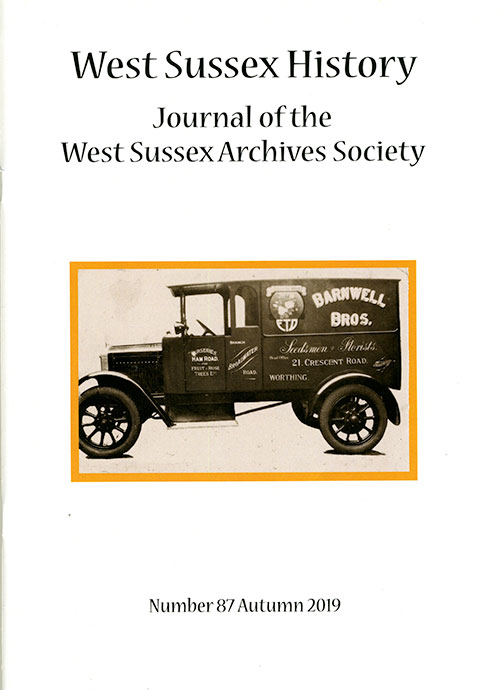
West Sussex History
By focusing on this earlier period the author introduces a variety of factors contributing to what she calls ‘a quiet revolution’: the Dissolution; the need for timber; the charcoal industry; wealth from mercantile activities; mapping and surveying; and the ‘Great Rebuilding’. It is a readable and welcome introduction to a topic which could be researched in other counties.
Sean Gubbins, ‘Hackney, Shoreditch and Stoke Newington and the Hearth Tax’, Hackney History vol.20 (2019)
This paper takes a familiar source – the hearth tax of the 1660s – and assesses what it reveals about the social structure of this area which was just beyond the edge of London in the Restoration period.
Among the key late-seventeenth century sources for local history are the hearth tax returns of the 1660s and 1670s, familiar to many but very difficult to use and analyse because of the ambiguities in the collection procedures and the scope of the returns.

Hackney History
This paper takes that familiar source and assesses what it reveals about the social structure of an area which in the Restoration period was just beyond the edge of London and as such had a semi-suburban role, with many prosperous residents. Unlike some hearth tax studies it does not have an over-heavy burden of statistics, but it shows how other local investigations making use of this source might be constructed.
Norman A. Alvin, ‘”Klondike Villa”: the back to the land movement in Bradford’, The Bradford Antiquary no.79 (2018)
A local case study of a widespread national phenomenon, the ‘land grabbing’ of the Edwardian period, describing the temporary squatting by a group of unemployed workers on land at Manningham in Bradford from July to October 1906, its context and the aftermath.
‘Back to the land’ movements were a widespread national phenomenon, from the Chartist colonies of the 1840s to the plotland developments of the inter-war period.

The Bradford Antiquary
This paper looks at an example of ‘land grabbing’ of the Edwardian period, describing the temporary occupation by a group of unemployed workers on land at Manningham in Bradford between July and October 1906.
The narrative recounts the ‘action’ and the gradual dwindling of momentum, provides notes on key personalities, and shows how sympathy for the unemployed was very strong in the city. A very interesting article which rescues, and contextualises, a forgotten event in Yorkshire’s working class history.
Sue Andrews, ‘Why did the parish of Hadleigh not join Cosford Incorporation in 1779’, Suffolk Review new series 79 (Autumn 2019)
An analysis of the complexities of the creation of the incorporation of the parishes in Cosford Hundred, Suffolk, in 1779, seeking to explain why the parish of Hadleigh refused to participate in the scheme, and remained independent until the creation of the Cosford Poor Law Union in 1834.
From the early 18th century onwards voluntary ‘incorporations’ of parishes for Poor Law purposes occasionally took place, particularly in East Anglia.
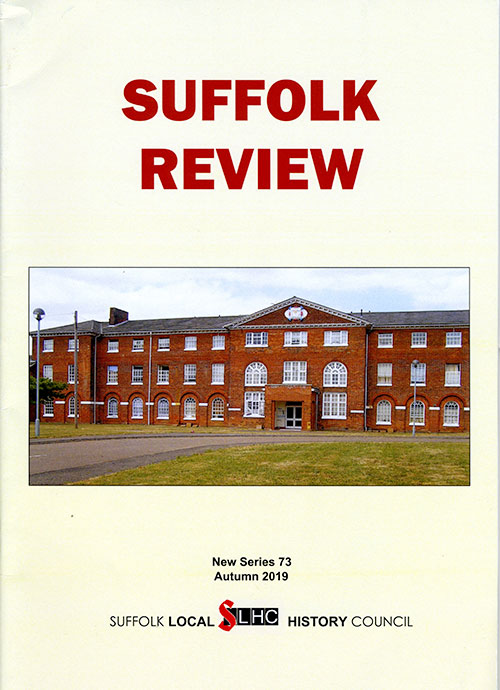
Suffolk Review
This paper analyses the complexities involved in incorporating the parishes in Cosford Hundred, Suffolk, achieved by local Act of Parliament in 1779. The Act was oddly-titled: ‘For the better Relief and Employment of the Poor of the several Parishes within the Hundred of Cosford (except the Parish of Hadleigh), and also of the Parish of Polsted, within the Hundred of Babergh’. In her comprehensive analysis Sue Andrews seeks to explain why Hadleigh was excluded and refused to participate in the scheme, remaining independent until forcibly included in the new Cosford Poor Law Union established in 1834.
Essex Society for Archaeology and History
An attractively-produced Newsletter which regularly includes a letter from the President, topical news items and snippets culled from other journals and newspapers, brief notes on historical topics, Society information, and short book reviews, as well as letters from readers.
This attractively-produced quarterly Newsletter is exactly what is needed for a county society and makes maximum use of the opportunity provided by 24 pages.
Essex Society for Archaeology and History
It regularly includes a letter from the President, as well as topical news items and snippets about aspects of Essex history culled from other journals and newspapers. There are also brief notes on historical topics, too short to make full articles but full of interest. Society information is of course provided, with full details of forthcoming events, and there are short book reviews, as well as letters from readers. Like all good Newsletters, it is both a handy reference and a way of maintaining contact with the membership. It also serves as a historical source in its own right – well worth keeping for your local history collection and definitely not destined for the WPB!
The David Hey Memorial Article 2020: Brian Hodgkinson, ‘The Holland Causeway and Bridge End Priory: piety, people and communications in the Lincolnshire Fenland’, Lincolnshire History & Archaeology vol.50 2018
A detailed case study, making use of a wide range of primary sources, which looks at a key link in Lincolnshire’s medieval communications network (and which remains a major artery today). The paper shows how the small priory at Bridge End near Sleaford tried to manage the burden of upkeep.
This detailed case study makes use of a wide range of primary sources, and is the product of extensive documentary research demonstrating the author’s very considerable expertise.
Lincolnshire History & Archaeology
It looks at a key link in Lincolnshire’s medieval communications network, which remains as a major artery today, and shows how the small priory at Bridge End near Sleaford tried to manage the considerable burden of upkeep. In addition to giving a detailed history of a particular (and little-known) religious house the paper clearly reveals a first-hand knowledge of the geography of the area, and is wisely cautious about its conclusions. The assessors felt that this was a very strong overall winner for the award.
Neil Wiffen, ‘Supplying the army: the contribution of Essex to provisioning the forces of Edward III, c.1337’, Essex Journal vol.54 no.1 (Spring 2019)
A stimulating study of the local impact of national events during the Hundred Years War, focusing on the requisitioning of supplies and showing who in Essex provided what the king demanded
This is a stimulating study of the local impact of national events during the Hundred Years War, focusing on the requisitioning of supplies and showing who in Essex provided the resources which the king demanded.
Essex Journal
One of the assessors, noted that ‘this author writes with infectious enthusiasm ... He sets his topic in context and makes very good use of both secondary and primary sources both in print and manuscript’. The records used are challenging, but Neil Wiffen showed considerable ingenuity in investigating how far the demand for food supplies for the army was fulfilled in Essex. He questions his evidence, but makes solid and sound conclusions. This is an exemplar of how a paper might be used as a model by readers elsewhere seeking to explore the same topic.
Ian Hancock, ‘Forestry between the Tyne and the Derwent 1770-1870’, Hexham Historian no.28 (August 2018)
A detailed study of how deliberately-planted commercial woodland long predated the establishment of the Forestry Commission in 1922, its commercial and geographical rationale, and the ways in which it dramatically altered the landscape of the southern part of Northumberland
This is a detailed study of how deliberately-planted commercial woodland long predated the establishment of the Forestry Commission in 1922.
Hexham Historian
The author looks at the economic and geographical rationale, including the significance of parliamentary enclosure, and discusses the ways in which plantations dramatically altered the landscape of the study area in south Northumberland. He is very knowledgeable about forestry and the geography of the area about which he is writing, and makes good use of primary sources. A sub-theme of particular interest is the ways in which the demand for different kinds of timber for shipbuilding or local mines affected the types of trees planted. It is a specialised but accessible and innovative piece of work.
David C. Neilson, ‘The operation and achievements of the Winchester pavement commissioners 1770-1866’, Hampshire Studies vol.73 (2018)
The task of improving the urban environment in late 18th and early 19th century Britain often fell to commissioners rather than municipal corporations; this very detailed study examines the achievements of the pavement commissioners for Winchester and demonstrates the impact they had on the town’s infrastructure, health and environment.
The task of improving the urban environment in late 18th and early 19th century Britain often fell to commissioners rather than municipal corporations.
Hampshire Studies
This very detailed study, based on meticulous research in the documentary sources, describes the history of the Pavement Commissioners for Winchester, a body which functioned separately from the ancient corporation. In its concluding sections, the paper demonstrates the impact of their work over almost a century on the town’s infrastructure, health and environment. Bodies such as these have been much neglected by historians and it is good to see that imbalance being redressed.
Short articles
Winner: Caroline Adams, ‘The influence of the early modern gentleman on the changing landscape of West Sussex’, West Sussex History no.87 (Autumn 2019)
This paper takes a broad brush approach, looking at a wide range of landed estates in West Sussex and assessing the impact upon the county’s landscape of the creation and development of parkland and woodland in the centuries before the better known ‘designed’ landscapes of the 18th century.
This paper takes a broad brush approach, looking at a wide range of landed estates in West Sussex and assessing the impact upon the county’s landscape of the creation and development of parkland and woodland in the centuries before the better known ‘designed’ landscapes of the 18th century.
West Sussex History
By focusing on this earlier period the author introduces a variety of factors contributing to what she calls ‘a quiet revolution’: the Dissolution; the need for timber; the charcoal industry; wealth from mercantile activities; mapping and surveying; and the ‘Great Rebuilding’. It is a readable and welcome introduction to a topic which could be researched in other counties.
Sean Gubbins, ‘Hackney, Shoreditch and Stoke Newington and the Hearth Tax’, Hackney History vol.20 (2019)
This paper takes a familiar source – the hearth tax of the 1660s – and assesses what it reveals about the social structure of this area which was just beyond the edge of London in the Restoration period.
Among the key late-seventeenth century sources for local history are the hearth tax returns of the 1660s and 1670s, familiar to many but very difficult to use and analyse because of the ambiguities in the collection procedures and the scope of the returns.
Hackney History
This paper takes that familiar source and assesses what it reveals about the social structure of an area which in the Restoration period was just beyond the edge of London and as such had a semi-suburban role, with many prosperous residents. Unlike some hearth tax studies it does not have an over-heavy burden of statistics, but it shows how other local investigations making use of this source might be constructed.
Norman A. Alvin, ‘”Klondike Villa”: the back to the land movement in Bradford’, The Bradford Antiquary no.79 (2018)
A local case study of a widespread national phenomenon, the ‘land grabbing’ of the Edwardian period, describing the temporary squatting by a group of unemployed workers on land at Manningham in Bradford from July to October 1906, its context and the aftermath.
‘Back to the land’ movements were a widespread national phenomenon, from the Chartist colonies of the 1840s to the plotland developments of the inter-war period.
The Bradford Antiquary
This paper looks at an example of ‘land grabbing’ of the Edwardian period, describing the temporary occupation by a group of unemployed workers on land at Manningham in Bradford between July and October 1906.
The narrative recounts the ‘action’ and the gradual dwindling of momentum, provides notes on key personalities, and shows how sympathy for the unemployed was very strong in the city. A very interesting article which rescues, and contextualises, a forgotten event in Yorkshire’s working class history.
Sue Andrews, ‘Why did the parish of Hadleigh not join Cosford Incorporation in 1779’, Suffolk Review new series 79 (Autumn 2019)
An analysis of the complexities of the creation of the incorporation of the parishes in Cosford Hundred, Suffolk, in 1779, seeking to explain why the parish of Hadleigh refused to participate in the scheme, and remained independent until the creation of the Cosford Poor Law Union in 1834.
From the early 18th century onwards voluntary ‘incorporations’ of parishes for Poor Law purposes occasionally took place, particularly in East Anglia.
Suffolk Review
This paper analyses the complexities involved in incorporating the parishes in Cosford Hundred, Suffolk, achieved by local Act of Parliament in 1779. The Act was oddly-titled: ‘For the better Relief and Employment of the Poor of the several Parishes within the Hundred of Cosford (except the Parish of Hadleigh), and also of the Parish of Polsted, within the Hundred of Babergh’. In her comprehensive analysis Sue Andrews seeks to explain why Hadleigh was excluded and refused to participate in the scheme, remaining independent until forcibly included in the new Cosford Poor Law Union established in 1834.